
25 Critical Questions to Ask a New Home Builder in Florida (2026 Guide)
- Team 239
- 3 hours ago
- 12 min read
The friendly sales representative in the model home works for the builder, not for you. Without the right questions to ask new home builder in Florida professionals, you're essentially flying blind into one of the most complex real estate markets in the country. It's natural to feel anxious about whether "hurricane-proof" is just marketing fluff or if your "starting at" price will skyrocket once lot premiums and upgrades are added. You deserve a home that meets the strict 9th Edition Florida Building Code standards without the stress of construction delays or hidden CDD fees.
We believe that total transparency is the only way to build a lasting partnership. This 2026 guide provides a comprehensive checklist designed to protect your equity and ensure your new home is a high-quality investment. We'll break down the critical financial inquiries, structural requirements, and timeline expectations you need to master before signing a contract. From Naples to Bonita Springs, these insights will give you the clarity to navigate the Southwest Florida market with the confidence of a seasoned expert.
Table of Contents
The "Florida Factor": Questions About Resilience and Local Codes
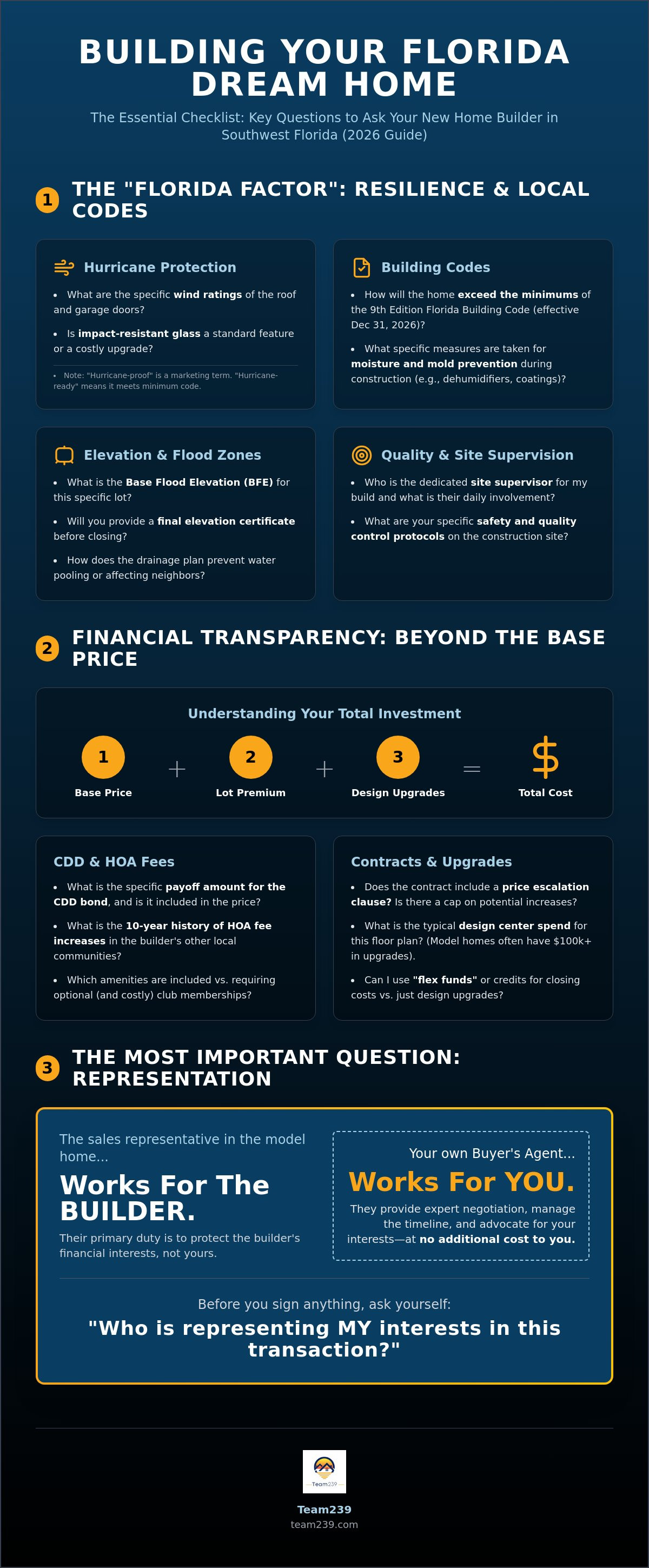
Living in Naples or Bonita Springs means accepting that the environment is as challenging as it is beautiful. Southwest Florida building requirements aren't just strict; they're among the most rigorous in the world. The Florida Building Code, specifically the 9th Edition scheduled to take effect on December 31, 2026, sets a high bar for structural integrity. When compiling your questions to ask new home builder in Florida, start with how they plan to exceed these minimums. A home that merely "meets code" today might be behind the curve tomorrow.
Florida's humidity is relentless, especially during the summer construction months. Ask how the builder manages moisture and mold prevention before the HVAC system is operational. Expert builders often use industrial dehumidifiers or anti-microbial coatings on the framing to ensure the home's skeleton stays dry during the "dried-in" phase. This level of care separates a standard build from a high-quality investment.
Hurricane Protection and Structural Integrity
Your home's envelope is its first line of defense. Ask the builder for the specific wind rating of the roof and garage doors. Garage doors are frequently the weakest point in a high-wind event. If they fail, the internal pressure can literally lift the roof off the structure. You should also inquire if impact glass is a standard feature or a design center upgrade. While some builders use shutters to meet code, impact-resistant windows offer 24/7 protection and significant insurance savings. Legally, it's vital to understand that "hurricane-ready" means the home meets minimum code, whereas "hurricane-proof" is a marketing term with no actual legal standing.
Elevation and Flood Zone Realities
Water often poses a greater threat than wind in our coastal communities. You need to know the Base Flood Elevation (BFE) for your specific lot. Ask if the builder will provide a final elevation certificate before you head to the closing table. This document is essential for your insurance agent to calculate accurate premiums. In Naples and Estero, lot drainage is a precise science. Ask how the builder's drainage plan prevents runoff from affecting neighboring properties or pooling in your backyard. Finally, confirm the home is being built to the latest FEMA flood map standards. Building even one foot above the minimum requirement can lead to thousands of dollars in long-term savings on flood insurance.
Mastering these questions to ask new home builder in Florida ensures you aren't just buying a house, but a fortress designed for the unique Florida climate. We recommend digging into these technical details early to avoid expensive surprises after the foundation is poured.
Financial Transparency: Beyond the "Starting From" Price
The sticker price on a model home billboard is rarely the number you'll see at the closing table. In the Southwest Florida market, the "starting from" price is merely the entry point for a much larger financial conversation. To protect your investment, your list of questions to ask new home builder in Florida must include a deep dive into the three pillars of pricing: base price, lot premiums, and design center spend. Understanding how these interact prevents the "budget creep" that often catches buyers off guard during the six to twelve months of construction.
Lot premiums in luxury resort communities can vary by $50,000 or more based on water views, cul-de-sac privacy, or proximity to the clubhouse. Beyond the land itself, you must account for the 5% year-over-year rise in construction input prices. Many 2026 contracts now include price escalation clauses. Ask if your contract has a "cap" on these increases or if you have the right to cancel if the price exceeds a certain percentage. While builders often push their "preferred" lenders, taking the time to learn how construction loans work through independent sources can give you the leverage needed to negotiate better "flex funds" or closing cost credits.
CDD Fees and HOA Structures in SWFL
Southwest Florida is famous for Community Development District (CDD) fees. These are non-ad valorem assessments used to fund infrastructure like roads and utilities. They appear on your property tax bill and can significantly impact your monthly carrying costs. Ask the builder for the specific payoff amount of the CDD bond and if that amount is included in the advertised price. You should also request a 10-year history of HOA fee increases in their other local communities. It's vital to clarify which amenities are included in your base fees and which require an additional, often expensive, "optional" club membership.
Upgrades and the Design Center Process
The model home you toured likely features $100,000 or more in upgrades. Before signing, ask for the average design center spend for the specific model you're interested in. Some builders allow you to bring in your own contractors for items like appliances or flooring after closing, while others strictly forbid it. If you're focusing your search on the Estero or Bonita area, our guide on New Construction Homes in Bonita Springs, FL: The Complete 2026 Buyer’s Guide provides a localized breakdown of what to expect during the selection process.
Navigating these financial layers requires a partner who understands the fine print of developer contracts. Our team at Team239 provides the professional oversight needed to ensure you aren't overpaying for lot premiums or hidden community taxes.
The Build Process and Quality Control Standards
A beautiful floor plan means very little if the execution on the ground is flawed. While the sales representative is your point of contact for the contract, the site supervisor is the person actually building your home. One of the most telling questions to ask new home builder in Florida is how many other projects that supervisor is currently managing. In a high-demand market like Naples or Estero, a supervisor overseeing twenty homes simultaneously can't provide the granular attention your investment requires. You want to know you're more than just a number on a production schedule.
Safety and transparency should go hand in hand during the construction phase. Ask about the builder’s protocol for site visits. Most reputable builders allow scheduled walkthroughs but require twenty-four hours' notice and specific safety gear. Regarding the 2026 supply chain, ask how they've secured critical long-lead items like impact-rated windows and high-efficiency HVAC units. With construction input prices rising by approximately 5% year-over-year, a builder who hasn't pre-purchased or warehoused essential materials is a builder who'll likely face significant delays.
Milestone Inspections You Should Request
Don't rely solely on the builder's internal quality assurance team. You should have the right to bring in an independent, third-party inspector at three critical stages: the pre-pour (foundation and underground plumbing), the pre-drywall (framing, electrical, and HVAC rough-ins), and the final walkthrough. Ask specifically: "Will you allow my independent inspector to walk the site and provide a report?" If a builder hesitates, it's a red flag. You also need to clarify how "punch list" items are handled. Ideally, every cosmetic and functional flaw should be corrected before you sign the closing documents, as getting a crew back to the house after you've moved in is notoriously difficult.
Trade Partners and Labor Quality
The quality of your home's "bones" depends on the subcontractors. Inquire about the longevity of the builder’s relationship with their primary plumbing, electrical, and roofing subs. High turnover in trade partners often leads to inconsistent quality and missed details. Ask what their internal quality control process looks like beyond what the local municipality requires. County inspections are the bare minimum required by law to ensure life safety; they aren't a guarantee of the high-end craftsmanship or luxury finish expected in Southwest Florida's resort-style communities. A builder committed to excellence will have their own multi-point checklist that far exceeds the local building department's basic standards.
Timeline Realities and Post-Closing Support
The moment you sign a contract, the clock starts ticking in your head. However, the "dirt to keys" timeline in Southwest Florida is rarely a straight line. In 2026, a persistent shortage of skilled labor continues to challenge even the most established builders, often stretching completion dates. One of the most vital questions to ask new home builder in Florida teams is how they communicate these inevitable shifts. You don't want to find out your move-in date has slipped through a generic automated email three weeks before closing. Demand a clear protocol for monthly or bi-weekly project updates.
Transparency shouldn't end when you get the keys. Most luxury builders offer a standard "1-2-10" warranty: one year for workmanship and materials, two years for major mechanical systems like HVAC and plumbing, and ten years for structural integrity. You need to know exactly who your point of contact is once the sales representative moves on to the next phase of the community. A builder with a dedicated in-house service team in Naples or Bonita Springs is always preferable to one that out-sources warranty claims to a third-party corporation located out of state.
Managing Construction Delays
Delays aren't just an inconvenience; they're a financial risk. If your build is delayed by 90 days, your mortgage rate lock could expire, potentially costing you thousands in higher interest payments over the life of the loan. Ask the builder for their "on-time completion" percentage for the last twelve months to gauge their reliability. It's also critical to discuss material substitutions. If the specific flooring or cabinetry brand you selected is unavailable due to 2026 supply chain shifts, does the builder have the right to swap it for an "equivalent" brand without your prior approval? To understand why professional oversight is non-negotiable during these negotiations, read our post on Why You Need a Realtor for a New Construction Home.
Long-term Warranty and Service
Your home's resale value depends heavily on the strength of its warranty. Ask if the 10-year structural warranty is transferable to a new owner if you decide to sell in three or four years. This is a massive selling point in the competitive SWFL market. Additionally, clarify the "emergency" service protocol. If your AC fails on a Sunday in July, you need to know if the builder’s trade partners are contractually obligated to respond within twenty-four hours. Professional builders will have a clear, written schedule of what constitutes an emergency and a guaranteed response time for those issues.
Protecting your move-in timeline and your long-term investment requires a contract that holds the builder accountable. Connect with Team239 today to ensure your interests are represented from the first shovel in the ground to the final warranty walk-through.
The Most Important Question: Who is Representing You?
The most critical of all questions to ask new home builder in Florida professionals isn't about the roof or the floor plan. It's about who actually has your back during the negotiation. When you walk into a model home in Naples or Estero, the person greeting you is an employee of the builder. Their fiduciary duty is to the developer's bottom line, not yours. They're trained to protect the builder's margins, manage their own liability, and sell you on the lifestyle without necessarily highlighting the risks or the "real" status of the construction schedule.
Independent buyer representation changes the dynamic completely. Team239 acts as your strategic partner, bringing over 10 years of local experience to the table. We know which builders are currently hitting their 2026 timelines and which ones are struggling with labor shortages. Because the builder pays our commission from their marketing budget, this expert oversight typically costs you $0. You get a professional advocate for the same price you'd pay walking in alone, ensuring you don't overpay for lot premiums or fall for marketing fluff.
The Role of Team239 in Your New Build
We don't just hand you a brochure and disappear. Our team attends your design center meetings to help you spot "over-improved" options that won't provide a return on investment. It's easy to get swept up in luxury finishes that don't match the neighborhood's ceiling. We also handle the high-pressure conversations with site supervisors when quality standards aren't being met. If you're looking for a broader perspective on the local market, check out our Luxury Homes for Sale in Naples FL: The 2026 Insider’s Guide for a deeper look at specific resort communities and high-end developments.
Taking the Next Step in Southwest Florida
Timing is everything in new construction. To ensure your right to independent representation, you must register your realtor during your very first visit to a model home or your first interaction with a builder’s online team. If you go alone first, the builder may "lock out" your agent, leaving you without an advocate for the duration of the build. Whether you're eyeing a coastal estate in Bonita Springs or a golf course villa in Estero, starting with an expert ensures your contract is fair and your equity is protected. We leverage our deep-rooted builder relationships to get the unfiltered truth about material availability and pricing shifts.
Don't leave your largest investment to chance. Contact Team239 to start your new construction journey with an expert advocate and gain the clarity you need to build with total confidence.
Build Your Future with Total Clarity
Building a new home in Southwest Florida is a significant investment that requires more than just a signature. You now have the framework to navigate the 9th Edition Building Code and the financial transparency to manage CDD fees and lot premiums effectively. Using these questions to ask new home builder in Florida will help you secure a home that is as resilient as it is beautiful. Don't leave your equity to chance by relying on the builder’s sales team alone; you deserve an advocate who understands the fine print.
Our family-led team brings over 10 years of local experience to every project, serving as expert negotiators in the region's most exclusive luxury resort communities. We understand the Naples and Bonita Springs markets from the ground up and are ready to protect your interests through every milestone inspection. Let Team239 Ask the Tough Questions for You: Schedule a New Construction Consultation. Your new construction journey should be an exciting milestone, not a source of stress. We look forward to helping you build your Florida future with total confidence.
Frequently Asked Questions
Do I really need a realtor when buying new construction in Florida?
Yes, you absolutely need independent representation. The builder’s sales agent has a fiduciary duty to the developer, not to you. Having your own realtor ensures someone is negotiating lot premiums and design center credits on your behalf. Since the builder typically pays the commission from their marketing budget, this professional oversight costs you nothing. This is one of the essential questions to ask new home builder in Florida professionals before you ever visit a model home.
What are CDD fees and how do they differ from HOA fees?
CDD fees are non-ad valorem assessments used to fund community infrastructure like roads and utilities. They appear on your annual property tax bill and can last for 20 to 30 years. HOA fees are private charges collected by the association for amenities and landscaping. In Southwest Florida, it's common to have both, so always ask for the specific payoff amount of the CDD bond before signing a contract.
How long does it typically take to build a new home in Naples in 2026?
A realistic "dirt to keys" timeline in Naples for 2026 currently ranges from 8 to 14 months. While some inventory homes can be ready sooner, custom or semi-custom builds often face delays due to the persistent skilled labor shortage. Always ask for the builder’s current on-time completion rate for the last twelve months to set your expectations correctly for your move-in date.
What is a "lot premium" and can it be negotiated?
A lot premium is an additional fee for a specific piece of land based on its view, size, or location. While builders often present these as fixed costs, they're frequently negotiable, especially during the final closeout phase of a community. We help our clients identify which premiums offer the best resale value and where there's room to negotiate the price or trade for design center credits.
Is impact glass required by law for new homes in Southwest Florida?
Impact glass isn't technically required by state law if you use hurricane shutters, but it's the preferred standard under the 9th Edition Florida Building Code. In coastal areas of Southwest Florida, most luxury builders include impact-resistant windows to meet strict wind-load requirements. Choosing impact glass over shutters can lead to insurance premium savings of 25% to 40% depending on your specific carrier and home location.
What happens if the builder goes over the estimated completion date?
Most builder contracts include clauses that protect the developer from penalties due to weather or supply chain issues. If the builder exceeds the estimated date, you're usually responsible for any mortgage rate lock extensions or temporary housing costs. It's vital to have a buyer’s agent review these clauses to ensure there's a clear communication protocol for any timeline shifts that occur during the build.
Can I use my own floor plan with a production builder in Florida?
Production builders generally don't allow you to use your own floor plans. They rely on a specific set of pre-approved, engineered designs to maintain efficiency and control costs. If you want a fully custom home using your own architectural drawings, you'll need to work with a custom builder rather than a production or "tract" builder in a resort-style community.
What should I look for during the final walkthrough of a new build?
Focus on the "punch list" items that are difficult to fix once you move in. Check every window for smooth operation, test all appliances, and look for "nail pops" in the drywall or uneven grout lines. You should also verify that the lot drainage matches the approved site plan to prevent future flooding. Bringing an independent inspector to this final walkthrough is highly recommended for any questions to ask new home builder in Florida quality checks.
Comments