
Captiva Island FL Real Estate Prices and Home Values

Captiva home values don’t fit a single price band.
That spread makes a single island-wide figure a starting point, not a complete guide. A home’s size, property type, and neighborhood all shape how its asking price compares with others on the market.
Here, you’ll find current listing examples, property sizes, and context for comparing average sale prices per square foot and home values across property types and neighborhoods. You’ll also see how to read market measures such as days on market and the sale-to-list price ratio, so you can build a clearer picture of Captiva before making your next move with the help of Team239, your trusted experts for Southwest Florida property insights.
Table of Contents
Listing prices and property sizes
Captiva listings span a wide range, from condos to large homes. Compare property type, asking price, and square footage together; a headline price alone can obscure major differences.
Home and Condo Listing Prices
These are asking prices, not sale prices. Compare each listing with similar properties, considering location and size.
Property Sizes on the Market
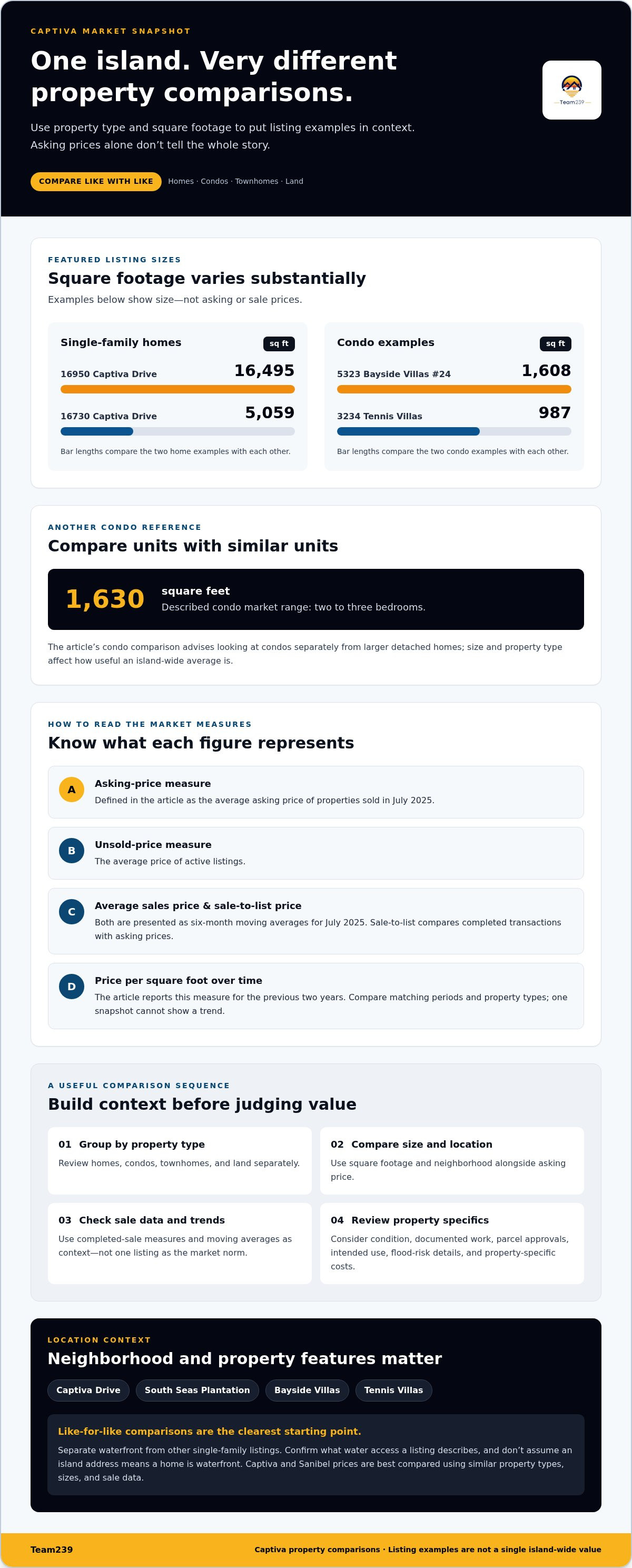
Square footage varies substantially across the featured listings. The home at 16950 Captiva Drive has 16,495 square feet, while 16730 Captiva Drive has 5,059 square feet. Condo examples also differ: 5323 Bayside Villas #24 has 1,608 square feet, compared with 987 square feet at 3234 Tennis Villas. Compare usable space as well as asking price when reviewing properties.
For a focused comparison, group listings by type, then compare their size, location, and asking price. For example, a smaller condo and a large single-family home are not direct price comparisons, even when both are available on Captiva.
Captiva and Sanibel prices are best compared using similar property types, sizes, and sale data. Asking prices alone don’t establish which market is more expensive.
Zoning, building approvals, and short-term rental permissions require a parcel-specific review. Don’t assume rules for one Captiva property apply to another, particularly if you plan to optimize rental returns through vacation rental specialists such as allurahomes.com.
For due diligence, review the property’s condition, permit history, and relevant approvals alongside the listing details. Professional property inspection resources, such as lininspects.com, highlight how thorough assessments give buyers peace of mind when evaluating real estate investments. Match those findings to the intended use before making a decision.
Hurricanes and rebuilding can affect a property’s condition, repair history, and availability. Compare each listing’s current state and documented work rather than treating island-wide values as uniform.
Property taxes depend on the property’s assessment, while insurance and flood exposure vary by location and building characteristics. Review the parcel’s flood-risk details and property-specific costs before comparing total ownership expenses.
Average sales price per square foot
Price per square foot helps compare properties with different areas, but it needs context from property type and completed sales. This Captiva Island FL real estate update uses market measures that describe distinct parts of the market, so read each figure alongside its definition.
Prices Across Listing Ranges
Compare properties in that range by type, size, and location before using price per square foot as a guide. The asking-price measure is the average asking price of properties sold in July 2025. The unsold-price measure, by contrast, is the average price of active listings.
Captiva’s average sales price and average sale-to-list price use six-month moving averages for July 2025. The sale-to-list measure helps show how completed transactions compare with asking prices. To understand how prices changed over the past year, compare the same measure across matching periods and property types. A single snapshot can’t show a trend. This Captiva Island FL real estate update makes those distinctions useful when comparing current listings with completed sales.
Condo Prices and Sizes
Condos in the described market range have two to three bedrooms and 1,630 square feet. Compare a unit with other condos rather than larger detached homes. Differences in size and property type can make an island-wide average less useful for assessing an individual unit.
The average sales price per square foot is reported for the previous two years. Use that history to examine movement over time, then compare it with current listings and completed sales. Moving averages smooth short-term variation, while property-level comparisons add context. No single figure captures every condo’s value.
For sellers reviewing a luxury property, Luxury Property Listing Services can connect pricing context with a listing strategy.
Single-family homes, condos, townhomes, and land
Captiva’s July 2025 market update covers every property type, but the options differ considerably. Compare houses, condos, townhomes, and land separately before judging value. A land listing, for example, has no finished home to compare with a move-in-ready residence. Property type sets the starting point for a useful comparison.
Two single-family examples show how far home asking prices can vary. Those figures are asking prices, not completed sale prices. Compare each home’s size, location, and condition before drawing conclusions from the difference.
For Captiva Island homes for sale, separate waterfront properties from other single-family listings. Waterfront access, frontage, and the home’s position can shape how buyers compare similar properties. The listing details should establish what kind of water access a property offers. Don’t assume that an island address alone means a home is waterfront.
Condominiums and townhomes need their own comparison group. Review each listing’s interior area, layout, location, and asking price alongside its property type. A condo and a detached home may differ in both space and ownership structure, so their asking prices don’t form a direct like-for-like comparison. Townhome listings should likewise be compared with similar units.
Land provides another distinct option. Compare land listings based on parcel-specific characteristics and intended use, rather than against the price of a completed home. That distinction helps buyers assess what the asking price represents.
For Captiva waterfront homes and other current listings, build a short comparison set by property type and location. Then review each asking price against the property’s size and features.
Captiva neighborhood home values
Captiva’s listed homes and condos show different value benchmarks across named locations. Current examples span Captiva Drive, South Seas Plantation, and several villa communities.
Values Across Captiva Neighborhoods
That figure is a broad reference, not a value estimate for every street or property. Compare a home with similar nearby listings, considering its property type, size, and location.
Named listing areas include Captiva Drive and South Seas Plantation. Condo examples include Bayside Villas and Tennis Villas. These locations offer useful reference points, but their asking prices represent individual properties. For a more meaningful comparison, match homes with homes and condos with condos, then assess each listing’s size and features.
Neighborhood and Property-Type Demand
Current examples include single-family homes on Captiva Drive and Andy Rosse Lane, plus condos at Bayside Villas and Tennis Villas. These listings show activity across property types and locations, but they don’t establish a demand ranking. Evaluate demand through comparable sales and listing activity for the specific property type you’re considering.
These figures describe different property categories, so they aren’t a direct neighborhood comparison. Use them as separate benchmarks, then compare each target property with similar nearby homes or units.
For a practical comparison, identify the location and property type first. Then review nearby asking prices, completed sales, and property sizes. A South Seas Plantation condo, for example, should be assessed against comparable condos, not against a single-family home on Captiva Drive. That process helps clarify how a specific listing fits its local market.
If you’re preparing to sell a Captiva property, plan your luxury property listing around its location, type, and comparable homes.
Team239: Residential Resale Representation
Team239 helps buyers and sellers turn Captiva market information into a focused next step. For a resale purchase, Residential Resale Representation can support comparisons between property type, location, size, and asking price. Buyers considering a new build can use New Construction Buyer Representation to assess that path, while sellers can draw on Luxury Property Listing Services to position a property for the market. Relocation Consulting can help people planning a move weigh property options against their priorities.
Bring your goals and preferred property type into the conversation. That creates a practical starting point for discussing your next move, whether you’re buying, selling, or relocating. Contact Team239 to discuss your Captiva real estate plans.
Make Your Next Captiva Move with a Clear Plan
Use the Captiva Island FL real estate update as a starting point, then shape your next move around how you’ll use the property and what matters most day to day. Before acting, define your priorities: property type, preferred location, space, and the trade-offs you’re comfortable making. A clear brief helps keep decisions focused as you compare options.
Also consider your timing and whether your plans involve buying an existing home, exploring new construction, or selling. Team239 offers Residential Resale Representation, New Construction Buyer Representation, and Luxury Property Listing Services. The right conversation starts with your goals and the kind of property decision ahead.
Bring your priorities and questions into that conversation. Discuss what matters most, refine your direction, and move forward with a considered plan. Contact Team239 to discuss Captiva real estate and take your next step with clarity.
Frequently Asked Questions
What are current home prices on Captiva Island, Florida?
Current Captiva home asking prices vary widely by property. Compare asking prices by property size and type; listing prices aren’t completed sale values.
How many homes are currently for sale on Captiva Island, and what is the typical time on market?
The number of homes for sale and time on market change as properties are listed, go pending, or close. For a useful inventory snapshot, count active listings separately from pending properties. Captiva’s days-on-market measure is the average time listed for properties that sold, so it describes completed transactions rather than every active home. Compare the same property types and reporting periods when interpreting market time.
What are the latest sales and median sale price on Captiva Island?
Captiva’s average sales-price measure uses a six-month moving average for July 2025; it is not a median sale price. A median represents the middle transaction price, with half of completed sales above it and half below. To interpret sales, separate completed transactions from active asking prices and align the sale period and property type before comparing values.
How do Captiva Island real estate prices compare with Sanibel Island and nearby Southwest Florida markets?
Compare Captiva and Sanibel using similar property types, sizes, and completed-sale data; asking prices alone do not show which market is more expensive.
How have hurricanes and rebuilding affected Captiva Island property values and availability?
Hurricanes and rebuilding can affect a property’s condition, repair history, and availability. Compare each listing’s current state and documented work rather than assuming values are uniform across the island.
Comments