
Deep Water Access Homes for Sale in Marco Island: The 2026 Boater’s Guide

Updated: Jul 31
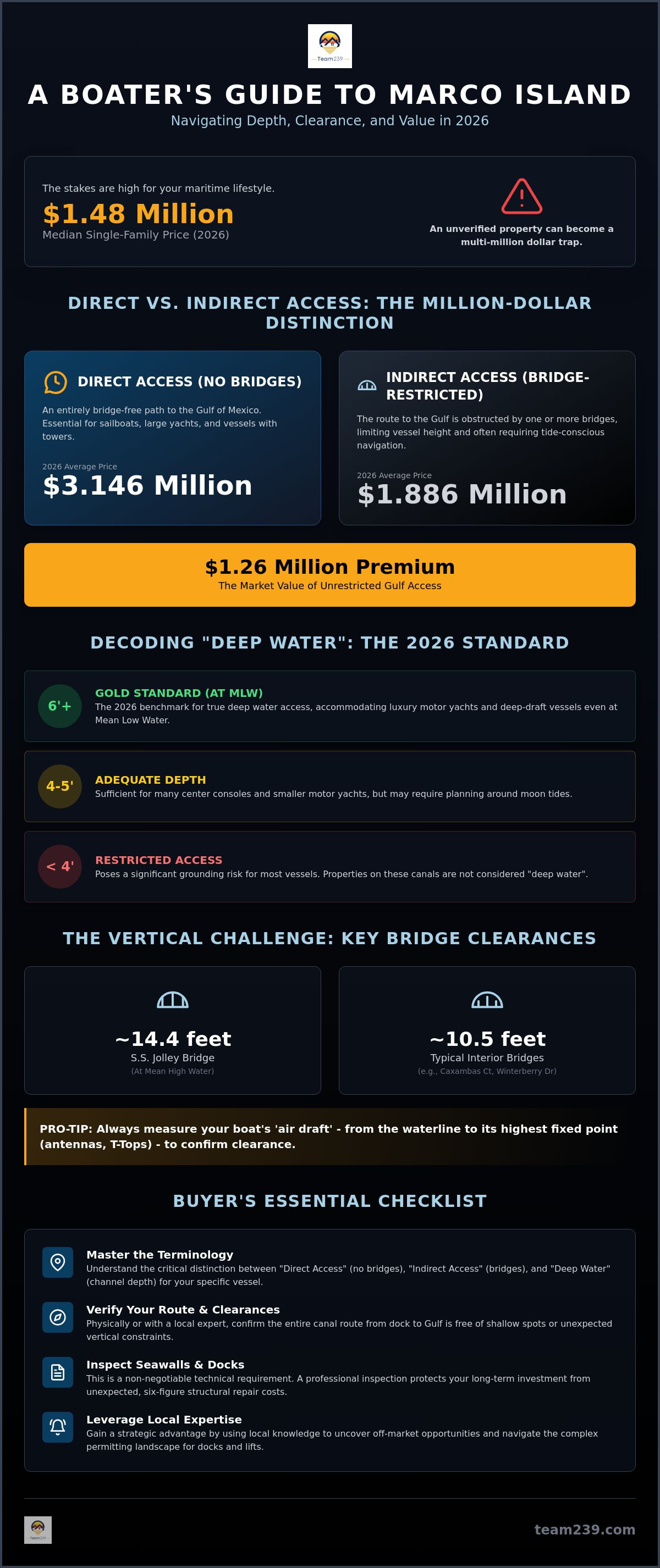
Buying a waterfront property without verifying the exact bridge clearance for your vessel is like buying a garage without measuring the height of your SUV. It's a mistake that can leave a multi-million dollar investment feeling like a landlocked trap. Many buyers search for deep water access homes for sale Marco Island only to realize too late that "direct access" doesn't always mean "unrestricted access." With median single-family prices hitting $1.48 million in 2026, the technical stakes for your maritime lifestyle have never been higher.
You want more than just a view; you want the freedom to reach the Gulf of Mexico without constantly checking a tide chart or worrying about a 10-foot bridge clearance. It's frustrating to navigate the jargon of indirect versus deep water while trying to assess the structural integrity of an aging seawall. We understand that a home is a strategic asset, and for a boater, its value is tied directly to the water depth and vertical clearance available at the dock.
This guide provides the technical clarity you need to ensure your yacht or sailboat has a safe, deep path to open water. We'll break down the specific neighborhood clearances, current 2026 market trends, and the essential permitting nuances that protect your investment and your peace of mind.
Table of Contents
Understanding Deep Water Access on Marco Island
For serious boaters, the term "waterfront" is too broad to be useful. When searching for deep water access homes for sale Marco Island, you're looking for a specific set of technical parameters that allow your vessel to move freely. Marco Island, Florida, is famous for its intricate canal system, but not every waterway is created equal. True deep water access is defined by the depth of the channel at Mean Low Water (MLW) and the total absence of vertical obstructions like bridges. If your boat has a significant draft or a tall mast, these details aren't just preferences; they're operational requirements that dictate where you can live.
The technical nuances of the canal system are often overlooked by casual buyers. Beyond just the depth at your dock, the entire route to the Gulf must be deep enough at all points. Some canals feature "humps" or silted-in areas that can trap a deep-draft vessel during a moon tide. This is why we emphasize the importance of local navigational knowledge during your property search. A home might look perfect on paper, but if the surrounding channel depth doesn't support your boat's draft, the property loses its primary utility. We look for properties that offer a clear path: a combination of depth and clearance that ensures your maritime lifestyle remains uninterrupted.
Direct vs. Indirect Access: What is the Difference?
The market makes a sharp distinction between these categories. Direct access means your path to the Gulf is entirely bridge-free, a requirement for sailboats and large yachts. In early 2026, direct waterfront homes averaged $3.146 million, while indirect homes averaged $1.886 million. This price gap reflects the freedom of having no vertical obstructions between your dock and the open sea.
The "Deep Water" Standard for 2026
In 2026, 6 feet at mean low tide is the gold standard for deep water. While small boats need less, a luxury motor yacht often requires 5 feet just to stay afloat at the dock. We categorize canals with less than 4 feet at low tide as restricted. When you evaluate deep water access homes for sale Marco Island, verifying depth at your specific dock prevents costly grounding issues.
Bridge Clearances and Navigational Constraints
Vertical clearance is the ultimate filter in the local real estate market. While depth ensures your hull stays off the bottom, bridge heights determine if you can even leave your canal. For owners of sportfishers with tuna towers or sailboats with fixed masts, the 14 bridges across the island act as physical barriers that cannot be negotiated. This is exactly why deep water access homes for sale Marco Island are categorized so strictly by their path to the Gulf. Understanding these constraints is vital before you commit to a property that might physically limit your maritime ambitions.
Navigating the local waterways requires a firm grasp of Florida boating laws and local tide variations. Clearance isn't a static number. It fluctuates with the tide, wind direction, and even barometric pressure. High-performance boaters often find themselves checking tide charts daily to ensure they don't get "stacked" out of their own dock by an incoming tide that reduces clearance below their T-top height. This logistical dance is a daily reality for those living behind the island's many 10-foot bridges. It’s a technical challenge that requires precision planning every time you leave the dock.
Major Marco Island Bridge Heights
The S.S. Jolley Bridge serves as the primary gateway, offering a vertical clearance of approximately 14.3 to 14.4 feet at Mean High Water. However, once you move into the interior canal systems, the limits drop significantly. Many key bridges, such as those on Caxambas Court or Winterberry Drive, hover around the 10.3 to 10.6-foot mark. If your vessel's static draft and equipment height exceed these numbers, your search must focus exclusively on "Direct Access" zones. Always measure your boat from the waterline to its highest fixed point, including antennas and outriggers, before touring homes.
The "No-Bridge" Advantage
The financial premium for bridge-free living is substantial. In 2026, the average closed price for a direct waterfront home reached $3.146 million, compared to $1.886 million for indirect homes. This $1.26 million gap represents more than just convenience. It offers the flexibility to upgrade to a larger vessel in the future without selling your home. Neighborhoods like The Estates or the Tigertail Beach area provide this unrestricted freedom, allowing for massive yachts that would be physically blocked in other sectors. If you aren't sure which canals fit your specific vessel, you can consult with our team to map out a precise navigational path for your boat.
Top Neighborhoods for Deep Water Access Homes
Finding the right location is a strategic decision that depends on your vessel's draft and your preferred cruising grounds. While the entire island offers waterfront living, the inventory of deep water access homes for sale Marco Island is concentrated in a few elite enclaves. Each neighborhood offers a different technical profile. You'll find everything from the massive canal widths of the Estates to the immediate Gulf proximity of the Tigertail area. Your choice determines whether you'll spend your afternoons navigating tight channels or cruising the open sea.
Location dictates your lifestyle. Some boaters prefer the quiet backwaters of the South End for fishing, while others want the social energy of the Marco River. In the 2026 market, the most successful buyers are those who match their specific boat's needs to the neighborhood's navigational reality. We see a clear trend where move-in-ready homes in these deep water pockets sell significantly faster than those with draft or clearance restrictions.
Whether you are focused on Marco Island or exploring other Florida island chains, working with a dedicated expert like Krissy in the Keys (Krissy Carnahan, Realtor) ensures you find a property that perfectly accommodates your vessel’s technical needs.
The Estates: Luxury and Depth
The Estates represent the peak of maritime real estate. This area is characterized by oversized lots, often exceeding half an acre, and some of the deepest canals on the island. Many waterways here maintain depths well over 8 feet even at low tide. This makes them the primary choice for owners of large motor yachts. Because these lots offer longer seawall frontages, they provide the lateral space needed for multi-lift configurations or expansive dock systems. Run times to the Gulf from the Estates are remarkably efficient, typically taking 10 to 15 minutes at idle speed.
South End and Caxambas Pass
The South End is the gateway to the Ten Thousand Islands and the open Gulf via Caxambas Pass. This region is a favorite for sportfishers who want to be in deep water within minutes of untying. Streets like Swallow Avenue and Caxambas Court are highly sought after for their direct, bridge-free routes. When planning a purchase in these high-velocity water zones, it's vital to understand how the Coastal Construction Control Line (CCCL) Program influences where you can build or expand marine structures. This regulation ensures that your dock and seawall projects meet strict environmental and structural standards.
For those who prioritize social boating, Old Marco offers a unique blend of historic charm and deep water access near the famous Snook Inn. It's a high-activity area where deep-draft vessels can easily navigate the Marco River. Meanwhile, the Tigertail Beach area serves boaters who want the fastest possible exit through Big Marco Pass. Both areas provide the "Direct Access" status that ensures your investment retains its value in the 2026 market.
Due Diligence: Seawalls, Docks, and Lift Permits
A pristine kitchen is easy to appreciate, but the most critical asset of deep water access homes for sale Marco Island is often submerged. While most buyers prioritize roof inspections, a failing seawall can represent a far greater financial risk. In the 2026 market, a seawall is the literal foundation of your property's value. If it's compromised, your ability to safely dock a large vessel or maintain the integrity of your upland yard disappears. We treat the "wet" side of a property inspection with more scrutiny than the "dry" side because marine construction is technically complex and strictly regulated; even if you are exploring other coastal regions, you can discover A Premier Home Inspection for high-standard property assessments in the Virginia Beach area.
Permitting is a multi-layered process involving the Department of Public Works and often state-level agencies. Current regulations dictate exactly how far your dock can extend into the canal. For waterways 100 feet wide or greater, your dock can protrude the shorter of 30 feet or 25% of the canal width. On narrower canals under 100 feet, that limit drops to 20%. These aren't just suggestions; they are hard limits that determine if your 60-foot yacht will physically fit at the dock without violating local ordinances. If you are evaluating a property for a specific vessel, you can schedule a technical consultation with our team to verify these clearances before you make an offer.
The Seawall Inspection Checklist
Professional marine inspectors look for specific red flags that indicate structural fatigue. We watch for soil subsidence behind the cap, which often signals that "weep holes" are no longer filtering water correctly. Large cracks in the vertical concrete or evidence of "kick out" at the base of the wall are signs of imminent failure. It's also important to note that the City of Marco Island prohibits the fabrication of seawall panels within city limits, meaning any replacement project requires significant logistical planning and a Marine Staging Permit, which is typically issued for a 100-day window.
Dock and Lift Upgrades
Evaluating an existing boat lift requires checking both the motor's maintenance history and its weight capacity. A lift rated for a 10,000-pound center console will not support a modern 35-foot cabin cruiser. We also analyze the materials used in the dock construction. While pressure-treated wood is traditional, many 2026 buyers prefer composite materials like WearDeck or Azek for their longevity and resistance to the Florida sun. If a property lacks the necessary lift capacity, we help you navigate the permitting process for an upgrade that meets your vessel's requirements while staying within the city's protrusion limits.
Partnering with Team239 for Your Waterfront Search
Navigating the technicalities of deep water access homes for sale Marco Island requires a partner who understands both the MLS and the maritime charts. Kristin and Jonathan Van Heukelom bring a digital expert attitude to the search, focusing on the data that matters most to boaters. We don't just look at the bedrooms and baths; we analyze the draft, the tide, and the navigational path to the Gulf. This holistic approach ensures your real estate investment aligns perfectly with your nautical goals and your vessel's specifications.
Our network provides access to off-market deep water listings that haven't hit the public portals yet. In a market where high-quality waterfront inventory remains selective, this insider access is a critical competitive advantage. We leverage this knowledge during luxury negotiations to ensure you're paying for actual utility, not just a generic waterfront label. Our support doesn't end at the closing table; we connect you with the most reliable local marine contractors to handle dock upgrades, lift maintenance, or seawall reinforcements.
Why Local Expertise Matters
A recent transaction highlights the value of this specialized knowledge. A buyer was interested in a property labeled "direct access," but our analysis revealed a "bridge trap" involving a nearby infrastructure project that would have temporarily restricted vertical clearance. By identifying this early, we protected the client's ability to use their vessel throughout the season. This same level of technical scrutiny applies whether you're looking here or exploring Luxury Homes for Sale in Naples FL: The 2026 Insider’s Guide. Understanding regional water nuances is the difference between a successful purchase and a costly navigational mistake.
Start Your Marco Island Journey
We've streamlined the search process to focus on your specific vessel requirements. We can set up a custom digital search that filters deep water access homes for sale Marco Island by canal depth and bridge clearance, saving you time and frustration. For those ready to move forward, we offer private boat tours of potential properties. Seeing a home from the water provides a perspective that a traditional walk-through simply cannot match. It allows you to feel the current and visualize the docking process firsthand. Contact Team239 today to begin your 2026 search for a home that offers a truly clear path to the Gulf.
Secure Your Maritime Legacy on Marco Island
Successful waterfront living in 2026 requires more than a beautiful view; it demands technical precision. We've explored how bridge clearances, canal depths, and the structural health of your seawall dictate the feasibility of your boating lifestyle. Choosing the right neighborhood, from the deep canals of The Estates to the high-speed access of the South End, ensures your vessel is never restricted by the tide or vertical obstacles. This strategic approach protects your investment and your time on the water.
Finding the right deep water access homes for sale Marco Island is a complex process that benefits from specialized expertise. Team239, led by local experts Kristin and Jonathan Van Heukelom, offers over 10 years of Southwest Florida real estate experience. We specialize in luxury waterfront properties and new construction, providing the technical insight needed to navigate complex marine regulations and off-market opportunities.
Find your perfect deep water access home on Marco Island with Team239. Let's turn your maritime ambitions into a permanent reality. Your clear path to the Gulf starts with a single, expert conversation.
Boater’s FAQ: Navigating Marco Island Real Estate
What is the average bridge clearance on Marco Island?
Bridge clearances vary significantly across the island, ranging from 3 feet to over 14 feet at Mean High Water. Most interior bridges, such as those on Caxambas Court or West Winterberry, provide between 10.12 and 10.64 feet of vertical space. You should always consult the city's official bridge clearance table and account for current tide levels before attempting to pass under any structure.
Can I keep a sailboat at a home with indirect access?
Keeping a sailboat at an indirect access home is generally impossible because fixed masts cannot clear the 10-foot height of most island bridges. Sailboat owners should focus their search exclusively on deep water access homes for sale Marco Island that offer direct, bridge-free routes to the Gulf. Even a smaller mast requires the unrestricted vertical space only found in "Direct Access" neighborhoods.
What is the difference between a canal and a bay front home on Marco Island?
Canal homes offer protected, narrower waterways that are ideal for docking and provide more shelter from wind and heavy wake. Bay front homes, such as those on Roberts Bay or Smokehouse Bay, offer expansive views and often deeper water but are more exposed to the elements. Many boaters prefer canals for the added safety and ease of vessel maintenance they provide.
Are seawalls the responsibility of the homeowner or the city?
Seawall maintenance and replacement are the sole responsibility of the individual homeowner on Marco Island. You must obtain a building permit from the Department of Public Works for any structural repairs or new construction projects. Because the fabrication of seawall panels is prohibited within city limits, these projects require strategic logistical planning and a Marine Staging Permit.
How long does it take to get to the Gulf from the Estates?
Run times from The Estates to the Gulf of Mexico typically range between 10 and 15 minutes at idle speed. This neighborhood is highly coveted for its deep canals and efficient, bridge-free access to open water. The lack of vertical obstructions means you don't have to wait for tide-specific windows to move your vessel in or out of your dock.
Do I need a special permit to install a larger boat lift?
Yes, a building permit from the Department of Public Works is required for any new boat lift or structural modification to your dock. Regulations dictate that docks can protrude up to 30 feet or 25% of the waterway's width on canals 100 feet wide or greater. Ensuring your new lift fits within these specific protrusion limits is a critical step in the city's approval process.
What should I look for in a waterfront home inspection?
A waterfront inspection should prioritize seawall structural integrity by checking for cracks, soil subsidence, and proper weep hole function. You must also verify the dock's protrusion compliance and the lift's weight capacity relative to your current and future vessels. Measuring the actual channel depth at mean low tide is the only way to guarantee your boat won't be grounded.
Why are some Marco Island canals deeper than others?
Canal depth is influenced by the original dredging depth, proximity to natural passes, and local siltation patterns. Canals in The Estates were often dredged deeper to accommodate larger luxury yachts. Conversely, some interior canals may have shallow sections due to natural sand movement. Proximity to high-flow areas like Caxambas Pass helps maintain the depth required for deep-draft vessels.
Comments