
Do I Need a Lawyer to Sell My House in Florida? (2026 Guide)

Updated: Aug 1
You can successfully close a $420,000 real estate deal in the Sunshine State without ever putting a lawyer on retainer. While many states mandate legal counsel for every transaction, Florida operates primarily as a title state. If you're asking, do I need a lawyer to sell my house in Florida, the short answer is no; it's not a legal requirement. Most sellers successfully navigate the process using a professional Realtor and a title company to handle the heavy lifting and escrow management.
It's natural to feel anxious about hidden legal pitfalls or paying for services you don't actually need. We'll show you exactly how the Florida market functions in 2026 so you can move forward with confidence. This guide breaks down the role of title companies, the impact of recent legislative updates on disclosures, and the specific scenarios where a lawyer becomes a strategic asset. You'll gain a clear roadmap for your sale and understand exactly which professionals belong on your team for a successful, stress-free closing in the current market.
Table of Contents
Is a Lawyer Legally Required to Sell a Home in Florida?
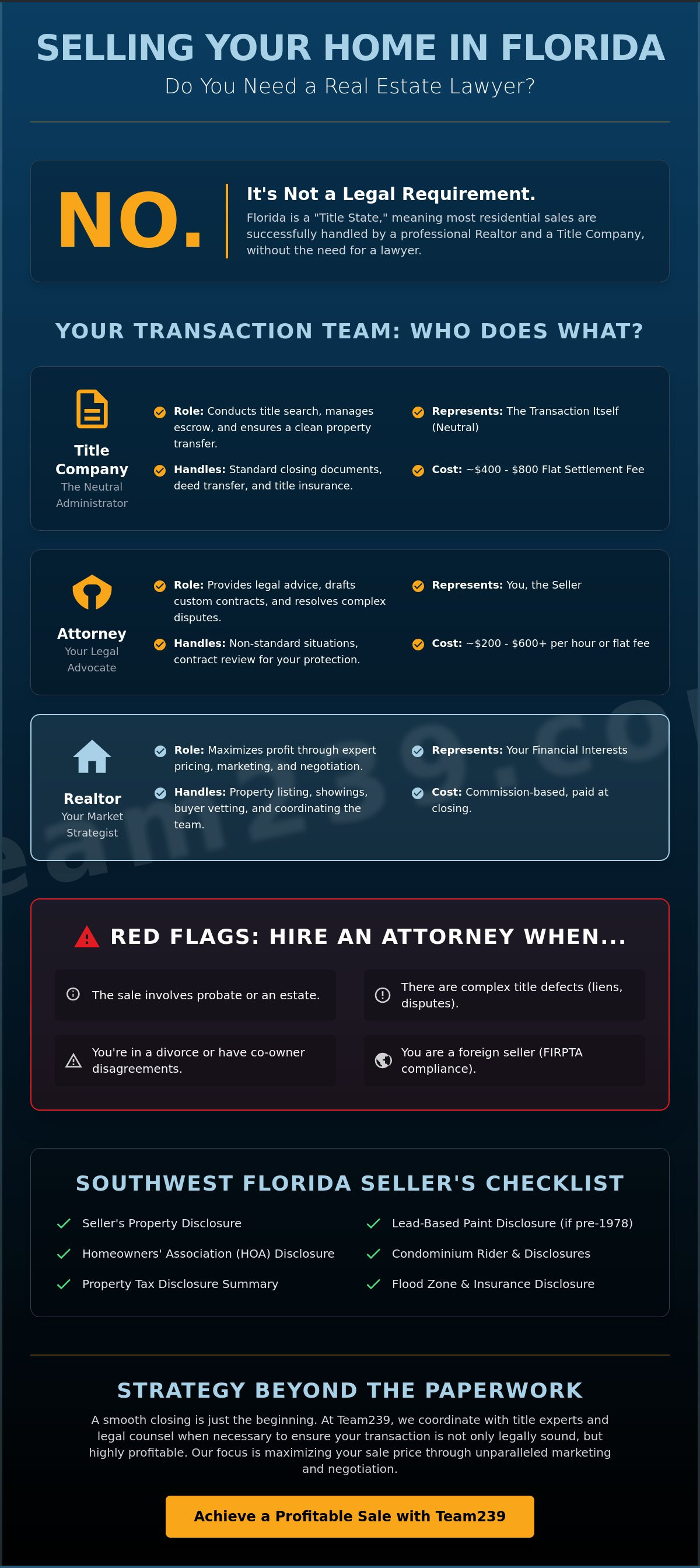
Florida law doesn't mandate hiring an attorney to sell your home. This often surprises sellers moving from "Attorney States" like New York or Georgia, where legal counsel is a statutory requirement for every transaction. Florida is known as a "Title State." In this environment, title companies and licensed Realtors manage the vast majority of residential sales from contract to closing. If you're wondering, do I need a lawyer to sell my house in Florida, the answer depends on the complexity of your specific situation rather than a legal obligation.
Most Southwest Florida transactions proceed smoothly without a dedicated attorney because the system is designed for efficiency. A title company typically serves as the "Closing Agent," acting as a neutral intermediary to ensure all parties fulfill their contractual duties. They don't represent you or the buyer; they represent the transaction itself. This streamlined approach works for thousands of sellers every month who rely on a professional real estate team to manage the timeline and paperwork.
For property owners in other regions, such as Central Florida, Morgan Property Solutions Inc. provides similar expert guidance to ensure every transaction is handled with professional precision.
Similarly, for homeowners in the Midwest looking for a direct and professional sale process, Freedom Path Investors offers a streamlined solution for those in the St. Louis market.
Florida’s Legal Landscape for Home Sellers
The efficiency of the Florida market relies heavily on standardized forms. The Florida Bar and Florida Realtors (FAR/BAR) have co-developed comprehensive contract templates that cover nearly every standard contingency. These pre-approved documents are the gold standard for residential resale representation. Because these forms are so widely used and legally vetted, the need for a lawyer to draft custom language is rare in a typical sale. Florida also has specific statutory requirements for transferring property deeds, including the presence of two witnesses and a notary acknowledgment. Title companies employ specialists who are well-versed in these technicalities to ensure the deed is recorded correctly with the county.
The Role of the Title Company in Your Sale
A title company is the engine behind the real estate closing process. Their primary job is to conduct a title search to verify the property is free of "clouds" like undisclosed liens, unpaid taxes, or boundary disputes. In Southwest Florida, it's customary for the seller to select the title company and pay for the owner’s title insurance policy. This policy protects the buyer from future claims against the property.
Beyond insurance, the title company provides vital escrow services. They hold the buyer’s earnest money deposit in a secure account and manage the final disbursement of funds. This ensures you receive your proceeds only after all legal documents are signed and the title is officially transferred. This structured approach allows most sellers to close with confidence using a professional real estate team and a reputable title agent instead of an attorney.
Real Estate Attorney vs. Title Company: Who Handles the Closing?
Choosing between a title company and an attorney is often the first major decision sellers face. Both have the legal authority to conduct a closing, but their roles are distinct. A title company is an administrative powerhouse. They prepare the essential documents like the deed, the bill of sale, and the Closing Disclosure (CD). While they employ staff attorneys to review these standard forms, they don't provide individual legal representation. If you are debating, do I need a lawyer to sell my house in Florida, it's helpful to know that a title company operates on a neutral basis, whereas a lawyer is hired specifically to advocate for your interests.
Cost structures also differ significantly. Title insurance premiums are regulated by the state, but title companies often charge flat settlement fees ranging from $400 to $800. In contrast, hiring a private attorney might involve an hourly rate between $200 and $600 or a flat fee for the entire transaction. At Team239, we streamline this process by coordinating with your chosen closing agent. We bridge the gap between high-end marketing and the technical administrative tasks required to get you to the finish line.
What a Real Estate Agent Does That a Lawyer Doesn't
A lawyer focuses on the "what if" scenarios of the contract. A Realtor focuses on the "how much" and "who." We provide deep-dive analytics on Naples Florida home values to ensure your property is positioned for maximum return. Our team handles the heavy lifting of luxury property listing services, from vetting high-net-worth buyers to managing private showings. Lawyers rarely touch the negotiation of inspection repairs or appraisal gaps. These are the active, strategic moves that protect your equity before the paperwork ever reaches a closing desk.
When the Title Company Reaches Its Limits
Title agents are experts in logistics, but they hit a hard wall when it comes to legal advice. They cannot interpret contract law for you or advise you on how to handle a breach of contract. Their role is to stay neutral. If a title search reveals a complex boundary dispute or a lien that requires litigation, the title company will advise both parties to seek independent counsel. This is the precise moment where the question, "do I need a lawyer to sell my house in Florida," shifts from a choice to a necessity. For most standard sales, our residential resale representation ensures these hurdles are identified early so your closing stays on track.
When You Should Absolutely Hire a Florida Real Estate Attorney
Standard transactions move like clockwork with a title company, but certain "red flag" scenarios make legal counsel a non-negotiable insurance policy. Many sellers ask, "Can't my Realtor just fix this title defect?" The reality is that real estate agents are legally prohibited from providing legal advice or drafting complex curative documents. If your property has a "clouded" title, a lawyer is the only professional with the authority to resolve it through litigation or specific legal filings. When you're evaluating do I need a lawyer to sell my house in Florida, look at the complexity of your ownership structure and the history of the land itself. Strategic legal support is often the difference between a closed deal and a collapsed contract.
International investors and non-resident sellers face a unique set of hurdles. An attorney ensures that unique financing arrangements, such as seller financing or post-closing leasebacks, are drafted with your protection in mind. They act as a defensive shield, ensuring that "standard" contract language doesn't leave you exposed to future liability or financial loss.
Complexity: Probate, Trusts, and FIRPTA
Selling an inherited property often requires navigating the Florida probate court system, which is a specialized legal track. You cannot sell what you don't legally own, and a lawyer ensures the transfer of authority is airtight. For international sellers, the Foreign Investment in Real Property Tax Act (FIRPTA) is a major hurdle. Without proper legal guidance, you could face a 15% withholding trap on the gross sales price at the closing table. Trust-owned properties also require a careful review of the trust documents to verify the Trustee has the specific legal authority to execute the sale, a step that goes beyond the scope of a title search.
Conflict: Liens, Boundary Disputes, and Breach of Contract
A title search, which typically costs between $200 and $400, might uncover a "unmarketable" title due to a 20-year-old lien or an expired permit. While a title company identifies these issues, a lawyer clears them. Boundary line disputes or encroachments, such as a neighbor's fence crossing your property line, often require a legal easement or a formal settlement agreement. If a buyer tries to back out of a contract without cause, having an attorney on retainer provides the leverage needed to protect your earnest money deposit. In these high-stakes moments, the cost of an attorney, often ranging from $200 to $600 per hour, is a small price for total financial security.
The Seller's Documentation Checklist for Southwest Florida
Success in a Florida real estate transaction depends on a flawless paper trail. Even if you decide the answer to do I need a lawyer to sell my house in Florida is no, you're still legally bound to provide specific disclosures. At the start of 2026, Florida Realtors implemented updated disclosure forms to increase transparency regarding property risks and timelines. You must provide a Seller’s Property Disclosure, along with mandatory notices for radon gas and lead-based paint if the home was built before 1978. In gated communities across Naples and Fort Myers, an "Estoppel" letter is vital. This document from your HOA or Condo Association confirms your account is current and outlines any pending assessments.
Choosing the right contract is your next strategic move. Most Southwest Florida sellers prefer the FAR/BAR "As-Is" contract. It protects you from being forced to make repairs, provided you disclose all known material defects. The Standard Contract, by contrast, requires you to fix items up to a certain percentage of the purchase price. In areas like Estero and Bonita Springs, you must also disclose Community Development District (CDD) fees. These are long-term bonds used to fund infrastructure. Buyers need to know exactly how these impact their annual property taxes before they sign.
Local Disclosures for Naples and Marco Island
Selling on the coast adds another layer of complexity. Properties seaward of the Coastal Construction Control Line (CCCL) require specific disclosures about state-regulated building zones. When marketing luxury homes for sale in Naples FL, we pay extra attention to elevation certificates and flood zone designations. High-end condo associations often have a "Right of First Refusal," meaning the board can match any outside offer. Missing these local details can derail a sale in the final hours of the closing process.
Closing Documents You Will Sign
The final stack of paperwork focuses on the transfer of ownership. You'll sign a Warranty Deed, which is the legal instrument that conveys the title. Most residential sales use a General Warranty Deed, offering the highest level of protection to the buyer. You'll also sign a Bill of Sale for personal property. In Southwest Florida, this often includes high-value items like designer furniture or golf carts. Finally, the 1099-S form ensures the IRS is notified of the proceeds from your sale. To ensure your documentation is handled with precision, schedule a consultation with Team239 for your residential resale representation.
Maximizing Your Sale with Team239: Strategy Beyond the Paperwork
A real estate attorney is your defensive shield, but Team239 is your offensive strategy. While legal counsel focuses on risk mitigation, we focus on value creation. If you're still debating, do I need a lawyer to sell my house in Florida, consider that an attorney won't help you find a high-net-worth buyer or negotiate a higher sale price. Our luxury property listing services are designed to coordinate seamlessly with your chosen legal or title team. We ensure the administrative side of the deal never slows down the momentum of your sale. We vet every potential buyer's financial and legal standing before you ever sign a contract. This eliminates "legal" excuses for a deal to fail mid-stream.
The real profit in selling your home in Southwest Florida comes from expert positioning. We don't just list properties; we engineer successful exits. By the time you reach the closing table, our team has already managed the complex interplay between marketing, showing, and negotiating. This leaves the final paperwork as the easiest part of your journey.
Expert Negotiation in the SWFL Luxury Market
The "Inspection Period" is where most deals face their greatest threat. We don't just wait for the report; we anticipate it. Our deep relationships with top-tier title companies in Collier County allow us to identify potential title or lien issues weeks before they become closing-day disasters. This proactive approach minimizes seller concessions and keeps your equity intact. We leverage competitive interest to drive multiple offers. This ensures you retain the leverage throughout the entire transaction, allowing you to dictate terms rather than reacting to them.
Your Next Steps: From Listing to Closing
Setting the right baseline starts with a professional valuation that reflects the current 2026 market dynamics. We help you prepare your home for the Southwest Florida lifestyle buyer. We focus on the aesthetic and functional details that command a premium in the luxury market. While the question of do I need a lawyer to sell my house in Florida is about legal compliance, working with Team239 is about market dominance. Contact us today to launch your residential resale representation and let us handle the technical details so you can focus on your move.
Take the Next Step Toward a Seamless Closing
Florida's status as a title state offers you the flexibility to choose a team that aligns with your specific needs. You now know that you aren't legally required to hire an attorney for a residential sale; however, identifying when to bring in legal counsel for probate or complex title defects is essential for your protection. For most standard transactions, the combination of a neutral title company and a strategic real estate partner ensures your interests are guarded without unnecessary overhead. When you weigh the question, do I need a lawyer to sell my house in Florida, focus on the complexity of your property and the strength of your representation.
Kristin and Jonathan Van Heukelom lead Team239 with over 10 years of specialized expertise in the Naples, Bonita Springs, and Estero luxury markets. We move beyond simple paperwork to provide comprehensive transaction management from listing to keys. Our data-driven approach ensures your home is positioned for maximum return in the current market. Get a Free Southwest Florida Home Valuation & Seller Strategy Session today. You deserve a partner who turns market complexity into your competitive advantage.
Frequently Asked Questions
Can a Florida real estate agent give legal advice if they aren't a lawyer?
No, a Florida real estate agent cannot give legal advice or interpret contract law. Doing so constitutes the unauthorized practice of law and could lead to the revocation of their license. While agents manage negotiations and timelines, they must refer you to a licensed attorney for any questions regarding legal rights or the interpretation of specific clauses.
How much does a real estate attorney cost when selling a house in Florida?
Expect to pay between $200 and $600 per hour for a Florida real estate attorney in 2026. For a standard residential closing, many firms offer a flat fee ranging from $750 to $1,500. Specific tasks like contract review typically cost between $350 and $800, while deed preparation usually falls between $200 and $400. Costs vary based on the complexity of the transaction.
What is the difference between a title search and title insurance?
A title search is a historical investigation into public records to find liens or claims, typically costing between $200 and $400. Title insurance is the actual policy that protects the buyer and lender if a hidden issue arises later. While the search identifies known problems, the insurance covers the "unknowns" that could threaten ownership after the sale is complete.
Does the seller or buyer choose the title company in Naples, Florida?
In Naples and throughout Collier County, local custom dictates that the seller usually chooses the title company and pays for the owner’s title insurance policy. This differs from other parts of Florida where the buyer might pay. This choice is a key part of your strategy when asking, do I need a lawyer to sell my house in Florida, as the title company handles the escrow and closing logistics.
What happens if I sign a contract and then decide I want a lawyer?
You can hire an attorney at any point, even after the contract is signed. However, the contract is a legally binding document the moment both parties sign. An attorney can still help you navigate disputes, review the closing disclosure, or handle title issues, but they cannot unilaterally change the terms you already agreed to without the buyer's consent.
Do I need a lawyer for a 'For Sale By Owner' (FSBO) transaction in Florida?
Hiring a lawyer is strongly recommended for "For Sale By Owner" transactions. Without a Realtor to manage mandatory 2026 disclosures and the FAR/BAR contract, the risk of legal errors increases significantly. An attorney ensures your paperwork is compliant and protects you from potential lawsuits that often arise from improper disclosure or missed deadlines in FSBO deals.
How does FIRPTA affect my home sale if I am not a US citizen?
FIRPTA requires a 15% withholding of the gross sales price if the seller is not a US citizen or resident alien. This tax is held by the IRS until your final tax liability is determined. Because this involves complex federal law, many sellers discover they need a lawyer to sell my house in Florida specifically to manage the withholding certificate process and avoid long-term financial delays.
What is an Estoppel letter and why does the seller pay for it?
An Estoppel letter is a legal document from an HOA or Condo Association that verifies the seller’s account balance and any outstanding violations. The seller pays for this letter because it proves they are delivering a clear title free of association debt. In 2026, these are mandatory for almost every gated community closing in Southwest Florida to ensure the buyer isn't inheriting the seller's unpaid dues.
Comments