
Florida Home Insurance Crisis: What to Know for 2026
- Team 239

- May 12
- 13 min read
Did you know that Florida's largest insurer is cutting rates by an average of 8.7% this year while seventeen new carriers have recently entered the market? If you're studying the Florida home insurance crisis what to know for 2026 is that the tide is finally turning toward stability. You've likely dealt with the frustration of sudden premium spikes or the stress of being told your roof is too old to cover. We know that finding reliable coverage has felt like an uphill battle lately.
We're here to help you move past the confusion and take control of your investment. This guide provides the expert strategies you need to navigate the 2026 landscape, from leveraging new legislative reforms to securing lower premiums through smart mitigation. You'll learn why the 1% FIGA assessment is ending this October, how to weigh Citizens against private carriers, and how to identify "insurable" homes before you even make an offer. It's time to stop worrying about the next bill and start building a resilient future in the Sunshine State.
Key Takeaways
Discover how the shift toward a resiliency-based market is moving policyholders away from Citizens and back into a more competitive private insurance landscape.
Unlock the single most effective discount tool available by mastering wind mitigation inspections and the My Safe Florida Home grant program.
Identify the major legislative shifts cooling the Florida home insurance crisis what to know to stay ahead of market changes and protect your investment.
Learn why "insurance-ready" properties are the new gold standard for Southwest Florida real estate and how they impact your long-term borrowing power.
See how our team integrates insurance feasibility into every property search to eliminate high-cost surprises before you reach the closing table.
Table of Contents
The State of the Florida Home Insurance Crisis in 2026
The Florida insurance market is finally exhaling. After years of headlines predicting a total collapse, 2026 marks a decisive shift from a systemic crisis to a fragile but real stabilization. If you're tracking the Florida home insurance crisis what to know right now is that the aggressive legislative reforms of 2022 and 2023 have finally reached the bottom line of premium filings. Litigation filings have fallen by more than 35% since 2021. This reduction in "legal friction" is creating the breathing room private carriers needed to return to the Sunshine State. For the first time in a decade, we're seeing more than just a handful of options for homeowners.
Southwest Florida remains a high-demand zone despite these insurance hurdles. Cities like Naples and Fort Myers continue to attract capital and new residents because the lifestyle value still outweighs the carrying costs. However, the market has become smarter. Buyers are no longer ignoring the "insurance line" on their closing disclosures. They're looking for homes that are "insurable" from day one. This demand is driving a new era of transparency where the quality of a home's construction is just as important as its waterfront view.
Is the 2026 Insurance Market Stabilizing?
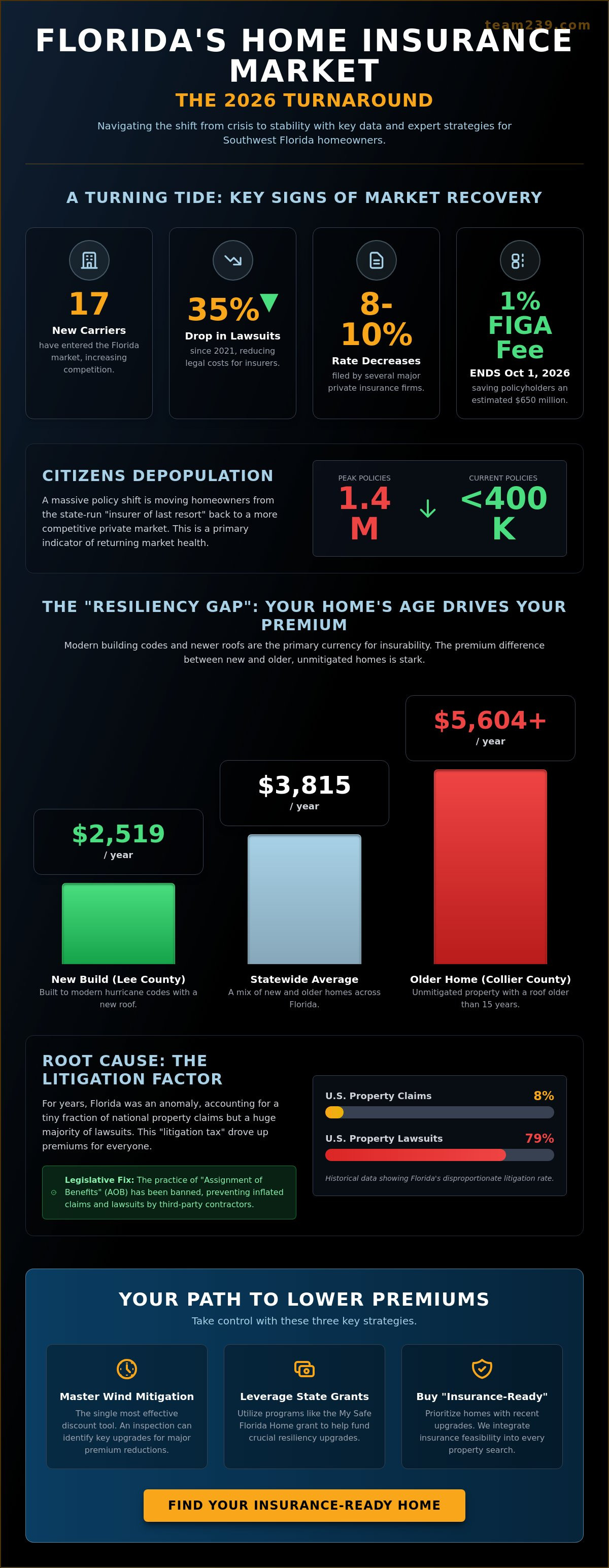
The numbers suggest a significant turnaround. At least 17 new insurance companies have entered the Florida market in the last 18 months, bringing fresh private capital. This influx is driving competition that didn't exist two years ago. Most importantly, the Citizens Property Insurance Corporation is no longer the only viable option for many. Its policy count has plummeted from a peak of 1.4 million to under 400,000 as "depopulation" programs move homeowners back to private firms. Several private insurers, including State Farm and Florida Peninsula, have actually filed for rate decreases between 8% and 10% this year. Additionally, the 1% FIGA emergency assessment is officially ending on October 1, 2026. This change alone will save policyholders roughly $650 million over the next two years.
The "Resiliency Gap": New Construction vs. Older Homes
In 2026, your home's "birth certificate" determines your premium more than your zip code. There's a clear resiliency gap between properties built under modern codes and those that haven't been updated. Homes built under the most recent Florida building code standards, particularly those with roofs installed after 2022, are seeing the most significant rate reductions. While the statewide average premium is stabilizing at $3,815, the actual cost varies wildly based on age. A new build in Lee County might see rates as low as $2,519, while an older, unmitigated home in Collier County could still face costs upwards of $5,604. Modern wind resistance isn't just about safety; it's the primary currency for insurability in the current market. If a roof is older than 15 years, finding private coverage remains difficult, making proactive upgrades the most effective strategy for lowering costs.
Root Causes: Why Rates Remain a Challenge in Southwest Florida
Understanding the Florida home insurance crisis what to know for 2026 requires looking past the surface. While the market is stabilizing, Southwest Florida homeowners still face premium pressure from three specific directions: legal expenses, global financial markets, and our unique geography. Naples and Fort Myers aren't just vacation destinations; they're Tier 1 hurricane zones. This means insurers calculate risk based on the statistical certainty of extreme weather. Even with better laws in place, the cost of "carrying" that risk remains higher than in most other states.
For years, Florida was an outlier in the legal world. The state accounted for only 8% of the country's property insurance claims but a staggering 79% of its lawsuits. This created a "litigation tax" that forced carriers to raise rates across the board to cover legal fees rather than actual repairs. The infamous "roofing loophole" also played a major role. Unscrupulous contractors used to promise "free roofs" by exploiting policy language, a practice that's finally been reined in by 2026 regulations. These systemic leaks are being plugged, but the financial damage from the previous decade still impacts today's balance sheets.
Litigation Reform and the 2026 Impact
The end of "Assignment of Benefits" (AOB) is the most significant victory for market health. Previously, homeowners could sign over their claim rights to a contractor, who would then sue the insurance company for inflated repair costs. This practice is now banned. We're seeing the results in 2026 through a 35% drop in litigation filings compared to 2021. This legal clarity is exactly what's attracting new capital back to the state. If you're planning a move to the area, our relocation consulting services can help you evaluate the true cost of ownership, including how these new laws affect your specific property choice.
The Reinsurance Factor
Your local insurance bill is tied to a global market you'll likely never see. Reinsurance is essentially insurance for insurance companies. When a major climate event happens in another part of the world, it can shrink the pool of available capital, driving up costs for carriers in Naples. The 2024 and 2025 hurricane seasons were active enough to keep reinsurance pricing firm, even as domestic litigation costs fell. To combat this, the Florida Hurricane Catastrophe Fund (FHCF) provides a state-backed safety net that keeps private carriers from fleeing the market entirely.
Living in a Tier 1 zone means building for the future is the only way to lower costs. Data shows that Florida's Building Codes are the gold standard for survival; homes built to these specifications suffer significantly less damage during major storms. This resilience is why insurers are now rewarding newer construction with much lower premiums. In Southwest Florida, the "old" way of insuring a home is gone. 2026 is about proving your home can withstand the wind before an agent will even give you a quote.
Practical Ways to Lower Your Florida Home Insurance Premiums
The market is shifting from panic to proactive protection. To survive the Florida home insurance crisis what to know is that mitigation is your best financial hedge. It's no longer just about paying a bill; it's about reducing the risk insurers price into your policy. In 2026, the most successful homeowners are treating their properties like high-performance assets, upgrading core components to qualify for the deepest discounts available. Proactive steps don't just protect your structure. They also unlock access to the 17 new private carriers that have entered the state, many of whom only want the most resilient "gold standard" homes.
A wind mitigation inspection is your most powerful tool. This single document can slash premiums by up to 40% because it proves your home won't fly apart during a Category 4 event. Insurers look for specific technical features like roof-to-wall attachments (clips or wraps) and the shape of your roof. Hip roofs, which slope down on all four sides, are much cheaper to insure than gable roofs. If you're buying a home in Southwest Florida, this inspection should be your first priority during the due diligence period.
The 2026 My Safe Florida Home Guide
The My Safe Florida Home program remains the MVP of 2026 for existing homeowners. This state-backed initiative provides matching grants, often up to $10,000, to help you harden your home against wind damage. You can use these funds for impact-resistant windows, reinforced garage doors, or roof upgrades. Eligibility in Southwest Florida generally requires a homesteaded property and a current wind mitigation inspection. In 2026, homeowners utilizing the My Safe Florida Home grant program are seeing premium reductions that frequently offset the cost of their required contributions within thirty-six months.
Physical Home Upgrades That Pay Off
Physical upgrades offer a clear return on investment. Secondary Water Resistance (SWR) is a prime example. This involves a self-adhering polymer modified bitumen "peel and stick" tape applied to the roof joints. It's a relatively inexpensive addition during a reroof, yet it saves thousands in premiums over the life of the roof. Impact windows also provide a high ROI, not just in insurance savings but in noise reduction and energy efficiency. However, be aware of the "Roof Age" rule. In 2026, most private carriers use 15 years as a hard cutoff. If your roof is older, your options shrink significantly, often leaving Citizens as the only choice.
Flood insurance is the final piece of the puzzle. As of January 1, 2026, Citizens requires all policyholders with a dwelling replacement cost of $400,000 or more to carry flood insurance, regardless of their flood zone. While the National Flood Insurance Program (NFIP) is the traditional choice, the private flood market in Florida is expanding. Private policies often offer higher coverage limits and shorter waiting periods, making them a strategic alternative for luxury homes in Naples and Fort Myers.
How the Insurance Crisis Impacts Southwest Florida Real Estate Values
Insurance has officially moved from a background utility to a primary driver of property value. In 2026, we're seeing a clear market bifurcation. Homes that are "insurance-ready" with new roofs, impact-rated openings, and updated systems are commanding a significant price premium. Conversely, properties requiring immediate mitigation are sitting on the market longer. If you're navigating the Florida home insurance crisis what to know is that your home's resiliency profile is now just as important as its square footage or kitchen finishes. Buyers are no longer willing to inherit the risk of uninsurable older roofs.
High premiums also create a math problem for mortgage approvals. Since insurance is part of the PITI (Principal, Interest, Taxes, and Insurance) calculation, a $5,000 annual premium can significantly impact a buyer's debt-to-income (DTI) ratio. In Collier County, where average premiums remain around $5,604, this can be the difference between qualifying for a luxury villa or being forced to look at a lower price point. Despite this, the Southwest Florida lifestyle continues to pull in buyers who view these costs as a manageable "sunshine tax" on a premium investment.
Buying Strategy: The "Insurability Period"
The standard inspection period has evolved into an "insurability period." You must secure a binding insurance quote before your right-to-cancel expires. If a wind mitigation report comes back with poor ratings, it becomes a powerful negotiation tool. You can ask the seller for a price credit or a roof replacement to ensure the home qualifies for private market coverage. Working with specialists who understand Naples real estate insurance nuances is critical. They'll know which surplus lines carriers are currently hungry for luxury risks and which zip codes are seeing the best rate reductions. If you need a property that won't surprise you at the closing table, contact our team for a curated search of insurance-ready homes.
Selling Strategy: Pre-Insuring Your Listing
Smart sellers are now performing a wind mitigation inspection before their home even hits the MLS. By providing this report upfront, you remove a major hurdle for cautious buyers. Marketing a home as "fully mitigated" or "built to 2024 codes" is a massive competitive advantage. This is why new construction homes in Bonita Springs are so dominant right now. They offer a "clean" insurance history and the lowest possible rates, often around $2,519 in Lee County. If you're selling an older home, investing in a new roof or impact glass isn't just a repair. It's a strategic move to preserve your equity and ensure a smooth transaction.
Navigating the Market with Team239: Your Local Advantage
Real estate in Southwest Florida has evolved into a high-stakes game of data and strategy. You can't just look at the listing price and the pool view anymore. Regarding the Florida home insurance crisis what to know is that the "hidden" costs of insurance can make or break your long-term ROI. We don't wait for the inspection period to start talking about coverage. Our team integrates insurance feasibility into every property search from the very first click. We analyze roof age, wind mitigation potential, and elevation certificates before you even step foot in a driveway.
We've spent years building a network of specialized Southwest Florida insurance brokers who provide rapid-response quotes for our clients. This local expertise is vital in cities like Naples and Fort Myers, where flood zone boundaries can shift from one street to the next. Understanding the nuances of the 2026 flood insurance requirements for high-value homes ensures our buyers aren't blindsided. We know which carriers are currently aggressive in the private market and which neighborhoods are seeing the best rate reductions following the 2023 reforms.
Take, for example, a recent case study involving a 1990s resale home in Estero. The property was perfect, but the roof was 14 years old, placing it right at the "cutoff" for many private carriers. Instead of letting the deal collapse, we collaborated with our brokers to identify a carrier willing to write a policy based on a clean wind mitigation report. We then negotiated a seller credit that covered the premium difference until the buyer was ready for a reroof. This proactive strategy turned a potential liability into a successful, protected investment.
A Strategic Approach to SWFL Real Estate
We move beyond the "doom and gloom" headlines with data-driven buying advice. Our process focuses on calculating the "Total Cost of Ownership" (TCO) before you ever make an offer. This includes projected taxes, insurance premiums, and the cost of any necessary resiliency upgrades. Our commitment to transparency means we'll tell you if a home's insurance profile is a red flag. We believe in partnership and professional precision, ensuring you have the full picture of your investment's future performance.
Ready to Move to Southwest Florida?
If you're moving to Southwest Florida this year, you need a team that understands the 2026 legislative landscape. We've already done the heavy lifting by identifying "Insurance-Optimized" homes across Lee and Collier counties that qualify for the best private rates. Don't leave your relocation to chance or outdated information. Schedule a consultation with Team239 to discuss your 2026 move and let's build a strategy that protects your lifestyle and your equity.
Secure Your Southwest Florida Future
The market is evolving. By mastering the Florida home insurance crisis what to know for 2026, you can move forward with a clear strategy. we've transitioned into an era where resiliency is the primary currency. Whether you're taking advantage of new rate reductions or hardening your home to meet the highest wind standards, the power to control your costs is finally within reach. The key is to stop reacting to the market and start anticipating it.
You don't have to navigate these technical waters alone. Team239 brings over 10 years of local expertise in Naples and Bonita Springs to every transaction. As a family-led team, we prioritize your long-term success by connecting you with a specialized network of insurance and mitigation experts. We ensure your investment is protected from day one so you can focus on enjoying the lifestyle you've earned.
Ready to find a property that's built for the future? Find Your Insurance-Optimized Home in Southwest Florida with Team239. The Sunshine State is ready for you, and with the right team by your side, your investment is more secure than ever.
Frequently Asked Questions
Is Florida home insurance getting cheaper in 2026?
Yes, premiums are finally beginning to stabilize and even decrease for many homeowners. Citizens is implementing a statewide average rate reduction of 8.7% for 2026, and the 1% FIGA emergency assessment ends on October 1. Major private carriers like State Farm and Florida Peninsula have also filed for rate decreases between 8% and 10%. This shift is a key part of the Florida home insurance crisis what to know if you're planning a move this year.
What is the "My Safe Florida Home" program and is it still available in 2026?
The My Safe Florida Home program is a state initiative providing matching grants of up to $10,000 for home hardening. It remains fully active in 2026. Homeowners can use these funds to upgrade roofs, windows, and doors to meet modern wind standards. These improvements don't just protect your structure; they're the most effective way to qualify for significant premium discounts in the current market.
Can I buy a home in Naples if it has an older roof?
You can certainly buy a home with an older roof, but your insurance options will be limited. Most private carriers in Southwest Florida use 15 years as a hard cutoff for eligibility. If the roof is older, you may be forced into Citizens Property Insurance or required to replace the roof as a condition of coverage. We often negotiate roof replacements or price credits during the inspection period to solve this.
How much does a wind mitigation inspection cost in Southwest Florida?
A wind mitigation inspection in Southwest Florida typically costs between $100 and $150. This is a standalone inspection performed by a licensed professional who documents your home's ability to withstand high winds. It's a vital investment because the resulting report is the primary document insurers use to calculate your premium discounts. Without it, you're likely overpaying for your coverage.
Does flood insurance cover hurricane damage in Florida?
Flood insurance specifically covers damage from rising water or storm surge, while standard homeowners insurance covers wind-driven damage. It's a common misconception that one covers the other. In a hurricane, you often face both threats simultaneously. Having both policies ensures that whether the water comes from the sky or the ground, your investment is fully protected against catastrophic loss.
What happens if my insurance company leaves Florida?
If your carrier leaves the state or becomes insolvent, you'll receive a formal non-renewal notice giving you time to find new coverage. The Florida Insurance Guaranty Association (FIGA) exists to handle outstanding claims from failed companies. While this was a major concern in previous years, the entry of 17 new insurers into the market by 2026 means you have more options for replacement coverage than before.
Is Citizens Property Insurance a good option for luxury homes?
Citizens is an excellent safety net, but it has limitations for high-value properties. As of January 1, 2026, any Citizens policyholder with a dwelling replacement cost of $400,000 or more must carry flood insurance. For luxury homes in Naples, private surplus lines often provide more comprehensive coverage and higher limits that Citizens cannot match. We help you compare these options to find the right fit for your portfolio.
How do I find out if a home is in a high-risk flood zone?
You can verify a home's flood risk by visiting the FEMA Flood Map Service Center or local county GIS portals. These maps show if a property is in a Special Flood Hazard Area (SFHA). When working with our team, we provide detailed flood zone analysis and elevation certificates for every listing you consider. This transparency helps you understand the Florida home insurance crisis what to know before making a financial commitment.
Comments