
Florida real estate disclosure laws for home sellers

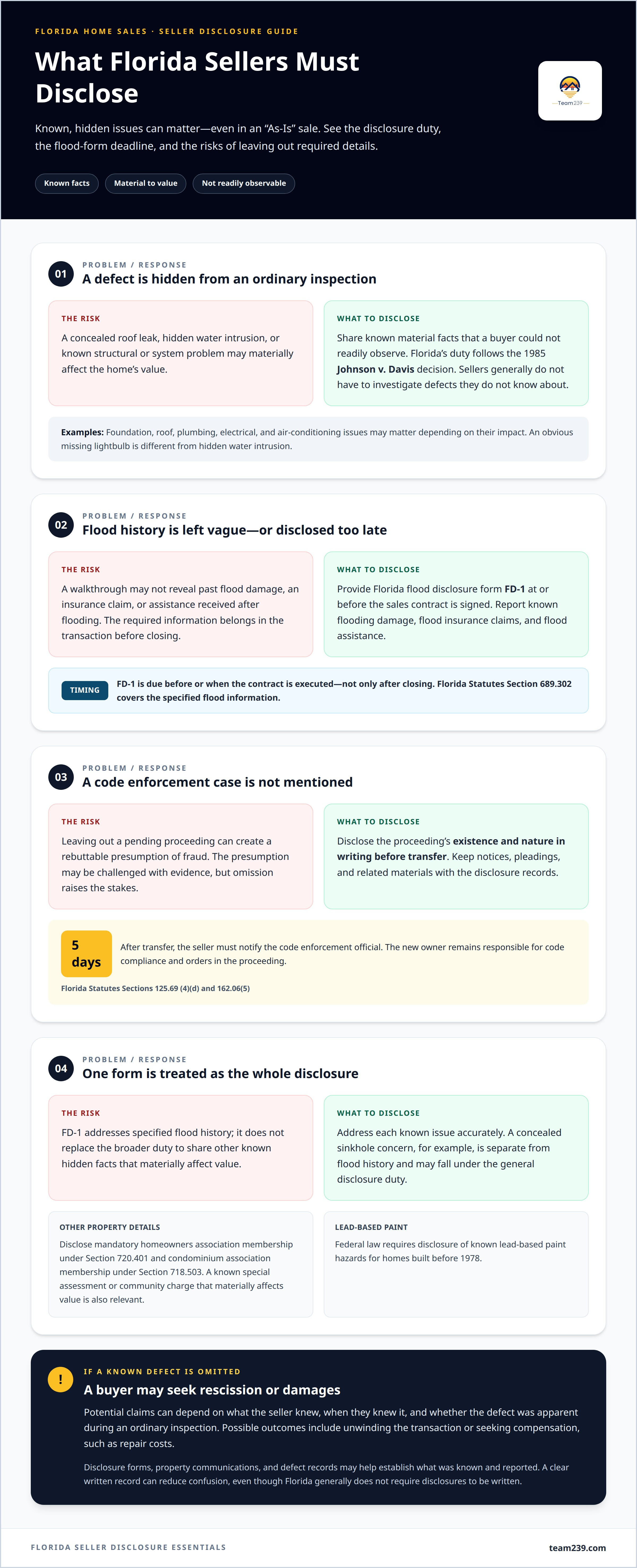
An “As-Is” sale doesn’t erase a Florida seller’s duty to disclose known, hidden defects that materially affect a home’s value. Florida real estate disclosure laws for sellers are based on the Florida Supreme Court’s 1985 decision in Johnson v. Davis, and state law also requires sellers to disclose specified flood history before or when the sales contract is signed.
It’s understandable to wonder what counts as a material issue, especially when a defect isn’t visible during an ordinary inspection. The key questions are what you know about the property and whether the issue could affect its value.
This guide explains Florida sellers’ disclosure duties, flood information requirements, and what may follow if a known defect or required detail is omitted. It also covers how written disclosures can make the sale process clearer for both sides.
Table of Contents
What does the seller of a home have to disclose in Florida?
Florida sellers must disclose known, hidden facts that materially affect a home’s value. Florida real estate disclosure laws for sellers focus on the seller’s actual knowledge and whether a buyer could readily observe the issue.
Known Latent and Material Defects
A latent defect is a problem that cannot readily be seen during a normal inspection. Under the Florida Supreme Court’s 1985 Johnson v. Davis decision, sellers must disclose known facts that materially affect property value and aren’t readily observable.
For example, disclose a concealed roof leak you know about, even if the ceiling looks sound. Sellers generally aren’t required to investigate unknown defects, but a pending code enforcement action must be disclosed in writing, including its existence and nature.
Structural, System, and Utility Defects
Known, concealed problems involving a foundation, roof, plumbing, electrical system, or air conditioning may materially affect a home’s value. The significance depends on the issue and its impact: an obvious missing lightbulb is different from hidden water intrusion.
Florida law also requires disclosure of mandatory homeowners association membership under section 720.401 and condominium association membership under section 718.503. If a known special assessment or community charge materially affects value, disclose it as a relevant fact.
Common Seller Disclosure Forms
Florida doesn’t require a single government seller disclosure form. Sellers commonly use the Florida Realtors Seller’s Property Disclosure to record known material facts. Florida real estate disclosure laws for sellers generally don’t require disclosures to be written, but a clear written record can help prevent confusion.
Sellers are advised to complete disclosures before marketing the property. There’s no general right to cancel simply because a buyer receives a disclosure; failing to disclose a known defect may allow the buyer to cancel and recover the deposit.
Lead-Based Paint Disclosures
Federal law requires disclosure of known lead-based paint hazards for homes built before 1978, according to the U.S. Environmental Protection Agency. This federal requirement applies alongside Florida’s disclosure duty.
For an older home, include known lead hazards in the disclosure materials. A written record helps buyers understand what the seller has reported before deciding how to proceed with the purchase.
Consequences of nondisclosure
A buyer’s claim may depend on whether the seller knew about a material fact before the sale. Florida’s disclosure duty covers known issues that materially affect value and aren’t readily observable. A seller who conceals a known hidden defect could face a claim for rescission or damages, including repair costs. The buyer’s case may turn on what the seller knew, when they knew it, and whether the defect was apparent during an ordinary inspection.
Possible outcomes include unwinding the transaction or seeking compensation for losses tied to the undisclosed condition. If a concealed defect requires repairs, for example, the buyer may seek those costs as damages. A buyer who believes required disclosures were omitted may consider legal action. The outcome depends on the facts and evidence, including the disclosure form, communications about the property, and records of the defect.
Pending code enforcement proceedings carry a specific consequence. Under Florida Statutes Sections 125.69 (4)(d) and 162.06(5), a seller must disclose the proceeding’s existence and nature before transfer. Failing to do so creates a rebuttable presumption of fraud. That presumption can be challenged with evidence, but it raises the stakes of omitting notices, pleadings, or other materials received about the case.
A property with a pending code enforcement action also has a post-transfer filing requirement: the seller must notify the code enforcement official within five days after the transfer. The new owner remains responsible for code compliance and orders in the proceeding, so clear records matter after closing too. Keep disclosure documents and related notices together, and ensure the buyer receives the information required for the property. A vague form entry may leave buyers without the details needed to understand the issue.
Flood disclosure requirements
Florida law requires a seller to give the buyer flood disclosure form FD-1 at or before signing the sales contract. Florida Statutes Section 689.302 covers known flooding damage, flood insurance claims, and flood assistance. The deadline matters: the disclosure belongs in the transaction before or when the contract is executed, not only after closing.
Use FD-1 to communicate the required flood information clearly. A prior flood that damaged the home, a flood-related insurance claim, or assistance received after flooding are relevant facts. The disclosure concerns known information, so sellers should report what they know rather than assume a buyer will find it during a walkthrough. Keep supporting records organized with the transaction documents.
Flooding and sinkholes are different property concerns, but a known hidden issue can matter under the broader rule from Johnson v. Davis. That Florida Supreme Court decision requires disclosure of known facts that materially affect value and aren’t readily observable. For example, a concealed sinkhole problem known to the seller may need disclosure even though FD-1 addresses flooding.
For residential real estate, keep the distinction clear: FD-1 addresses specified flood history, while other known material defects may fall under the general disclosure duty. Don’t treat a completed flood form as a substitute for communicating a separate known issue. If a property has both prior flood damage and a concealed structural concern, each should be addressed accurately in the transaction.
Timely, specific information helps buyers assess a property before signing. Sellers should avoid vague descriptions that omit known damage, claims, or assistance. If a buyer later alleges that required flood information was withheld, the disclosure and transaction records may help establish what was shared and when. An attorney can explain how the facts affect a particular dispute.
Florida sellers’ disclosure duty
Florida’s disclosure duty centers on actual knowledge, not a duty to uncover every possible defect. In 1985, the Florida Supreme Court’s Johnson v. Davis decision required sellers to disclose known facts that materially affect property value and aren’t readily observable. A seller generally doesn’t have to investigate for problems they don’t know about, but can’t conceal a known hidden issue.
This approach changed the traditional “let the buyer beware” rule for single-family home sales. A visible, obvious condition is different from concealed water intrusion the seller knows about. The duty applies to known material facts even when the sales contract describes the home as “As-Is.” A written disclosure can create a clear record, and sellers are advised to complete it before marketing, although Florida statutes and legal precedent don’t require disclosures to be written.
Some disclosures address specific subjects beyond defects. Under Florida Statutes Section 404.056(5), sellers must provide the statutory radon gas disclosure before or when the building sale contract is executed. The requirement doesn’t apply to unimproved property, such as vacant land, or residential transient occupancy in public lodging lasting 45 days or less. Section 689.261 also requires notice that property taxes may increase after ownership changes.
Other statutory requirements apply to particular properties. Under Section 161.57, sellers of coastal property must disclose possible coastal erosion and applicable federal, state, or local regulations. Section 689.25 doesn’t require disclosure of a death, homicide, or suicide on the property, or a prior occupant’s HIV/AIDS status. These specific rules sit alongside the general duty to disclose known material facts. A careful review before the contract helps separate required notices from facts that may affect value.
For guidance as you prepare a Florida resale, plan your home sale with a clear disclosure process.
Team239
Team239 helps Florida sellers bring disclosure questions into the wider decisions involved in preparing and marketing a home. Through Residential Resale Representation and Luxury Property Listing Services, the team can support sellers as they organize property information and move through the sale process. This can be useful when known defects, flood history, or property-specific notices raise questions about what buyers need to receive.
Clear disclosures help keep the transaction grounded in accurate information. Team239 offers guidance as sellers plan the next steps for a residential sale, while buyers considering new construction can access New Construction Buyer Representation. Contact Team239 to discuss your real estate plans and the questions you have about selling in Florida.
Set up your next move with clarity
A well-planned sale starts before the listing goes live. Create a process for gathering property records, noting what you know, and sharing relevant information at the right stage. That preparation can help keep decisions organized from the early planning through closing.
Understanding Florida real estate disclosure laws for sellers isn’t only about avoiding omissions. It’s also about creating a reliable record and communicating clearly with everyone involved. If a detail raises questions, address it early rather than leaving it unresolved as contract discussions begin.
Every property and sale has its own context. Team239 can help you plan your next real estate move with informed, practical guidance. Contact Team239 with your questions, and take the next step with greater clarity.
Frequently Asked Questions
What has to be disclosed?
Disclose known, non-obvious facts that materially affect a home’s value, along with information required for specific transactions. Examples include known flood history, a pending code enforcement proceeding, required radon notice, and mandatory association membership. To assess an issue, consider whether a buyer could readily see it and whether it could affect the property’s value or condition.
Do I have to disclose problems if I sell my house “as is” in Florida?
Yes. An “As-Is” clause doesn’t excuse concealing a known, hidden issue that materially affects the home’s value. For example, a seller who knows about recurring water intrusion can’t use the contract wording to hide that fact. The buyer’s inspection and the contract still matter, but “As-Is” doesn’t remove the seller’s disclosure duty.
What if the home or property is being sold, or was sold, “As-Is”?
An “As-Is” sale doesn’t remove the duty to disclose known, hidden material issues. If you’ve already bought a home and later discover a concealed problem, gather the signed contract, disclosure documents, inspection materials, messages, and repair records. They may help establish what was disclosed and when. A buyer who believes required information was withheld may consider legal action.
What should you do if you believe you are a victim of a seller’s failure to disclose issues?
First, preserve the records: save the contract, disclosure form, inspection report, photographs, seller communications, and repair estimates. Note when you discovered the issue and what evidence suggests the seller knew about it. For a Naples home, records of earlier water intrusion, for example, may help clarify the timeline. Consult an attorney about possible claims and remedies.
What must Florida home sellers disclose to buyers under state law?
Florida has no single comprehensive seller-disclosure statute or mandatory statewide form, but several specific requirements apply. Depending on the property and transaction, disclosures may concern flood history, radon, mandatory homeowners or condominium association membership, coastal erosion, and post-transfer property-tax changes. Federal law also covers known lead-based paint hazards in homes built before 1978. The applicable requirements depend on the home and known facts.
What is Florida’s Johnson v. Davis rule for disclosing known property defects?
In Johnson v. Davis, decided in 1985, the Florida Supreme Court established that sellers must disclose known facts that materially affect value and aren’t readily observable to buyers. The rule focuses on the seller’s actual knowledge. It generally doesn’t require sellers to investigate for unknown problems, while an obvious condition differs from a concealed defect.
All content on the Naples Florida Real Estate Channel and associated social media is for informational and entertainment purposes only. The owner makes no representations about the accuracy or completeness of this information, and it may change. Consult Kristin and Jonathan Van Heukelom or another licensed real estate agent for guidance specific to your situation. The owner is not liable for errors, omissions, information availability, or losses, injuries, or damages arising from the display or use of this information.
Comments