
How to Find Out Who Pays What at a Florida Closing

At a Florida closing, sellers customarily pay the deed documentary stamp tax, while buyers customarily pay mortgage documentary stamp tax and intangible tax. No single statewide rule assigns every closing cost, and the purchase contract can shift some expenses. To understand what to expect at a real estate closing in Florida, start with which charges are customary and which terms were negotiated.
Signing is only one part of the process. Buyers and sellers may sign separately, and the documents depend in part on whether the buyer is financing the purchase. Reviewing the settlement figures and knowing who will be present can help make closing day more straightforward.
This guide explains the typical division of closing costs, the documents buyers and sellers sign, and who usually attends. It also covers what a title search can uncover and how a title issue may affect closing, so you can prepare for the decisions and next steps ahead.
Table of Contents
What Documents Are Signed at Closing?
Flood and homeowners insurance paperwork, when part of the transaction, belongs with lender or property documents; homestead-related items belong with tax paperwork. The deed and loan documents remain central to the transfer.
The closing agent coordinates signatures and funds, then records the deed in the county’s official records. In many Florida transactions, buyers and sellers sign separately at a time and place arranged by the closing agent.
Review the figures before signing. For a financed purchase, the Consumer Financial Protection Bureau says buyers must receive the Closing Disclosure at least three business days before closing. Compare its figures with the agreed transaction terms, and raise discrepancies before the appointment. Late lender documentation or errors in transaction papers can delay closing.
Sign the applicable transfer and title papers. The seller signs the deed transferring ownership, while buyers receive the deed, settlement statement, and title insurance documents. Title paperwork may also include affidavits and tax-related forms. The closing agent uses the signed settlement statement to coordinate the transaction.
Complete financing documents if you have a mortgage. The buyer typically signs the lender-prepared promissory note and mortgage. Loan disclosures may also be included. Appraisal issues, lender requests, or inspection disputes can disrupt the schedule, so unresolved items may need attention before documents are ready to sign.
Confirm the deed tax in the settlement figures. In 2026, Florida’s deed documentary stamp tax is $0.70 per $100 of sale price in most counties. In Miami-Dade, it is $0.60 per $100, plus a $0.45 per $100 surtax; single-family homes are exempt from the surtax. The seller customarily pays the deed tax.
Finish funding and recording. The parties sign the required documents, and closing funds move through escrow. The closing agent then records the deed in county official records, completing the title transfer. A title defect or an inspection dispute can delay this final sequence.
When part of the transaction, flood and homeowners insurance paperwork belongs with lender or property documents, while homestead-related items belong with tax paperwork.
What happens if the title search reveals a problem?
A title search reviews public records for ownership and claims affecting the property. Follow these steps to understand any issue and how it may affect settlement.
Review the title search and commitmentRead the title commitment alongside the search results. It summarizes those results, lists requirements to satisfy before the title policy is issued, and identifies exclusions that remain. Note which requirements affect the transaction and whether the paperwork shows they have been addressed. A title commitment is not the same as the final title insurance policy.
Identify title defects and encumbrancesLook for recorded claims or encumbrances affecting the seller’s ownership or the property. The search may reveal an issue that must be addressed before the transaction can proceed as planned. Match each item to the commitment’s requirements. A title agent discloses title issues but does not assess their implications, explain resolution options, or advise on the consequences of leaving them unresolved.
Track the requirements through settlementUse the commitment’s requirements as a transaction checklist. Track each item through closing and confirm its status in the closing paperwork. If a requirement remains open, it may affect issuance of the title policy and delay settlement. The lender may also set title-related conditions for a financed purchase.
Understand the title insurance coverageTitle insurance is purchased with a one-time payment and protects the owner’s rights for as long as they own the property. The commitment identifies exclusions that remain, so distinguish them from requirements to satisfy before the policy is issued. Who pays for the owner’s policy depends on county customs and the purchase agreement.
Account for county customsIn most Florida counties, sellers customarily pay for the owner’s title insurance policy. Buyers customarily pay in Broward, Miami-Dade, Sarasota, and Collier counties. For new construction purchases, Team239’s new construction buyer representation can help keep transaction milestones in view while title paperwork progresses.
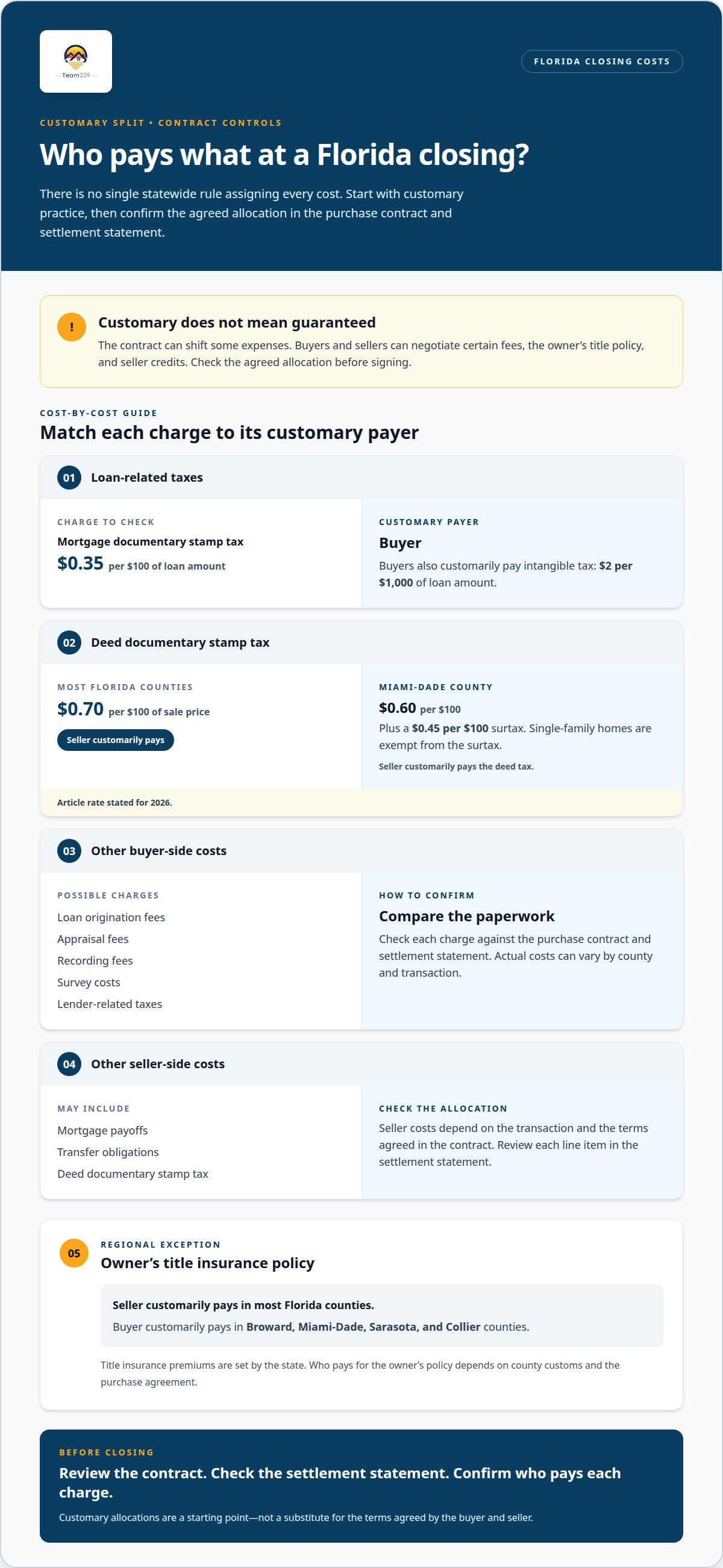
Who Pays What at a Florida Closing?
Florida has no single statewide rule assigning every closing cost. To understand what to expect at a real estate closing in Florida, start with the contract and settlement statement.
Review buyer and seller costsCompare each charge with the purchase contract and settlement statement. Buyers may pay loan origination fees, appraisal fees, recording fees, survey costs, and lender-related taxes. Sellers commonly pay the deed documentary stamp tax and may have mortgage payoffs and transfer obligations. Closing costs vary by county. Buyers and sellers can negotiate certain fees, the owner’s title policy, and seller credits in the contract, so review the agreed allocation before signing.
Account for Florida taxes and feesCheck who pays each tax and title charge. Buyers customarily pay mortgage documentary stamp tax, $0.35 per $100 of loan amount, and intangible tax, $2 per $1,000 of loan amount. Sellers customarily pay deed documentary stamp tax. The owner’s title policy is customarily seller-paid in most counties, but buyer-paid in Broward, Miami-Dade, Sarasota, and Collier counties. Title insurance premiums are set by the state.
Review the remaining line items with the title company. Depending on the transaction, costs may include HOA transfer fees, attorney fees, title insurance premiums, and recording charges. Sellers should compare mortgage payoff amounts and transfer obligations with the settlement statement. Knowing what to expect at a real estate closing in Florida also means understanding how county customs and contract terms affect the final allocation.
Bring the closing funds and paperwork requested for your transaction. Florida closing funds must reach the closing agent before or at closing; buyers are typically asked to wire funds a day or two beforehand. Verify wire instructions directly with the closing agent by phone before sending money. Review the final statement to ensure the amount due matches the agreed terms, and bring any documents the agent requested.
Who attends a Florida real estate closing
The closing agent coordinates the signing and transaction. In Florida, that agent is typically a real estate attorney or title company.
Confirm who is handling the closing. Ask whether the closing agent is an attorney or a title company representative, and note the appointment details. Florida law doesn’t require an attorney for every real estate closing. The closing agent coordinates the documents and closing funds, while the parties complete the steps required for their transaction.
Plan for separate signing appointments. Buyers and sellers often sign at different times or locations set by the closing agent. Don’t assume both parties will sit at the same table. The agent can coordinate each signing and the exchange of paperwork needed to complete the transfer.
Know which parties need to sign. The seller signs the deed, and a buyer financing the purchase signs lender-prepared loan documents, including the promissory note and mortgage. The closing agent guides the signing sequence and handles the transaction documents. Each party’s required signatures depend on the documents prepared for that sale.
Prepare for a remote signing if needed. Florida closings may use a power of attorney or remote online notarization. For a remote closing, the closing agent must receive original recordable documents before the transaction can close. Coordinate the signing method and document delivery with the agent so the deed can be recorded.
Understand what completes the appointment. The closing agent confirms receipt of the required funds and documents, then coordinates disbursement according to the signed settlement statement. Once the deed is recorded in the county’s official records, ownership transfers to the buyer. The seller delivers possession and keys after the agent confirms closing.
For support planning a Florida home purchase, get guidance for your purchase.
Team239
Team239 helps buyers and sellers connect closing details to the decisions made throughout a residential transaction. Turn to the team when you’re buying a resale home, considering new construction, selling a luxury property, or relocating to Naples, Bonita Springs, Estero, Marco Island, or Fort Myers. Representation can help you understand how contract terms shape your responsibilities and prepare questions about costs, title issues, and closing steps. The closing agent handles transaction documents and funds; your real estate representative helps keep your property goals and agreed terms in view as you move toward closing.
Contact Team239 to discuss your real estate plans.
Make Your Next Move With a Clear Plan
Use what to expect at a real estate closing in Florida as a starting point for planning, not a script for every transaction. Before moving forward, identify the decisions that matter most: the property, the terms you’re comfortable accepting, and the support you want as the transaction progresses. Discussing those priorities early can help keep your home search or sale aligned with your goals and give you a practical framework for weighing options as new details emerge.
Team239 offers Residential Resale Representation, New Construction Buyer Representation, and Luxury Property Listing Services. A focused conversation can help connect your real estate decisions with your broader plans, whether you’re preparing to buy or considering a sale. Start with the outcome you want, then discuss the steps that fit your situation.
Contact Team239 with your closing questions and take the next step with a plan that fits your move.
Frequently Asked Questions
How Long Does the Signing Take?
A financed Florida closing signing typically takes 45 to 90 minutes; a cash signing takes 20 to 30 minutes. Loan documents add steps for buyers with a mortgage, while cash buyers generally have fewer financing papers to sign. Buyers and sellers may sign separately, so their appointments can happen at different times or locations arranged by the closing agent.
How long does it take to close on a home in Florida?
A Florida home purchase generally takes 30 to 45 days from signed contract to closing. A cash purchase often closes in 7 to 21 days. The timeline depends on completing the transaction’s financing, appraisal, title, inspection, and document steps. A cash deal avoids lender processing, but title and other transaction requirements still need attention before closing.
What happens between the contract and closing day?
After signing the contract, the parties work through inspections, appraisal and financing, title review, and closing paperwork. A home inspection usually happens within the first 10 to 15 days after the contract, while a title search typically takes 5 to 10 business days. For financed purchases, the Consumer Financial Protection Bureau says buyers receive the Closing Disclosure at least three business days before closing.
What if something goes wrong before closing?
A delay may follow a late lender document request, low appraisal, title defect, inspection dispute, or error in transaction paperwork. Identify which part of the transaction is affected and whether it changes the documents, funds, or agreed timing. Title issues arise during the search and commitment process; inspection or appraisal concerns can also disrupt the planned closing sequence.
What should you bring to closing?
Bring the closing funds and any transaction documents requested by the closing agent. For a financed purchase, expect to sign the lender’s loan documents, including the promissory note and mortgage. Keep the settlement statement and Closing Disclosure available to review alongside the final figures. If you wire funds, verify the instructions directly with the closing agent by phone.
When does Closing occur and Keys Exchanged?
Closing is typically complete once the closing agent has received the required funds and documents, unless the contract says otherwise. The agent records the new deed in the county’s official records, establishing the buyer’s legal ownership. The seller delivers possession and keys after the agent confirms the transaction is closed. The contract can specify different possession timing.
Comments