
Marco Island Investment Properties: The 2026 Investor’s Strategy Guide

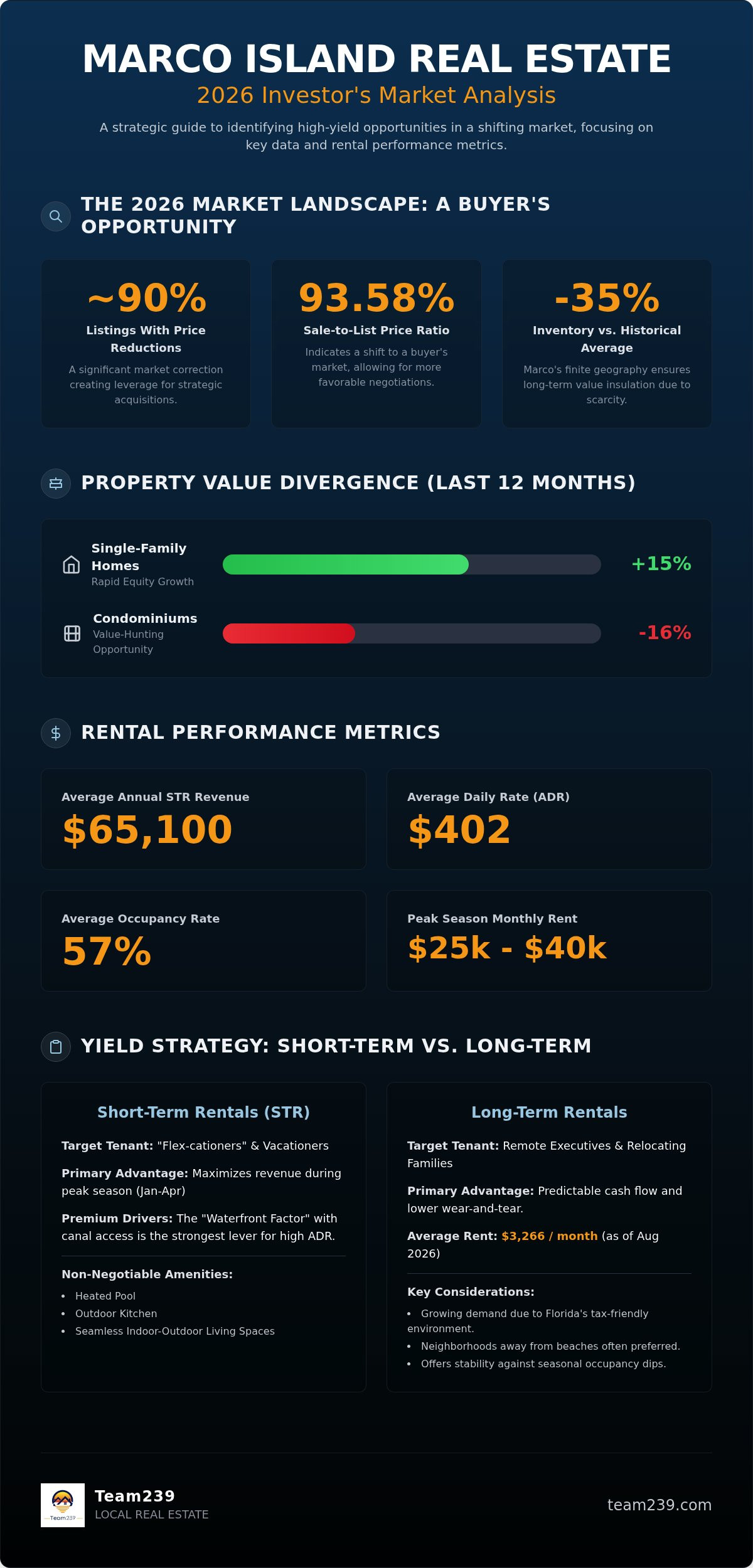
Nearly 90% of listings on Marco Island saw price reductions in early 2026. This signals a massive shift for strategic buyers who have been waiting for the high barrier to entry on waterfront real estate to soften. Investing in Marco Island investment properties requires more than just capital; it demands a clear eyed look at the math behind the lifestyle.
It's easy to be drawn in by an average annual short-term rental revenue of $65,100, but the real challenge lies in the details. You're likely concerned about opaque management fee structures and the evolving rental regulations in Collier County. This guide provides the clarity you need to move from speculation to strategy. We'll show you how to identify high-yield opportunities in the island's most resilient neighborhoods and explain why the choice between new construction and resale is critical for your net ROI. You'll gain a roadmap for acquiring a management-ready asset with a partner who understands the island's unique financial pulse and the specific requirements of the Florida market.
Table of Contents
The 2026 Marco Island Real Estate Investment Landscape
The 2026 market cycle for Marco Island residential properties is currently defined by a strategic transition. With a sale-to-list price ratio of 93.58 percent, the island has shifted into a buyer's market. This is a rare window for those looking into Marco Island investment properties. While roughly 90 percent of listings have seen price reductions, this isn't a sign of a failing market. Instead, it's a necessary correction after years of aggressive growth. Smart investors are using this leverage to acquire assets that were previously out of reach.
What sets this area apart is the "Island Premium." Unlike mainland markets like Naples or Bonita Springs, where developers can often find new land further east, Marco is geographically finite. According to Marco Island Demographics and Geography, the island's fixed boundaries create a natural moat. Inventory remains 35 percent lower than historical averages because there's simply nowhere left to build outward. This scarcity ensures that even when the market cools, long-term value remains insulated.
Market Trends and Appreciation Forecasts
Success in 2026 depends on understanding property type divergence. Single-family home values rose 15 percent in the last year, while condo values slipped 16 percent. This creates two distinct paths. You can either hunt for value in the condo sector or bank on the rapid equity growth of single-family homes. New construction continues to influence the market heavily. Modern, hurricane-resilient builds in gated communities are pushing resale owners to renovate or lower their price expectations. The current "sweet spot" for capital gains is found in properties priced between the median home price of $874,000 and the median list price of $1,175,000.
Why Marco Island Over the Mainland?
The choice to invest here over the mainland comes down to occupancy stability. The island's lifestyle draws a specific demographic of "flex-cationers" who stay for longer periods. This trend helps maintain a 57 percent occupancy rate and reduces the high turnover costs associated with shorter stays. While the mainland offers volume, Marco offers exclusivity and a higher average daily rate, which sat at $402 in August 2026. You can Learn about the Southwest Florida lifestyle to see why this micro-market continues to outperform neighboring coastal towns in rental demand.
Rental Strategies: Short-Term vs. Long-Term Yields
The seasonal model is the heartbeat of the local market. Between January and April, high-end rentals command between $25,000 and $40,000 per month. This aggressive four month window often generates enough revenue to cover a property's entire annual carrying costs. During the "maintenance summers," occupancy typically dips, but the rise of "flex-cationers" in 2026 is helping to bridge that gap. These travelers stay longer and work remotely, keeping the island's average occupancy at a healthy 57 percent.
The "Waterfront Factor" remains the strongest lever for rental premiums. Canal access doesn't just offer a view; it provides the boating lifestyle that premium renters expect. In 2026, resort-style amenities in private homes are non-negotiable. If you want to hit the average daily rate of $402, your property needs a heated pool, an outdoor kitchen, and seamless indoor-outdoor living spaces. These features differentiate your asset in a competitive market with 1,884 active listings.
The Short-Term Rental (STR) Goldmine
Beachfront condos offer the highest convenience and immediate ADR, while inland single-family homes often see better long-term appreciation. For out-of-state investors, turnkey Marco Island investment properties are the gold standard. They allow you to start generating income from day one without the delays of a renovation. Vetting a property for STR potential requires looking past the aesthetic. You must verify specific association bylaws and state licensing requirements during your due diligence phase to ensure the property can legally operate as a vacation rental. If you're unsure where to start, partnering with a strategic acquisition expert can help you filter for properties that are truly management-ready.
Long-Term Rental Stability
There's a growing appetite for high-end annual leases among remote executives and families relocating to Southwest Florida. With an average rent of $3,266 as of August 2026, the long-term model offers predictable cash flow and significantly lower wear and tear. Neighborhoods away from the immediate beach zones often provide the quiet environment these tenants seek. Florida's tax-friendly environment continues to attract permanent residents, and for owners, this means lower turnover costs and a simplified management experience compared to the high-intensity STR model. You'll also find that security deposits are capped at two months' rent, providing a clear financial framework for your lease agreements.
Analyzing Property Management Fees in Marco Island
Profitability on the island is often decided by the "leakage" in your monthly statement. For Marco Island investment properties, management fees are the largest variable expense after your mortgage. In 2026, vacation rental management fees typically range from 15 percent to 30 percent of gross revenue. Full-service management, which offers a completely hands-off experience, generally sits in the 22 percent to 30 percent range. If you prefer a more active role, booking-only models might charge closer to 10 percent to 15 percent, but you'll be responsible for local boots-on-the-ground logistics.
Understanding the fee is only the first step. You must identify the hidden costs that erode your ROI. Common surcharges include maintenance markups, where a manager adds a percentage to a contractor's bill, and marketing fees for premium platform placement. Cleaning fees should ideally be a pass-through cost paid by the guest, but some firms treat them as a profit center. Audit your agreement for "onboarding fees" or "annual administrative charges" before signing. These small line items can quickly turn a high-performing asset into a break-even property.
Full-Service vs. Self-Management
Self-management is a part-time job that many out-of-state owners aren't equipped to handle. A full-service fee covers 24/7 guest communication, professional photography, dynamic pricing algorithms, and routine property inspections. It's the price of peace of mind and professional-grade occupancy rates. Net Yield is the actual profit remaining after gross revenue is stripped of taxes, management fees, and operational overhead.
Selecting the Right Management Partner
Your acquisition strategy must align with your management choice from the start. When vetting local Marco Island firms, prioritize response time and local presence. If a manager takes six hours to reply to your inquiry, they'll take even longer to help a guest locked out of a beachfront condo at 10 PM. Modern managers use real-time owner portals and integrated tech stacks to track performance. This transparency is essential for strategic growth. While Team239 doesn't provide property management services, we focus on identifying properties that are built and zoned to be "management-ready" so your transition to a provider is seamless.
Navigating Marco Island Regulations and Zoning
Zoning is the invisible hand that guides your ROI. For Marco Island investment properties, the distinction between "Weekly" and "Monthly" zoning determines your entire business model. While the City of Marco Island has nullified previous local ordinances regarding specific registration fees, state laws remain non-negotiable. If you plan to rent your unit more than three times a year for periods under 30 days, you must obtain a license from the Florida Department of Business and Professional Regulation (DBPR). Failing to secure this state-level permit can result in heavy fines that immediately erase your seasonal gains.
In 2026, compliance has moved into the digital age. Smart investors now use noise monitors and occupancy sensors to prevent issues before they reach the city's radar. Parking enforcement is particularly strict on the island; exceeding the allotted spots for a single-family home is the fastest way to attract a citation. While these rules might seem restrictive, they're the primary reason property values remain so resilient. By maintaining the island's character and preventing "party house" scenarios, the city protects the luxury status of your asset.
Collier County vs. City of Marco Island Rules
You're operating under two layers of oversight. Collier County manages the broader tax landscape, including the 6% state sales tax on rentals under six months. The City of Marco Island focuses on the granular details of neighborhood harmony. To stay compliant, you must ensure your property is registered correctly at both levels. We recommend auditing your permits annually to account for any shifts in Florida state laws, which often update their safety and fire code requirements for short-term rentals. If you want to ensure your acquisition is fully compliant from day one, consult with our strategic acquisition team to vet potential properties against current codes.
HOA and Condo Association Hurdles
The "Hidden Layer" of regulation is often the most restrictive. Even if the city allows weekly rentals, your specific Condo Association might mandate a 30-day minimum. Before purchasing, you must ask the board for their current bylaws and any "pending" amendments. Many associations are moving toward stricter rules to preserve the lifestyle of permanent residents. If you're comparing these local hurdles to neighboring markets, our Guide to Naples Condos offers a clear perspective on how regulations vary across Southwest Florida. Understanding these nuances is the difference between a high-performing rental and a property that sits vacant due to zoning conflicts.
Strategic Acquisition: Building Your Portfolio with Team239
Success in a buyer's market isn't guaranteed by low prices alone; it's secured through surgical acquisition. With the average home on Marco Island selling for 6.4 percent below its listing price in early 2026, the opportunity for equity capture at the closing table is higher than it has been in years. Identifying the right Marco Island investment properties requires a partner who looks past the granite countertops and analyzes the underlying data. We focus on identifying assets with high "intrinsic yield," ensuring your property is positioned to outperform the 57 percent average occupancy rate from day one.
Expert negotiation is the difference between a standard deal and a strategic win. In a luxury market where inventory has dropped 35 percent year over year, the best opportunities often never reach the major public portals. We leverage our local network and digital reach to find "pre-market" properties for our clients. This gives you a first-mover advantage in a competitive landscape. Whether you're looking for a single-family home to capitalize on the 15 percent value growth seen in 2026 or a luxury condo at a corrected price point, we ensure your offer is backed by real-time market metrics.
The Team239 Advantage for Investors
Kristin and Jonathan Van Heukelom founded Team239 in 2014 with a commitment to a data-first approach. We don't just show homes; we provide a roadmap for long-term growth. Our digital marketing strategies help our buyers tap into off-market deals that others miss. If you're looking to diversify your portfolio beyond the island, exploring New Construction in Bonita Springs offers a compelling alternative with different appreciation drivers. We specialize in buyer representation for new builds, ensuring your new asset meets the high standards required for the modern "flex-cationer" market.
Next Steps: From Search to Closing
Our customized search process is designed to filter for properties that are truly management-ready. We don't provide property management ourselves, but we ensure the property you buy won't face the zoning hurdles or HOA restrictions discussed earlier. Once we identify a high-yield asset, we connect you with a vetted network of local legal and tax professionals to handle the complexities of Florida real estate law. If you're planning a 1031 exchange to scale your portfolio, we provide the strategic oversight needed to meet strict federal deadlines. You can Contact Team239 today to start your Marco Island investment journey and move from browsing to building real equity.
Mastering the Marco Island Market in 2026
The 2026 real estate cycle has opened a unique entry point for Marco Island investment properties. We've explored how the island's finite geography and recent price corrections create fertile ground for strategic growth. Success in this micro-market hinges on a deep understanding of zoning nuances and selecting management models that protect your net ROI. By focusing on properties with resort-style amenities and regulatory-proof zoning, you position your portfolio for long term stability and high seasonal yields.
Building a high performing portfolio requires more than just browsing public listings. It takes a partner with family-led local expertise since 2014 and a specialized focus on luxury and new construction acquisitions. Team239 provides the comprehensive SWFL market knowledge and data-first approach needed to navigate this complex landscape with confidence. We help you look past the aesthetics to see the true financial potential of every deal.
Ready to find your Marco Island investment? Let Team239 guide you.
The market shift is already underway. Let's work together to identify your next high-yield asset and secure your place on the island.
Frequently Asked Questions
What are typical property management fees in Marco Island for 2026?
Vacation rental management fees typically range from 15 percent to 30 percent of gross revenue. If you opt for full-service management, expect costs between 22 percent and 30 percent. For long-term annual rentals, Florida averages stay between 8 percent and 12 percent of the monthly rent. These fees cover guest vetting, marketing, and routine maintenance. Always audit your agreement for hidden markups on contractor services or extra marketing surcharges that can impact your net yield.
Can I Airbnb my Marco Island property year-round?
You can rent your property year-round, but compliance depends on your specific zoning and building rules. Florida law requires a license from the Department of Business and Professional Regulation for any unit rented more than three times a year for periods under 30 days. While the city doesn't impose its own caps, many condo associations have 30-day minimum stay requirements. Always verify association bylaws before listing on platforms like Airbnb or VRBO.
Is Marco Island or Naples better for real estate investment?
Marco Island offers a finite supply of land that creates a natural "Island Premium" for investors. Naples provides more diverse inventory and a larger volume of new construction communities further inland. While Naples has a broader commercial base, Marco Island investment properties often command higher average daily rates during the peak season. Your choice depends on whether you prioritize the exclusivity of a barrier island or the high-growth potential of Naples' suburban corridors.
What is the 7-day rental rule in Marco Island?
The "7-day rule" usually refers to the minimum stay allowed by specific zoning or homeowners associations. Many residential neighborhoods on the island are zoned for monthly rentals only; you can't rent for shorter weekly increments. Some beachfront condos allow weekly stays, which significantly boosts seasonal revenue. You must check the specific zoning code and association documents for your property to ensure you don't face fines for unauthorized short-term stays.
Do I need a special license to rent out my investment property?
Yes, you need a license from the Florida Department of Business and Professional Regulation (DBPR) if you're renting for periods under 30 days. You also must register with the Collier County Tax Collector to handle the 6 percent state sales tax and local tourist development taxes. Staying current on these registrations is essential for legal operation. Team239 helps you identify Marco Island investment properties that are already set up to meet these specific licensing requirements.
How do property taxes in Collier County affect my ROI?
Collier County property tax rates generally fall between 0.63 percent and 0.82 percent. This relatively low rate compared to other Florida counties helps preserve your ROI. However, remember that investment properties don't qualify for the Homestead Exemption, which is reserved for primary residences. You should factor in the full assessed value when calculating your carrying costs. Accurate tax planning ensures your net cash flow projections remain realistic even as the market fluctuates throughout the year.
What are the most profitable neighborhoods on Marco Island?
Neighborhoods with direct canal access or proximity to the beach consistently show the highest rental demand. The "Southend" is popular for its beach access, while the "River Area" offers deep-water access for larger boats, attracting a high-end demographic. Waterfront homes typically command a significant premium over inland properties. We use real-time data to help you find the specific pockets where occupancy rates and daily rates align to maximize your annual revenue.
Is it better to invest in a condo or a single-family home?
Condos often offer lower entry prices and built-in amenities like pools and security, making them easier to manage from afar. However, single-family homes on Marco Island saw a 15 percent value increase in 2026, while condo values slipped 16 percent. Homes generally offer more privacy and fewer rental restrictions than condo boards. If you want maximum appreciation and control over your asset, a single-family home is usually the stronger long-term investment choice.
Comments