
Seller Concessions in a Florida Buyer’s Market: Costs and Options

A lower asking price isn’t the only way to make a Florida home purchase more affordable. Seller concessions in Florida’s buyer’s market are costs the seller agrees to cover for the buyer, often toward closing expenses; they’re typically limited to 3%-6% of the sale price, though the cap can vary by loan and situation. They generally can’t be used for the down payment.
It’s reasonable to focus on the offer price, but the cash due at closing and future mortgage payments matter, too. A seller concession may help cover eligible upfront expenses or reduce payments temporarily through a mortgage rate buydown.
This article explains which costs seller concessions may cover, how buyers and sellers negotiate closing costs, and how a rate buydown compares with a price reduction. It also explains why loan limits and the seller’s net proceeds matter when shaping an offer in a buyer’s market.
Table of Contents
What Are Seller Concessions?
Seller concessions are costs the seller agrees to pay for the buyer, subject to mortgage program rules. They can reduce eligible closing expenses, but generally cannot fund the down payment. In an offer, a concession may reduce the cash needed at closing; a price reduction lowers the purchase price instead. Buyers in Naples, Bonita Springs, Estero, Marco Island, and Fort Myers can compare these approaches with their financing priorities.
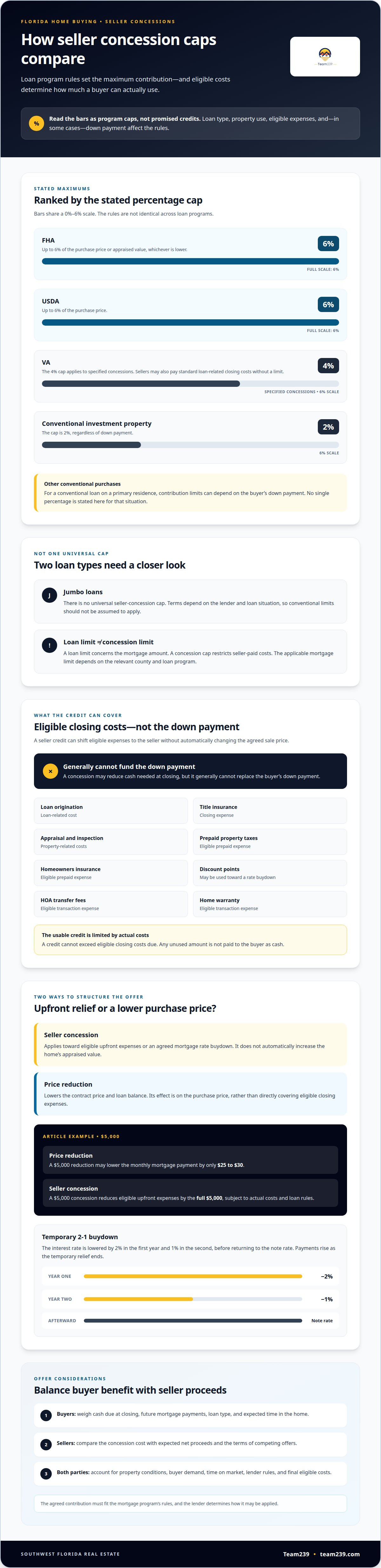
For a conventional loan on a primary residence, seller contribution limits can depend on factors such as the buyer’s down payment. Conventional financing for an investment property has a 2% cap, regardless of down payment. These are maximums, not guaranteed credits, and eligible costs still limit how much the buyer can use.
Other loan program limits differ. FHA allows up to 6% of the purchase price or appraised value, whichever is lower. VA’s 4% cap applies to specified concessions; sellers may also pay standard loan-related closing costs without a limit. USDA permits up to 6% of the purchase price. Jumbo loans don’t follow one universal seller-concession cap; their terms depend on the lender and loan situation, so conventional limits shouldn’t be assumed to apply.
Loan limits and concession limits are different. A loan limit concerns the mortgage amount, while a concession cap restricts seller-paid costs. For a Southwest Florida purchase, the relevant county and loan program determine the applicable mortgage limit. Concession rules depend on financing type, down payment, and property use.
How do concessions vary across Naples, Bonita Springs, Estero, Marco Island, and Fort Myers? The same loan-program caps apply, but negotiations depend on the property, competing offers, buyer demand, and time on the market. A seller may consider a credit differently for a resale home than for new construction, where the offer’s overall terms matter, too.
Who Pays Closing Costs in Florida?
The buyer and seller can each pay transaction costs, depending on the contract. A seller credit shifts eligible expenses to the seller without automatically changing the agreed sale price.
Seller Credits for Closing Costs
A seller credit is an agreed contribution toward the buyer’s eligible closing costs, recorded in the transaction paperwork. It can reduce the cash needed at closing, which may help first-time buyers managing a down payment alongside other upfront expenses. First-time buyer status doesn’t create a separate concession cap; the mortgage program’s limits still apply.
Credits may cover loan origination, title insurance, appraisal and inspection costs, prepaid property taxes or homeowners insurance, discount points, HOA transfer fees, and a home warranty. The credit can’t exceed the buyer’s actual costs due at closing, and any unused amount isn’t paid as cash.
Effects on Sale Price and Net Proceeds
A concession is a seller-paid expense, while a price reduction lowers the contract price. The distinction matters: a credit doesn’t automatically increase a home’s appraised value, which reflects the property and comparable sales. The lender also limits eligible credits under the buyer’s loan program.
Buyers should consider both the cash due at closing and the contract price; sellers should weigh the credit against their expected proceeds.
Risks for Buyers and Sellers
Concessions can reduce a buyer’s upfront burden, but they don’t pay the down payment. A credit that exceeds eligible closing costs can’t be converted into cash, so the agreed amount may not deliver its full intended benefit. The lender’s program rules and final transaction costs determine what the buyer can use.
For sellers, a credit reduces proceeds and may be less attractive than another offer with stronger net terms. Florida property taxes are prorated at closing based on the parties’ ownership periods; taxes are due November 1 and become delinquent the following April 1. For a new-build purchase, New Construction Buyer Representation can help align offer terms with closing priorities.
Seller-paid mortgage rate buydowns versus price reductions
A seller-paid mortgage rate buydown directs an agreed contribution toward lowering the buyer’s mortgage interest rate. A price reduction lowers the purchase price instead. The better fit depends on the buyer’s upfront cash needs, expected time in the home, loan type, and the seller’s negotiating priorities.
A temporary 2-1 buydown lowers the interest rate by 2% in the first year and 1% in the second, before returning to the note rate. The payment rises as the temporary relief ends, so buyers should assess later payments too.
A permanent buydown uses mortgage discount points to lower the rate for the loan term. Discount points can lower a buyer’s mortgage interest rate, though the effect depends on the loan and lender. The IRS says seller-paid discount points may be treated as if the buyer paid them, subject to applicable requirements. Lenders apply program rules when calculating the transaction’s eligible contribution.
A price reduction affects the purchase price and loan balance, while a buydown targets the interest rate. A $5,000 price reduction may lower the monthly mortgage payment by only $25 to $30; a $5,000 seller concession reduces eligible upfront expenses by the full amount. That difference can shape a buying strategy: immediate cash relief versus ongoing payment savings.
In a competitive housing market, a rate buydown can make a listing more attractive without reducing its stated price. It may also leave room to negotiate inspection-related repairs separately. Sellers should compare the concession’s cost with the offer’s net proceeds, while buyers weigh payment changes over time against cash needed at closing. The mortgage program and lender determine how the agreed contribution can be applied.
Seller concessions in a buyer’s market
In Florida’s buyer’s market, seller concessions can give purchasers more room to negotiate offer terms. Sellers may consider help with eligible expenses when homes face less competition or remain listed longer. A home on the market more than 30 days may have a seller more open to discussing a concession. Listing time is one signal, not a substitute for weighing the full offer.
Market conditions can shift over time. In July 2026, 68% of REALTORS® surveyed by the Orlando Regional REALTOR Association reported seeing more seller concessions than a year earlier. For buyers considering seller concessions in Florida’s buyer’s market, that trend offers context, while each transaction still depends on the property, competing offers, and the buyer’s loan program.
Look beyond the headline offer price. A higher offer can produce a lower net if its concession is larger: a $460,000 offer with $15,000 in concessions nets less than a $450,000 offer with $3,000 in concessions. Compare the full transaction, not just the stated price.
Concessions can also be non-monetary. A seller might agree to leave furniture or appliances that weren’t initially included. Put agreed items and credits in the contract so the closing terms reflect what both parties accepted. Conventional loan rules still govern eligible seller contributions, even when the parties agree on another structure.
Buyers can direct a concession toward a priority such as upfront expenses or an eligible interest-rate buydown. Sellers should weigh that support against net proceeds and other offer terms. A competitive proposal connects the buyer’s financing needs with the seller’s goals without confusing a credit with a lower purchase price.
Plan your Florida buyer-market offer with representation that helps connect concession terms to your purchase priorities.
Team239: New Construction Buyer Representation
Team239 helps buyers assess new construction purchases, including how seller concessions fit their financing and priorities. When comparing a builder’s offer with a resale home, consider the full value of each option: purchase terms, eligible closing-cost assistance, and any rate buydown offered. A lower monthly payment or reduced upfront expense can matter differently depending on your budget and plans.
With New Construction Buyer Representation, Team239 can help you evaluate the terms of a new-build purchase alongside your goals. For an existing home, Residential Resale Representation supports buyers considering seller credits in a resale transaction. The right representation depends on the type of property you’re buying and the decisions involved.
Contact Team239 to discuss your Florida home search and the purchase terms you’re weighing.
Set Your Priorities for the Next Move
Your strongest offer starts with deciding which outcome matters most to you. Is your priority protecting cash reserves, keeping future payments manageable, or preserving flexibility for move-in plans? A clear order of priorities helps you assess trade-offs without treating every seller incentive as equally valuable.
That preparation makes negotiations more focused. Instead of negotiating around a single number, you can explain what would make the overall transaction work for you and stay aligned as terms evolve. A thoughtful approach to seller concessions in a buyer’s market in Florida connects your offer to your broader homeownership goals.
For sellers, defining acceptable net terms and preferred timing can clarify which offers deserve a closer look. For buyers, understanding financing priorities can help you respond confidently when a property or opportunity fits. The next step is a conversation grounded in your plans, not a one-size-fits-all formula.
Talk with Team239 about your Florida real estate plans, and move forward with a strategy that fits your goals.
Frequently Asked Questions
How do I know if a concession request is reasonable?
A reasonable request fits the buyer’s eligible costs, loan-program cap, and the seller’s net-proceeds goals. Start by identifying the expense the credit would address, then compare the requested amount with the buyer’s estimated closing charges. For example, a request tied to documented costs is easier to assess than an unexplained round figure. The home’s time on the market and competing offers also shape negotiations.
What Are Buyer Concessions?
Buyer concessions are terms a buyer offers to make an offer more workable for the seller. They can include a faster closing, covering the seller’s closing costs, waiving certain contingencies, an as-is offer, or a rent-back period. These terms can strengthen an offer without raising its price, but each changes the transaction differently. Buyers should weigh the practical trade-offs before including one in an offer.
What are seller concessions in a Florida home sale?
Seller concessions are agreed costs or benefits the seller provides to support a buyer’s purchase. In a Florida transaction, they may appear as a closing credit or another negotiated item, such as leaving furniture or appliances that weren’t originally included. The written agreement should make the terms clear. A concession helps only if it fits the buyer’s financing rules and addresses a real purchase priority.
What seller concessions are common in a Florida buyer's market?
Common requests include help with eligible closing expenses, discount points or a temporary mortgage rate buydown, and credits related to repairs. A seller may also agree to leave appliances or furniture. The best fit depends on the property and offer: a buyer focused on immediate cash needs may value closing assistance, while another may prefer support aimed at the mortgage interest rate.
How much can Florida sellers typically contribute toward a buyer's closing costs?
Seller contributions are commonly limited to 3%-6% of the home’s sale price, but that range isn’t a single cap for every Florida purchase. The applicable maximum depends on the mortgage program, down payment, property use, and eligible costs. The credit also can’t exceed the buyer’s actual costs due at closing. Any unused amount isn’t paid to the buyer as cash.
What are the conventional, FHA, VA, and USDA seller concession limits in Florida?
For a conventional primary-home loan, the cap is 3% with less than 10% down, 6% with 10% to 25% down, and 9% with 25% or more down. FHA allows up to 6% of the purchase price or appraised value, whichever is lower. USDA allows up to 6% of the purchase price. VA’s 4% cap applies to specified concessions; standard loan-related closing costs have no limit.
Comments