
Capital Gains Tax and Closing Costs for Sellers in Florida: The 2026 Guide
- Team 239
- 36 minutes ago
- 13 min read
You might think selling your home in a state with zero income tax means keeping every cent of your profit, but the IRS still wants its cut of your Southwest Florida equity. When calculating the total closing costs for seller in Florida, many homeowners in high-value markets like Naples are shocked to find that federal capital gains can bite harder than the local fees. It's frustrating to watch your hard-earned appreciation get tangled in a web of IRS exclusions and cost basis calculations. You've spent years maintaining your property. You shouldn't have to lose a massive chunk of your net proceeds simply because you didn't know which kitchen remodel counted as a capital improvement.
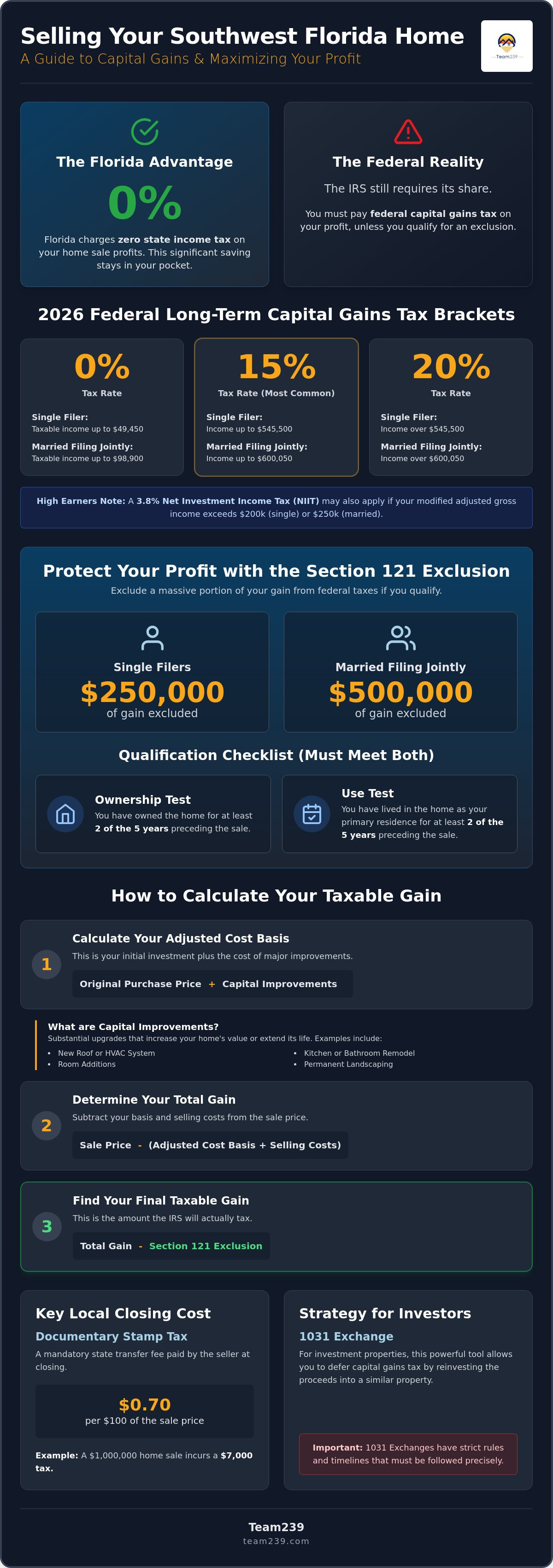
We're here to ensure you master the 2026 tax landscape to protect your wealth. This guide provides a clear roadmap to maximizing your profit while staying fully compliant. We'll confirm why you owe $0 in state income tax, explain how to qualify for the $250,000 or $500,000 federal primary residence exclusion, and show you how to legally reduce your taxable gain through a precise adjusted cost basis.
Table of Contents
Florida Capital Gains Tax: State Benefits vs. Federal Reality
Florida is famous for being a tax haven. When you sell a home here, the state doesn't take a single cent of your profit. This is why moving to Southwest Florida has become a strategic move for high-net-worth individuals from California or New York. In those states, you might lose another 13% to state taxes. In Florida, that money stays in your pocket. It's a massive advantage for your long-term wealth strategy. You can reinvest those proceeds or use them to fund your next luxury purchase without worrying about a state-level haircut.
The Sunshine State Tax Advantage
The lack of state income tax is more than just a perk; it's a fundamental financial pillar. For many sellers, this means their effective tax rate is significantly lower than it would be elsewhere in the country. This transparency allows for more aggressive financial planning. You aren't guessing what the state will demand at the end of the year. Instead, you can focus entirely on the federal side of the equation. This clarity is a major reason why the Southwest Florida market remains so resilient and attractive to sophisticated investors who value capital preservation.
Federal Capital Gains Brackets for 2026
Don't confuse state benefits with federal immunity. The IRS still expects its share. To understand the full scope of Capital Gains Tax in the United States, you must first distinguish between short-term and long-term holds. If you sell a property you've owned for less than a year, your profit is taxed as ordinary income at your highest marginal rate. For most Southwest Florida sellers, the goal is long-term status, which applies after one year and one day of ownership. This grants access to much lower rates.
For 2026, the federal government has set specific thresholds that dictate your liability. If your taxable income is below $49,450 as a single filer or $98,900 for married couples, your rate is 0%. Most sellers fall into the 15% bracket, which covers income up to $545,500 for individuals or $600,050 for married couples. If you're selling a high-value luxury estate in Naples and your income exceeds those limits, you'll hit the 20% rate. High earners must also account for the 3.8% Net Investment Income Tax (NIIT) if their modified adjusted gross income exceeds $200,000 for singles or $250,000 for couples.
While state income tax is non-existent, you can't ignore local transfer fees. These are a primary component of the total closing costs for seller in Florida. The Documentary Stamp Tax is the most significant local levy. In most Florida counties, you'll pay $0.70 for every $100 of the sale price. On a $1 million sale, that’s a $7,000 expense due at the closing table. It’s a mandatory cost that funds state infrastructure. It’s one of the few places where Florida’s tax-friendly reputation meets local reality, and it must be factored into your net proceeds calculation from the start. Understanding these closing costs for seller in Florida ensures you aren't surprised by the final numbers on your settlement statement.
The Section 121 Exclusion: Avoiding Tax on Your Primary Residence
The Section 121 exclusion is your most powerful tool for protecting equity. It’s the primary reason many residents keep their entire profit. If you’ve owned and used your home as a primary residence for at least two of the five years before the sale, you can exclude up to $250,000 of gain as a single filer. Married couples filing jointly see that limit jump to $500,000. It’s a massive shield, but it requires precision to execute correctly. These tax savings are separate from the standard closing costs for seller in Florida, but they impact your bottom line just as significantly.
Qualifying for the Full Exclusion
The IRS is strict about the use test. You must physically live in the property for at least 730 days within the five year window. These days don't have to be consecutive. You could live there for a year, rent it out for two, and move back for another year. As long as you hit the 24 month mark, you qualify. For more complex situations involving military service or health related relocations, IRS Publication 523 outlines specific safe harbors that may allow for a partial exclusion.
Don't assume your intent to stay is enough. The IRS looks for objective evidence like voter registration, tax returns, and utility records. If you're selling high value luxury homes for sale in Naples FL, the stakes are too high to rely on guesswork. Ensuring your residency is documented is as vital as managing the standard closing costs for seller in Florida.
What if Your Gain Exceeds the $500,000 Limit?
In Southwest Florida’s elite neighborhoods like Port Royal or Old Naples, home appreciation often outpaces the federal exclusion. This creates what we call the Luxury Gap. If you bought a waterfront estate for $3 million and sell it for $5 million in 2026, you’re looking at a $2 million gain. Even with the $500,000 exclusion, you still have $1.5 million in taxable profit. This is where your strategy must shift from simple exclusion to basis maximization.
Every dollar you spent on a new roof, impact windows, or a pool remodel can be added to your cost basis. This reduces the taxable portion of your gain. In high stakes transactions, meticulous record keeping isn't just a chore; it's a financial necessity. If you're unsure how your specific property fits into this landscape, it’s worth connecting with a strategic real estate partner who understands the nuances of the Naples market. Protecting your net proceeds requires looking beyond the basic closing costs for seller in Florida and focusing on the long term tax implications of high value sales.
Calculating Adjusted Cost Basis to Lower Your Tax Bill
Your cost basis is the financial foundation of your tax strategy. It starts with the original purchase price, but it shouldn't end there. For luxury sellers in Southwest Florida, the adjusted cost basis is often much higher than the initial investment. By accurately tracking every dollar poured into the property, you can significantly reduce the "gain" the IRS sees. This isn't just about record-keeping; it's about protecting your net proceeds from unnecessary taxation. Every valid adjustment brings you closer to keeping more of your equity at the closing table.
The IRS draws a sharp line between home repairs and capital improvements. This distinction is where many sellers lose money. A repair, like fixing a leaky faucet or replacing a broken window pane, is considered routine maintenance and doesn't add to your basis. An improvement, however, must add value to the home, prolong its useful life, or adapt it to new uses. If you're managing the closing costs for seller in Florida, identifying these improvements is the most effective way to lower your taxable profit legally.
Common SWFL Improvements That Increase Basis
In our local market, certain upgrades are standard for maintaining high property values. Adding a screened lanai, a custom infinity pool, or a fully equipped outdoor kitchen are all classic examples of basis-boosting improvements in Naples FL real estate. Given our climate, hurricane-impact windows and doors are also major capital expenses that the IRS typically recognizes. Other qualifying items include a full roof replacement, new HVAC systems, and high-end kitchen or bathroom renovations. These aren't just lifestyle choices; they're strategic investments that lower your eventual tax liability.
Deductible Selling Costs
Beyond physical improvements, you can also deduct the expenses required to actually sell the home. These costs are subtracted from your final sale price, which further reduces your taxable gain. When calculating the total closing costs for seller in Florida, ensure you include the following:
Real estate commissions paid to listing and buyer agents.
Professional photography, drone footage, and 3D virtual tours.
Legal fees and title insurance premiums.
State documentary stamp taxes (transfer taxes).
Home staging costs, provided they were essential for the sale.
If you're selling an investment property rather than a primary residence, these basis adjustments are even more critical. While primary homeowners rely on the Section 121 exclusion, investors often utilize a 1031 exchange to defer taxes entirely by rolling their equity into a new property. Regardless of your situation, the goal remains the same: use every legal deduction to maximize what you take home after the deal is done.
Advanced Strategies: 1031 Exchanges and Investment Property
When you shift from selling a primary residence to an investment property, the tax landscape changes instantly. You no longer have the safety net of the Section 121 exclusion. Without a proactive strategy, a significant portion of your Southwest Florida equity could vanish into federal coffers. While managing the closing costs for seller in Florida for a primary home is relatively straightforward, investment sales require a higher level of tactical precision. This is where advanced tools like the 1031 Exchange become essential for capital preservation.
Deferring Gain with a 1031 Exchange
The 1031 Exchange is a powerful mechanism that allows you to defer capital gains taxes by "swapping" one investment property for another. To qualify, the properties must be "like-kind," a term the IRS defines broadly to include almost any real estate held for business or investment purposes. This strategy is a favorite for investors eyeing new construction homes Bonita Springs, as it allows them to move equity from older, high-maintenance rentals into modern, high-performance assets without an immediate tax hit.
Precision is everything in an exchange. You have exactly 45 days from the date of your sale to identify up to three potential replacement properties in writing. Following that, you must close on the new property within 180 days. These deadlines are absolute. There are no extensions for weekends or holidays. You must also use a Qualified Intermediary (QI) to handle the funds. If you take constructive receipt of the sale proceeds for even a second, the IRS will disqualify the exchange and demand full payment of taxes. Missing a deadline isn't just a mistake; it's a massive financial hit.
Taxation of Rental and Second Homes
There's a common misconception that second homes and rental properties are treated the same way as your main house. They aren't. A second home used primarily for personal vacations doesn't qualify for the $250,000 or $500,000 exclusion. Furthermore, pure rental properties are subject to depreciation recapture. The IRS taxes the cumulative depreciation you've claimed over the years at a flat 25% rate upon sale. This hidden tax is often the most overlooked part of the total closing costs for seller in Florida for investors.
Some savvy owners choose to convert a second home into a primary residence by moving in for at least two years before selling. This can help capture a portion of the exclusion, though the IRS now requires a pro-rated calculation based on the time the home was used as a rental versus a residence. If you're ready to transition your portfolio or need to protect your gains, schedule a strategic consultation with our luxury listing experts to evaluate your options.
Maximizing Net Proceeds in the Southwest Florida Market
Success in the Naples market requires more than just a "For Sale" sign. It demands a holistic view where tax strategy meets market timing. To truly understand the closing costs for seller in Florida, you must look at the macro trends of the region. The Southwest Florida lifestyle continues to drive high demand, but maximizing your net proceeds means knowing exactly when the buyer pool is deepest and how your tax liability shifts with the calendar. We don't just list properties; we engineer a transition that protects your equity at every stage.
Strategic Pricing and Timing
The seasonal cycles of Naples and Marco Island are legendary. Listing during the peak winter months can drive higher offers, but your federal tax clock matters just as much. Selling at day 364 instead of day 366 could be the difference between a 37% short-term rate and a 15% long-term rate. Our luxury property listing services go beyond aesthetics. We align your market entry with your personal tax goals to ensure the highest possible after-tax profit. We use data-driven insights to price properties where they attract motivated buyers without leaving money on the table. This strategic approach is essential in a market where buyers have become increasingly price-sensitive in 2026.
Your Next Steps to a Successful Sale
Start your preparation by gathering every piece of paper related to your property. Locate your original purchase HUD-1 or closing statement. Dig up receipts for that 2024 roof replacement or the 2025 kitchen upgrade. These documents are the only way to prove your adjusted basis to the IRS. Without them, you're essentially volunteering to pay more tax than you owe. This documentation process is a vital part of managing the closing costs for seller in Florida.
Once your documents are in order, request a professional market valuation. This provides a realistic baseline for your potential gain. At Team239, we help you translate those improvements into a compelling narrative for buyers while ensuring your records are ready for your tax professional. We always recommend consulting with a qualified CPA to finalize your tax plan. A real estate team provides the market data; a CPA provides the final tax filing precision. This partnership ensures you aren't guessing about your final check at the closing table.
If you're ready to move forward, check out our comprehensive guide on how to sell my home in naples florida. We provide the strategic framework you need to navigate federal tax implications and walk away with the highest possible proceeds from your Southwest Florida investment.
Secure Your Southwest Florida Equity for the Long Term
Navigating the tax implications of a property sale doesn't have to be a source of stress. By mastering the Section 121 exclusion and meticulously tracking your capital improvements, you can significantly reduce your federal liability. While Florida's lack of state income tax provides a massive head start, your final net proceeds depend on a precise calculation of the closing costs for seller in Florida and a strategic approach to federal capital gains. Whether you're selling a primary residence or utilizing a 1031 exchange for an investment property, the right preparation ensures you keep more of what you've earned.
Success in the Naples luxury market requires a partner who understands both the numbers and the digital landscape. Led by Kristin and Jonathan Van Heukelom, Team239 brings over 10 years of local expertise to every transaction. We specialize in high-value luxury and new construction sales, utilizing advanced digital marketing and deep market analysis to position your home for maximum return. Ready to see what your property is truly worth in today's market? Get a Free Naples Home Valuation and Profit Estimate from Team239. You've worked hard to build your equity; we're here to help you protect it.
Frequently Asked Questions
Does Florida have a state capital gains tax on home sales?
No, Florida does not impose a state-level capital gains tax on real estate transactions. This is one of the primary financial advantages of selling property in the Sunshine State. While you still owe federal taxes to the IRS, you won't see a separate deduction for state income tax on your settlement statement. This transparency simplifies the calculation of closing costs for seller in Florida and helps maximize your final net proceeds.
How long do I have to live in my Florida home to avoid capital gains tax?
You must own and use the property as your primary residence for at least two out of the five years preceding the sale. These 24 months don't need to be consecutive, which offers flexibility for seasonal residents or those who have relocated temporarily. Meeting this "2-out-of-5" rule allows you to qualify for the Section 121 exclusion, shielding up to $250,000 for individuals or $500,000 for married couples from federal capital gains tax.
Can I avoid capital gains tax by buying another home in Florida?
Buying a replacement home does not automatically defer or eliminate capital gains tax on a primary residence sale. The old "rollover" rule was replaced years ago by the Section 121 exclusion. However, if you're selling an investment property, you can use a 1031 exchange to defer taxes by reinvesting the proceeds into a "like-kind" property. For primary homes, your main protection is the residency exclusion rather than the purchase of a new house.
What is the documentary stamp tax in Florida and who pays it?
The documentary stamp tax is an excise tax on the transfer of real estate, and it is typically paid by the seller in Florida. In most counties, the rate is $0.70 per $100 of the sale price. For example, a $1 million sale results in a $7,000 tax. This is a mandatory part of the closing costs for seller in Florida and is collected at the time the deed is recorded to fund state infrastructure.
How do I calculate the capital gains on my Florida property?
To calculate your capital gain, subtract your adjusted cost basis and selling expenses from the final sale price. Your adjusted basis includes the original purchase price plus major capital improvements like a new roof or impact windows. Selling expenses include commissions, title insurance, and transfer taxes. The resulting figure is your realized gain, which is then reduced by any applicable Section 121 exclusions to determine your total taxable profit.
Are home improvements tax deductible when I sell my house?
Home improvements aren't directly deductible as expenses, but they increase your property's cost basis, which legally lowers your taxable gain. It's vital to distinguish between a repair, which is routine maintenance, and an improvement, which adds permanent value. Replacing an entire HVAC system or remodeling a kitchen counts as an improvement. Keep all receipts for these projects to ensure you can prove a higher basis and reduce your federal tax bill during the sale.
What happens if I sell my Florida home at a loss?
If you sell your primary residence at a loss, you don't owe capital gains tax, but you generally cannot deduct the loss from your income. The IRS considers a loss on a personal residence a nondeductible personal expense. However, if the property was a dedicated investment or rental, you might be able to claim a capital loss to offset other investment gains. Always consult a tax professional to see how a loss impacts your specific portfolio.
Does the capital gains tax exclusion apply to foreign nationals selling Florida property?
Foreign nationals can qualify for the capital gains exclusion if they meet the same residency requirements as U.S. citizens, but they are also subject to FIRPTA withholding. The Foreign Investment in Real Property Tax Act requires the buyer to withhold a percentage of the sale price, typically 15%, to ensure the IRS receives any taxes owed. While the exclusion might eventually reduce your tax to zero, the initial withholding remains a mandatory part of the transaction process.