
How Are Florida Property Taxes Calculated? A 2026 Guide

A seller’s property tax bill may not reflect what you’ll pay as a buyer. The seller’s exemptions and assessment history can differ from yours. If you’re searching “how are Florida property taxes calculated,” start with three parcel-specific inputs: taxable value, applicable exemptions, and the combined millage rate.
Market value, assessed value, and taxable value are not interchangeable, and there’s no single statewide rate that predicts every bill. This guide explains how those figures fit together, which local records to review, and why a prior owner’s tax bill isn’t a reliable forecast. You’ll also find a practical way to compare property tax estimates with other ownership costs when considering a home in Southwest Florida.
Table of Contents
How Florida property taxes are calculated: the basic formula
From market value to taxable value: Florida assessments and exemptions
Why Florida property tax bills differ: millage, local authorities, and assessments
How to estimate and review a Florida property tax bill before buying
Plan for Florida property taxes as part of a Southwest Florida home purchase
How Florida property taxes are calculated: the basic formula
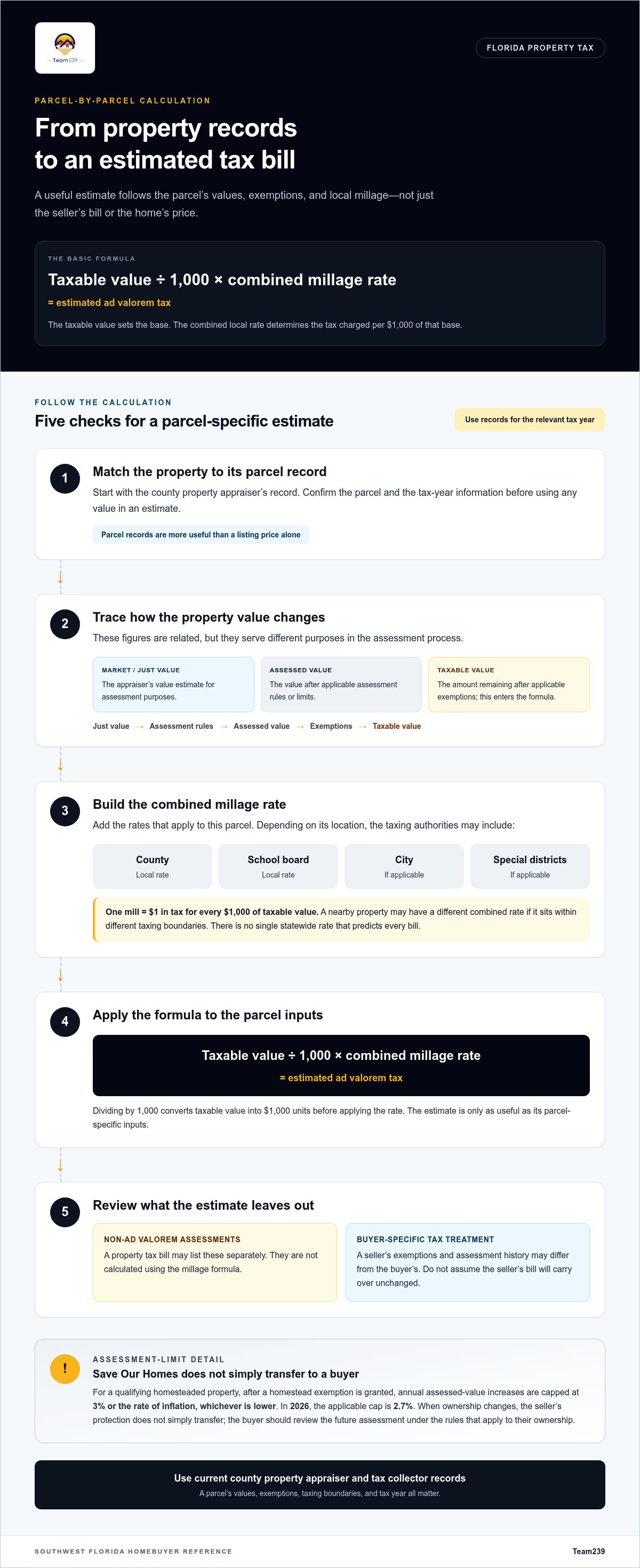
A Florida property’s ad valorem tax is calculated from its taxable value and the combined millage rates that apply to its parcel. The taxable value sets the base, while local rates determine the tax charged per $1,000 of that base.
Taxable value ÷ 1,000 × combined millage rate = estimated ad valorem tax
Dividing by 1,000 converts the taxable value into $1,000 units, and the millage rate states the tax for each unit. This formula explains how are Florida property taxes calculated, but an estimate is only as useful as its inputs. A final bill uses the applicable figures for a specific parcel and tax year. A property tax bill may also list non-ad valorem assessments, which aren’t calculated using this millage formula.
What does one mill mean in a Florida property tax calculation?
One mill means $1 in tax for every $1,000 of taxable value. Because millage rates are expressed in mills, the formula divides taxable value by 1,000 before applying the rate. Adding the applicable rates together shows how the combined rate affects a parcel’s tax.
Each taxing authority sets a millage rate to fund its services. Depending on the property’s location, applicable authorities may include the county, school board, city, or special districts. Their rates are combined to produce the parcel’s total millage rate. A nearby property may have a different combination if it falls within different taxing boundaries.
Which property values go into the formula?
Florida property records can show several values, and they don’t all serve the same purpose:
Market or just value: The property appraiser’s estimate of the property’s value for assessment purposes. It is not necessarily the same as a buyer’s offer or the seller’s asking price.
Assessed value: The value used after applicable assessment rules or limits are applied. It may differ from just value.
Taxable value: The amount remaining after applicable exemptions are applied to assessed value. This is the figure used in the basic millage formula.
Exemptions and assessment limits can affect the path from assessed value to taxable value. Their impact depends on the property, its tax status, and the rules that apply. Don’t assume that a sale price automatically becomes the new owner’s taxable value or that a previous owner’s tax calculation will carry over unchanged.
For a practical estimate, match the parcel to its current property appraiser records, identify the values shown for the relevant tax year, and account for the exemptions and assessment rules that apply to the property. Then compare the applicable millage figures with official local records. These parcel-specific inputs, not a statewide rate or a rough calculation based on market price, determine how useful the estimate will be.
From market value to taxable value: Florida assessments and exemptions
A home’s asking price is only one part of its property tax picture. The county property appraiser determines the property’s just value for assessment purposes, then applicable assessment rules and exemptions help determine its assessed and taxable values. A listing price, offer, or previous tax bill therefore won’t tell a buyer exactly what they’ll owe.
Market or just value is the appraiser’s value estimate, assessed value reflects applicable assessment limits, and taxable value is the amount left after eligible exemptions are applied. These values are related, but they are not interchangeable. When exploring how are Florida property taxes calculated, the county property appraiser’s parcel record is a more useful starting point than the home’s advertised price.
Why a home's sale price is not its whole tax calculation
Consider a hypothetical purchase. A buyer finds a home listed at one price, while the parcel record shows a just value and an assessed value shaped by the property’s existing assessment history. Those figures may not match the eventual tax treatment for the buyer. The sale is relevant, but it doesn’t mean the asking price or closing price automatically becomes the buyer’s taxable value or tax bill.
Instead, follow the values through the assessment process: review the appraiser’s just value, determine what assessment rules apply, and account for any exemptions the new owner may qualify for. Each step can affect the figure used to calculate property taxes. For system-level background, the Florida TaxWatch Property Tax Resource Center offers research on Florida’s property tax structure and millage rates.
Before relying on a seller’s current bill or a market-price estimate, locate the parcel’s current records through the county property appraiser. Compare the relevant values and tax-year information, keeping in mind that a prior owner’s assessment history may not carry over unchanged. This distinction matters across Southwest Florida, where two homes with similar asking prices can have different parcel records and tax circumstances.
How homestead exemptions and assessment limits may affect taxable value
Eligible exemptions can reduce the value subject to taxation, while assessment limits can restrict how assessed value changes under specific conditions. Eligibility and treatment depend on the property and owner, so don’t assume a home’s current exemption will appear automatically in a new owner’s calculation.
For a qualifying homesteaded property, Florida’s Save Our Homes limit caps annual increases in assessed value at 3% or the rate of inflation, whichever is lower. The cap begins after a homestead exemption is granted. In 2026, the applicable cap is 2.7%. When ownership changes, the seller’s Save Our Homes protection doesn’t simply transfer to the buyer. The buyer should review the parcel’s future assessment based on the rules that apply to their ownership.
When evaluating a purchase, separate the seller’s existing tax treatment from an estimate for your own situation. Review the parcel record, consider which exemptions you may qualify for, and use current official guidance for the tax year you’re evaluating. Team239’s Southwest Florida home-buying guidance can help put property tax questions in the wider context of comparing homes and ownership costs.
Why Florida property tax bills differ: millage, local authorities, and assessments
A property’s tax bill reflects more than one local rate. Its location determines which taxing authorities can levy ad valorem taxes on it, and each authority’s millage contributes to the combined rate. That’s why homes with similar values can have different tax calculations, even within the same county. To understand how are Florida property taxes calculated, review the specific parcel and the authorities that apply to it rather than treating a countywide figure as a universal rate.
Which local taxing authorities can contribute to the bill?
Several authorities may tax the same parcel, but not every property is within the same city or special district. Each authority sets its own millage through its local budget process. The applicable rates are combined for the parcel, so a change in location can change which rates enter the calculation.
Collier and Lee counties illustrate why location matters, but they aren’t interchangeable rate schedules. A home in unincorporated Collier County may have a different combination of taxing authorities from a home within the City of Naples. Likewise, parcels in Lee County can fall within different municipalities or special district boundaries. County-level averages or examples offer context, but they don’t establish the rates that apply to a particular address. Check the parcel’s official records and tax bill for its taxing districts and current rates.
Property taxes, special assessments, and community fees are not identical
Ad valorem property taxes are based on taxable value and millage. A special or non-ad valorem assessment, where applicable, is a separate charge and isn’t calculated with that same formula. Bills may show such items separately, but the exact charges and how they’re billed depend on the parcel.
Community costs can also come from outside the property tax calculation. Homeowners’ association fees are not property taxes and shouldn’t be added to the millage-based tax figure as if they were another tax rate. Community Development District charges or other parcel-specific costs may be listed on a tax bill or billed separately, depending on the property and arrangement.
For a sound comparison, review each parcel’s records and identify the line items instead of relying on a single “tax rate” or total. Keep property taxes, separately identified assessments, and HOA fees distinct in your ownership-cost estimate. This makes it easier to see how two Southwest Florida homes may differ beyond their purchase prices.
How to estimate and review a Florida property tax bill before buying
A useful estimate starts with the parcel, not a county average or a seller’s bill. County property appraiser records help you review a property’s values, exemptions, and taxing districts. County tax collector records show tax bills and payment information. Together, these official sources give you a stronger starting point than a general calculator, although neither guarantees what a future bill will be if circumstances change.
A prior owner’s tax bill records that owner’s circumstances, not a buyer-specific forecast. Their exemptions and assessment history may differ from yours. Use the steps below to build a parcel-specific estimate, then check the assumptions behind any online calculator or listing estimate.
A parcel-specific checklist for researching an estimate
Identify the parcel. Search the property address on the relevant county property appraiser’s website and confirm that the parcel record matches the home you’re considering.
Review the recorded values. Note the just value, assessed value, and taxable value for the relevant tax year. Check the exemption information and assessment details shown in the record.
Check the taxing districts. Identify which county, school district, municipality, and special district rates apply to that parcel. A nearby address may fall under different taxing authorities.
Compare estimate assumptions. If you use a calculator, note the value, tax year, millage rate, and exemptions it assumes. Compare those inputs with current county records rather than treating its output as an official bill.
Review tax collector records. Look up the parcel’s available tax bill information with the county tax collector. Distinguish ad valorem taxes from any separately listed assessments, and remember that the seller’s bill may reflect a different tax situation.
What to check on a TRIM notice or tax bill
A Truth in Millage notice, usually called a TRIM notice, is a review document, not the final tax bill. It presents proposed property values and estimated taxes based on proposed rates from taxing authorities. In Florida, 2026 TRIM notices are mailed in mid-August. Read the parcel details and proposed rates carefully, then compare them with the county property appraiser’s records.
If you believe the proposed value is incorrect, review the instructions and dates printed on the notice and consult the relevant county office promptly. For the 2026 process, property owners have 25 days from the notice’s mailing date to file an appeal with the Value Adjustment Board. Confirm the applicable procedure and deadline with the county, since missing a deadline can affect review options. Final tax bills are mailed on or before November 1, so don’t confuse the proposal with the final amount due.
For a home purchase, keep the parcel record, calculator inputs, and any TRIM or tax bill information together. That makes it easier to compare a tax estimate with other ownership costs. If you’re evaluating a Southwest Florida home, connect with Team239 to discuss your home search alongside the property-specific details you’ve gathered.
Plan for Florida property taxes as part of a Southwest Florida home purchase
A property tax estimate is one part of the ownership-cost picture, not a complete measure of what a home will cost to own. As you compare homes in Naples, Bonita Springs, Estero, Marco Island, or Fort Myers, use each property’s parcel-specific records and keep the estimate alongside other costs, such as insurance, HOA fees, and any separately billed community charges. This gives you a more useful comparison than asking price alone.
Consistency matters. Compare estimates for the same tax year, record which figures come from current official records, and label anything based on a calculator or planning assumption. That way, you can see what’s known and where a figure may change without mistaking an estimate for a future bill.
Questions to resolve before comparing homes
Are the records for the exact parcel? Nearby properties may have different taxing districts, assessments, exemptions, or separately billed charges. Compare the current records for each address rather than assuming similar homes have similar tax bills.
Are you comparing like with like? Keep the property tax estimate separate from insurance, HOA fees, and other ownership costs. These expenses are determined differently and should not be combined into a single tax figure.
Which numbers are official, and which are estimates? Note the tax year and source beside each figure. County property appraiser and tax collector records provide parcel-specific information; calculator outputs and purchase-planning projections depend on their stated assumptions.
Does the estimate reflect your circumstances? A prior owner’s exemptions or assessment history may not match a buyer’s situation. Treat the seller’s bill as historical context, not as a forecast of your own taxes.
This side-by-side approach can bring hidden differences into focus. One home may have a different combination of taxing authorities or parcel charges, while another may carry different non-tax ownership expenses. The goal is not to force every cost into one number, but to make each home’s assumptions visible before you compare your options.
Where Team239 fits into your home search
Kristin and Jonathan Van Heukelom, REALTORS®, guide buyers through residential real estate decisions across Southwest Florida. Team239 can help you consider property details in the context of your home search, whether you’re comparing homes in Naples, Bonita Springs, Estero, Marco Island, or Fort Myers. Keep tax calculations and questions about exemptions or eligibility distinct from your real estate search, and use the relevant county records for property-specific information.
For purchase context, the Naples Florida home-buying guide can help frame your search, while the Southwest Florida relocation guide offers regional planning context. Explore these resources as you build a home comparison that accounts for both the property and the broader move.
Turn your property research into a confident next step
Before settling on a home, turn your research into a side-by-side comparison you can revisit as your plans take shape. Keep source notes with each estimate, and update them when you focus on a particular property. Understanding the question “how are Florida property taxes calculated” can help you ask more focused questions, but your purchase decision should reflect the full ownership picture and your priorities.
Ready to explore homes in Southwest Florida? Explore Southwest Florida homes with Team 239, then call or text Team239 at 239-571-7082 or 239-399-1175 to talk about your home search.
All content provided on the Naples Florida Real Estate Channel and other associated social media platforms is for informational and entertainment purposes only. The owner of Naples Florida Real Estate makes no representations as to the accuracy or completeness of any information on this site or found by following any link on this site. Information provided is subject to change; consult Kristin and Jonathan directly or another licensed real estate agent to receive the best expertise for your specific situation. The owner of Naples Florida Real Estate will not be liable for any errors or omissions in this information nor for the availability of this information. The owner will not be liable for any losses, injuries, or damages from the display or use of this information. This article is not legal, tax, or financial advice.
With a clear comparison and the right local context, you can move forward with greater confidence.
Frequently Asked Questions
How are Florida property taxes calculated?
Florida property taxes are generally calculated by dividing a property’s taxable value by 1,000 and multiplying by the combined millage rate that applies to its parcel. That’s the basic answer to “how are Florida property taxes calculated,” but the result depends on current parcel details, including applicable exemptions and taxing districts. For a useful estimate, compare the figures for the correct tax year and property with official county records rather than relying only on a listing or calculator.
Is there one property tax rate for all of Florida?
No, Florida doesn’t have one property tax rate that applies to every parcel. A home’s location determines which local taxing authorities may be included, and a parcel near a municipal boundary could have a different set of applicable rates from a nearby home. For example, don’t assume two homes in Naples or elsewhere in Collier County have identical tax calculations just because they’re close together. Check each parcel’s records separately.
What is the difference between assessed value and taxable value in Florida?
Assessed value reflects applicable assessment rules, while taxable value is the amount used in the tax calculation after eligible exemptions are applied. The difference can affect a buyer comparing properties with similar asking prices. Check the property appraiser’s record for each home and note whether the displayed values refer to the same tax year. For questions about a specific exemption or assessment rule, use current guidance from the relevant county office.
Can a new homeowner pay different property taxes than the previous owner?
Yes. A buyer may have different exemptions or assessment treatment from the seller, so the seller’s last bill isn’t a dependable prediction of the buyer’s future taxes. For instance, a buyer comparing two listings can use each seller’s bill as background, then build a separate estimate from the current parcel record and the buyer’s own assumptions. County property appraiser and tax collector records can help clarify which information is specific to the property.
What is a TRIM notice in Florida?
A TRIM notice, short for Truth in Millage, gives a property owner proposed value and tax-rate information to review. It isn’t the final bill. If you’re reviewing one, compare the property details and taxing authority information with the county’s parcel records, and read the notice’s instructions carefully. Review procedures and deadlines can change, so confirm current requirements with the relevant county property appraiser or other appropriate county office.
How can I estimate property taxes on a home in Naples or elsewhere in Southwest Florida?
Start with the exact parcel record from the county property appraiser, then compare its tax-year values and listed taxing districts with current local information. A calculator can help organize a rough planning figure, but check which assumptions it uses before comparing results across Naples, Bonita Springs, Estero, Marco Island, or Fort Myers. Keep the estimate separate from insurance, HOA fees, and other ownership costs, and treat it as planning information, not tax, legal, or financial advice.
Comments