
Best Dog-Friendly Communities in Fort Myers: A 2026 Homebuyer’s Guide

The community with the biggest dog park may not be the best fit for your dog. A convenient walk from your front door, nearby green space, and rules that suit your household can matter just as much. If you’re comparing the best dog friendly communities in Fort Myers, look beyond the pet-friendly label and consider what your dog’s everyday routine would actually be like.
“Pet-friendly” can mean different things in different neighborhoods, buildings, and associations. Consider whether your dog can use the shared spaces, whether nearby walking routes work for your routine, and whether the property’s rules allow your pet. Those details can shape daily life as much as the home itself.
This 2026 guide compares Fort Myers areas by everyday dog-friendly features, housing options, and community considerations. Use it to build a shortlist around your dog’s routine, then review the relevant association documents and property-specific restrictions before choosing a home. The goal is to weigh lifestyle fit alongside the property, so you can make an informed decision for your whole household.
Table of Contents
What makes a Fort Myers community genuinely dog-friendly?
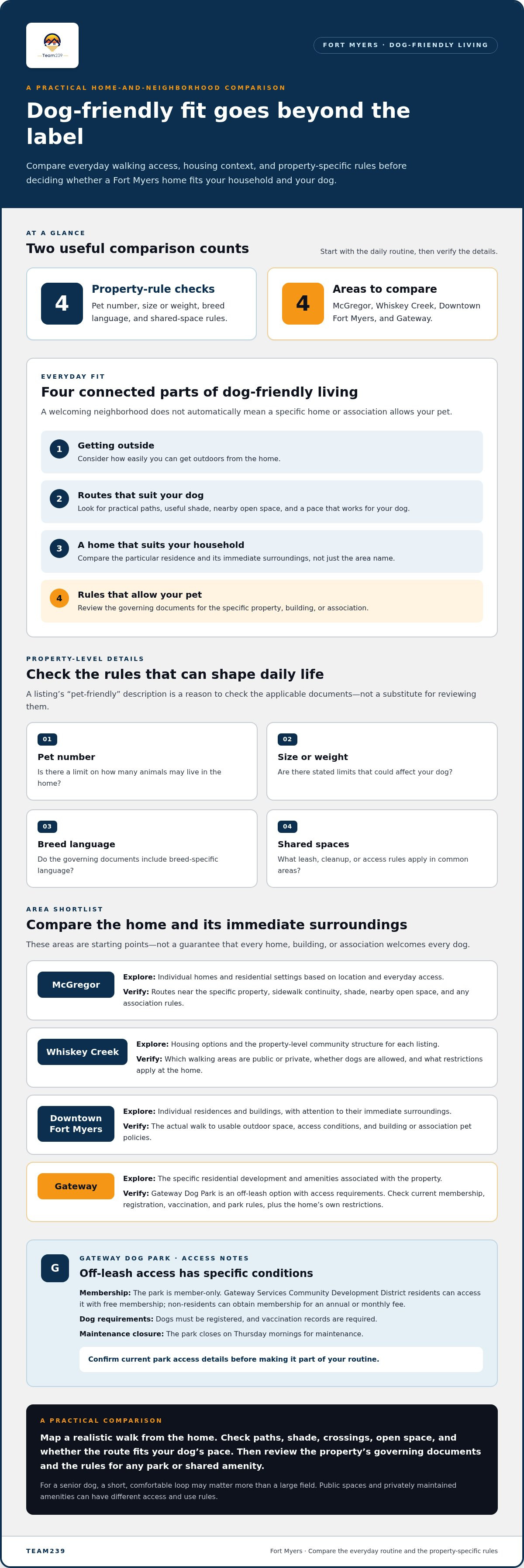
A dog-friendly label is only a starting point. The practical fit depends on four connected factors: how easily you can get outside, whether nearby routes support your dog’s routine, whether the home suits your household, and whether the applicable rules allow your pet. The Fort Myers, Florida overview provides general geographic and historical context, but your day-to-day experience will depend on the specific block, property, and community.
A dog-friendly area makes everyday outings practical; a pet-approved property allows your dog under its specific rules. The distinction matters. A neighborhood may have appealing walking routes while a particular condominium, association, or building has restrictions that affect your plans. The best dog friendly communities in Fort Myers are a matter of household fit, not amenities alone.
Dog-friendly living means more than nearby green space
Picture the walk you’d take on an ordinary day. Are there continuous sidewalks, useful shade, and a route that works at your dog’s pace? Is open space close enough to become part of your routine, rather than a destination that requires a drive? For a senior dog, a short, comfortable loop may matter more than access to a large field.
Distinguish public parks from privately maintained amenities. A community may advertise a lawn, trail, or dog area that residents can use under specific access and use rules. Public spaces have rules, too. Before making a park part of your routine, check whether dogs are allowed, whether leashes are required, and which areas are accessible. Conditions vary by location.
Why Fort Myers buyers should check property-level rules
A neighborhood’s welcoming feel doesn’t establish what’s allowed at a particular home. Rules can differ between a detached house, a condominium building, and individual associations. Governing documents may also include conditions that aren’t obvious during a showing. Treat a listing’s pet-friendly description as a reason to review the applicable documents, not as a substitute for them.
As you compare homes, look for terms that directly affect daily life:
Pet number: Is there a limit on how many animals may live in the home?
Size or weight: Are there stated limits that could affect your dog?
Breed: Do the documents include breed-specific language?
Shared spaces: What leash, cleanup, or access rules apply in common areas?
Don’t assume the same restrictions apply throughout Fort Myers. Identify which documents govern each property and read the relevant clauses together. That gives you a more reliable comparison than relying on a neighborhood’s reputation or an amenity list, and helps you focus on homes that suit both your dog’s routine and your household’s needs.
Fort Myers dog-friendly communities to compare by lifestyle
Use these areas as a starting shortlist, not as a guarantee that every home or association welcomes every dog. Neighborhood character, amenities within a particular development, and a property’s governing rules are separate parts of the decision. The best dog friendly communities in Fort Myers depend on which combination works for your household.
Compare established neighborhoods and walkable areas
McGregor, Whiskey Creek, and Downtown Fort Myers can all belong on a buyer’s comparison list, but an area name alone doesn’t confirm walkability or pet access. Map a realistic route from each home and visit at the time of day you’d usually walk. Look for safe crossings, continuous paths, shade, and a practical turnaround point. Separately confirm whether nearby parks allow dogs and what rules apply.
Compare planned communities and residential settings
In Gateway and other planned settings, distinguish resident amenities from public parks outside the development. Gateway Dog Park is a member-only, off-leash park. Gateway Services Community Development District residents can access it with free membership; non-residents can obtain membership for an annual or monthly fee. Dogs must be registered, vaccination records are required, and the park closes on Thursday mornings for maintenance. Verify current access details before making it part of your routine.
For any property, review the applicable association documents and property-specific restrictions. An advertised dog amenity doesn’t necessarily mean every resident can use it, and park access doesn’t determine a home’s pet rules. No single area suits every dog-owning household: the best fit depends on the home, your dog’s routine, and the rules governing both.
Buyer representation can help bring the home, its community context, and documented rules into one comparison. Team239’s Fort Myers buyer guidance supports that process alongside relocation planning for households new to the area.
Dog parks, walking routes, and HOA rules: what matters most?
A dog park can be a useful bonus, but it won’t tell you whether a home supports the rest of your dog’s routine. Start at the front door: note the distance to a comfortable path, whether there’s shade, and whether crossings or traffic make the route less practical. Consider where your dog can take a quick break, too. A nearby amenity is useful only if you can access it easily and its conditions work for your household.
Assess dog amenities as part of an everyday routine
Fort Myers heat can affect when a walk feels comfortable, so consider whether your route offers shade and whether your schedule allows walks at cooler times. For a dog that needs frequent outings, an easy neighborhood loop may matter more than a destination park across town. For an energetic dog, a designated off-leash area may be valuable if its access and rules fit your routine.
Gateway Dog Park is a member-only, off-leash facility. Gateway Services Community Development District residents can access it with free membership; non-residents can obtain paid membership. Dogs must be registered, vaccination records are required, and the park closes on Thursday mornings for maintenance. Confirm current access requirements and operating details before making it part of your plan.
If you’re considering Barkingham Dog Park or another named local amenity, verify its current location, hours, facilities, and pet-access rules before relying on it. Listings and older descriptions may not reflect current conditions. Also distinguish public parks from facilities maintained for residents or members, since access rules can differ.
Understand HOA and condominium pet restrictions
A public park’s rules govern that space, not the home you buy. Access to a dog park doesn’t override an association’s restrictions, and a property’s approval of your pet doesn’t necessarily grant access to private community amenities. Review the current governing documents for the specific home, building, and association, along with any property-level restrictions.
Look for provisions that may affect your dog and daily routine. These may cover the number of pets, size or weight, breed, leash use, cleanup, and access to shared spaces. Don’t assume a rule applies across an entire neighborhood: requirements can vary between buildings and associations, and the controlling documents are the ones tied to the property.
Map the walk from the home to the route or park you’d actually use.
Check shade, crossings, access conditions, and hours at different times of day.
Compare public amenities with private facilities and their entry requirements.
Read property-specific pet and common-area rules before deciding the home fits.
In short, nearby amenities show where your dog might go, while the property’s governing documents show what your household is permitted to do at home and in shared spaces. Apply both checks as you compare the best dog friendly communities in Fort Myers, and prioritize the combination that works for your dog’s routine.
How to choose a Fort Myers community for your dog
Make your search a routine-based comparison, not a race to find the home with the most visible amenities. A useful shortlist accounts for your dog’s needs and your household’s preferences, then tests each home against the rules and access you’ll live with every day.
Define your dog’s routine. Note how often your dog needs to go outside, the typical walk length, and whether your dog is active, older, or has mobility needs. Include your household’s schedule: a convenient quick outing may matter more than a destination park if time is limited.
Shortlist areas by daily fit. Compare candidate areas based on the routine you want, such as a quiet neighborhood loop, walkable surroundings, or access to shared amenities. Treat area names as a starting point because walkability and pet access vary by location.
Compare homes, not just neighborhoods. A detached home may offer private outdoor space, while a condo may place you closer to shared facilities or require navigating common areas. Planned communities can bring amenities together, but access and rules may differ. None is automatically the better choice.
Review the property’s rules. Read current governing documents and applicable pet provisions for the specific home. Check how they address your household’s pets and the spaces you’ll use. A general neighborhood description doesn’t establish what a property allows.
Assess real-world access. Trace the route from the front door to the nearest practical outdoor space. Consider entryways, stairs or elevators, crossings, shade, and how the route works at your usual walking time. A feature counts only if you can reach and use it comfortably.
Match neighborhood features to your dog’s routine
Keep the comparison grounded in your dog’s size, activity level, and mobility, as well as your preferences for walkability, quiet, shared amenities, and maintenance. A high-energy dog may benefit from a convenient longer route; a dog with limited mobility may do better with a short, level path. A household that values private outdoor space may rank a detached home differently from one that prefers a shared setting.
For each candidate, write down the needs it meets and the trade-offs you’d accept. For example: easy short outings, limited private yard, or more outdoor space, longer drive to a dog park. Apply the same comparison to every home so a polished amenity list doesn’t outweigh practical daily fit.
Compare the home and its rules before committing
Look beyond the floor plan. Consider whether the entry makes frequent outings manageable, whether the layout suits your dog, and how shared spaces fit your routine. Review property-specific pet provisions alongside these features, then compare the overall lifestyle fit rather than assuming a certain home type or amenity guarantees convenience.
Planning a move to the area? Use Team239’s Southwest Florida lifestyle guide to connect your neighborhood shortlist with the wider relocation picture.
Find a Fort Myers home that fits your household and dog
A focused home search starts with the priorities you’ve identified: which areas feel right, what your dog needs day to day, and which trade-offs your household can accept. Buyer representation helps connect those lifestyle priorities with each property’s layout, outdoor access, and documented community rules. That makes it easier to compare homes as complete living options, not just listings with appealing features.
Turn your shortlist into a focused home search
Build a simple search brief before reviewing properties. Name your preferred areas, usual walking routine, and must-haves, such as a ground-level exit or nearby outdoor space. Separate essentials from preferences. If a private yard is essential, for example, a home that relies on shared outdoor areas may not suit your plans, even if it has other appealing features.
Then compare each home against the same criteria. Look at the layout and entry, how your dog gets outdoors, and the rules that apply to the property and its community. A condo, detached home, or planned-community property can each work well, depending on your routine and priorities. The goal isn’t to find the home with the longest amenity list; it’s to identify a strong fit for your household.
Daily routine: Does the home support your usual outings and schedule?
Outdoor access: Is the route from the home practical for your dog?
Home layout: Does the entry and interior work for your household?
Documented rules: Do the applicable provisions fit your pet?
Trade-offs: What would you give up, and does that compromise feel manageable?
Plan a move with local buyer guidance
For buyers comparing the best dog friendly communities in Fort Myers, local guidance can bring neighborhood preferences, property details, and governing documents into one decision process. Team239 provides residential buyer representation for resale and new-construction purchases, as well as relocation consulting for people moving to the region. Kristin and Jonathan Van Heukelom can help buyers organize their priorities and compare options against the routines they want to maintain.
If you’re relocating, consider the wider Southwest Florida context alongside your Fort Myers shortlist. A regional lifestyle guide can help you think through how location choices connect with everyday routines beyond the immediate property. Keep your dog’s needs in view while weighing the household’s commute, preferred home setting, and other priorities.
Share your preferred areas, must-have features, and open questions with Team239 as you shape your search. Discuss your Fort Myers home search with Team239 and compare homes with your household and dog in mind.
Make your next move with confidence
The right home should support more than your dog’s next walk. It should fit how your whole household wants to live, from everyday routines to the kind of neighborhood where you’ll feel at home. As you compare the best dog friendly communities in Fort Myers, keep your priorities clear and use them to guide the search.
Team239, founded in 2014, provides local real estate guidance from Kristin and Jonathan Van Heukelom. The team’s residential buyer representation and relocation consulting help buyers connect household priorities with home and community details. A focused conversation about your preferred areas, your dog’s routine, and your must-haves can turn an open-ended search into a practical next step.
Explore Fort Myers homes with Team239 and start shaping a home search around your household and dog. Your next chapter can begin with a choice that feels right for both.
Frequently Asked Questions
What are the best dog-friendly communities in Fort Myers?
The best dog-friendly communities in Fort Myers are the ones that fit your dog’s routine and the specific home’s rules. Gateway, McGregor, Downtown Fort Myers, and Whiskey Creek are useful areas to compare, but no area guarantees that every property welcomes every pet. If your search extends across Southwest Florida, compare Fort Myers with Naples, Bonita Springs, Estero, and Marco Island based on the lifestyle and home setting your household prefers.
Are dogs allowed in Fort Myers communities with an HOA?
Some Fort Myers HOA communities allow dogs, but the applicable documents determine the conditions for a particular property. Don’t rely on a listing description or a neighbor’s experience as the final word. Review the current pet provisions and any amendments, including whether the rules address registration, visitors’ pets, or shared areas. If your household has more than one animal, check how the documents define pets and which limits apply to the home.
Does Fort Myers have dog parks near residential communities?
Yes. Gateway Dog Park is a member-only off-leash park, and Bonita Beach Dog Park is an off-leash dog beach south of Fort Myers Beach. They suit different routines, so consider whether you want a neighborhood outing or a beach destination. Before planning regular visits, check the route from a prospective home and confirm access requirements and park conditions. A nearby park can be useful, but it may not be convenient for daily walks.
Can I bring my dog to a Fort Myers condo?
Permission depends on the rules that apply to the specific condominium and unit. Before committing, review the current governing documents and any property-specific pet provisions rather than relying only on a general “pet-friendly” description. Also consider the day-to-day logistics: reaching the exit, using elevators or stairs, and moving through shared areas with your dog. Those details can affect whether a condo works for your household even if pets are permitted.
How do I find out a Fort Myers community’s pet restrictions?
Review the current governing documents for the exact property, including relevant association rules and amendments. Look for terms covering pet limits, size, breed, registration, leashes, and shared spaces, then make sure you’re reviewing the documents that apply to that home or building. Keep a written copy of the relevant provisions with your property notes. If a listing’s pet description conflicts with the documents, use the property-specific rules as the basis for your decision.
Is Downtown Fort Myers a good place to live with a dog?
It can suit households that value an urban setting, provided the specific home supports their dog’s needs. During a visit, walk the immediate blocks and note traffic, noise, crossings, and how quickly you can reach outdoor space. A condo’s shared access and pet rules may also shape your routine. Downtown isn’t automatically more or less dog-friendly than another area; the fit depends on your dog and the property you’re considering.
What should I look for when touring a Fort Myers home with a dog?
Walk the route your dog would use from the main living area to the nearest outdoor exit, and notice stairs, slippery surfaces, tight turns, and nearby traffic. Check whether a yard is enclosed and whether the layout makes frequent outings manageable. If the home is attached or in a shared community, consider where you’ll pass other residents and pets. Then compare what you observed with the property’s written pet rules before deciding it fits.
Comments