
Negotiating Home Price in a Slow Market: Florida 2026 Buyer’s Guide
- Team 239

- May 8
- 12 min read
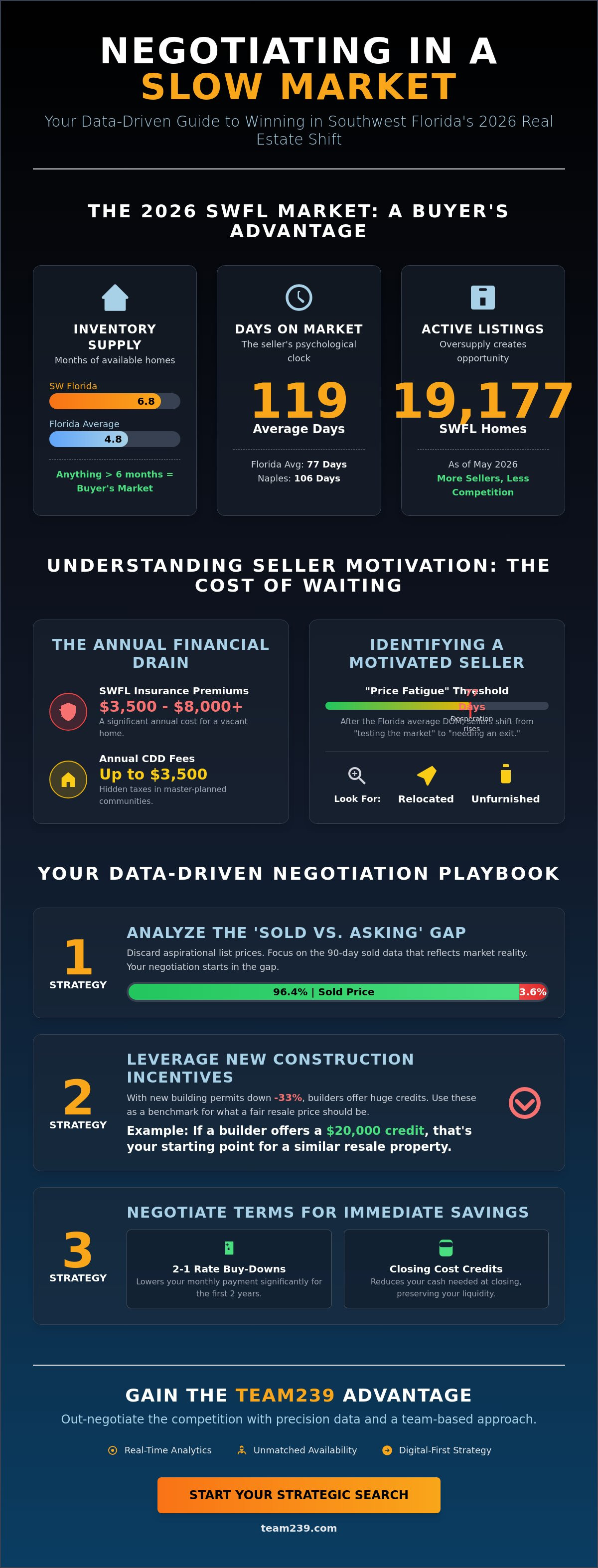
In a market where regional listings now sit for an average of 119 days and inventory has climbed to a 6.8-month supply, the most powerful move isn't just asking for a discount. Negotiating home price in a slow market Florida has shifted from a simple haggle to a strategic calculation of a seller's mounting carrying costs. You're likely skeptical of puffed listing prices; it's a valid concern when Southwest Florida insurance premiums can top $8,000 and annual CDD fees reach $3,500 in many master-planned communities across the region. You want a sound 2026 investment that doesn't drain your liquidity on day one.
This guide will show you how to master high-stakes negotiation to secure a contract below list price while getting the seller to pay for your closing costs or a rate buy-down. We'll analyze the latest market shifts from Naples to Fort Myers, giving you the leverage needed to turn a cooling market into your greatest financial advantage. You'll walk away with the confidence to navigate the As-Is contract and win the specific terms you deserve in today's rebalancing landscape.
Key Takeaways
Identify the specific inventory thresholds that signal a buyer’s market and learn how to use 'Days on Market' as a psychological lever.
Master the data-driven strategy of negotiating home price in a slow market Florida by focusing on neighborhood-specific sale-to-list ratios rather than active listing prices.
Discover why seller concessions like 2-1 rate buy-downs often provide more immediate financial relief than a standard reduction in the sales price.
Turn local hurdles into leverage by using 4-point inspections and CDD fee structures to negotiate credits for insurance-critical repairs and hidden taxes.
Learn how a digital-first, team-based approach provides the real-time analytics and availability needed to out-negotiate traditional agents in Southwest Florida.
Table of Contents
Defining the 2026 'Slow Market' in Southwest Florida
A slow market isn't just a vibe; it's a measurable data point. In Southwest Florida, we define a "slow" or buyer-friendly market once inventory crosses the 6-month threshold. As of March 2026, Florida reached a 4.8-month supply of single-family homes, but specific pockets in Southwest Florida have already surged past 6.8 months. When you're negotiating home price in a slow market Florida, this oversupply is your primary leverage. It transforms the transaction from a competition between buyers into a competition between sellers.
Days on Market (DOM) serves as your most potent psychological weapon. A listing that has sat for 119 days in Cape Coral or 106 days in Naples tells a story of a seller who is likely exhausted. To effectively deploy high-level negotiation strategies, you must recognize that time is the seller's enemy. Every month a house remains unsold, the seller bleeds cash through high insurance premiums and taxes. This "carrying cost" is the silent motivator that makes aggressive offers viable.
Inventory vs. Absorption Rates in Naples and Estero
Supply levels dictate your starting offer percentage. In areas like Bonita Springs and Estero, where inventory levels sat between 4.5 and 6.8 months in early 2026, buyers have firmly taken the driver's seat. While Naples prices saw a 3.7% year-over-year increase, the rising inventory suggests a market correction is simmering beneath the surface. It's different from a seasonal dip; it's a structural rebalancing where the number of active listings in Southwest Florida reached 19,177 by May 2026.
New construction in Bonita Springs also impacts your leverage in the resale market. With single-family building permits falling by 33% through January 2026, builders are often more willing to offer aggressive incentives than individual homeowners. We use this "incentive gap" to benchmark what a fair resale price should be. If a builder is offering a $20,000 credit, that's your starting point for a resale negotiation on a similar property.
The Psychology of the 2026 Florida Seller
The 2026 Florida seller is under immense pressure. With average insurance premiums in Southwest Florida sitting between $3,500 and $8,000, plus annual CDD fees reaching $3,500, a vacant home is a liability. You can spot "motivated" sellers by looking for those who have already relocated or have their home listed as "unfurnished." These sellers aren't just looking for a price; they're looking for an exit from a monthly financial drain.
Price fatigue is real. After 77 days on the market (the Florida average in March 2026), sellers often shift from "testing the market" to "desperate for an exit." We target these stale listings because the sellers are often more focused on stopping the bleed than holding out for a "puffed" valuation. Identifying this fatigue early allows you to structure an offer that solves their problem while securing your investment at a significant discount.
Leveraging Market Data to Build Your Negotiation Strategy
Strategy isn't about gut feelings; it's about processing raw data to find a seller's breaking point. When negotiating home price in a slow market Florida, your first move is discarding active listing prices as your primary benchmark. Active listings are merely aspirational, while sold data represents the factual reality of what the market will bear. Relying on "asking prices" in a cooling market like Cape Coral, where prices fell 10% year-over-year in January 2026, is a recipe for overpaying.
We target price "cliffs" by identifying properties that have missed the market's sweet spot. If a home has sat past the 77-day Florida average without a price correction, the seller is often bracing for a major drop. By analyzing 2026 tax assessment data, we can challenge unrealistic luxury valuations in Naples, where median prices hit $745,000 but may not align with the property’s actual assessed value. This data-driven approach removes emotion from the table and replaces it with logic.
The 'Sold' vs. 'Asking' Gap Analysis
In March 2026, Florida homes sold for approximately 96.4% of their list price. This 3.6% gap is your baseline, but regional volatility creates even bigger opportunities. Recent "comps" from the last 90 days are the only ones that matter because they reflect the current 6.0% to 6.8% interest rate environment. Following expert negotiation tips means using these hard numbers to anchor your offer before the seller can pivot to sentimental value.
Neighborhood-Specific Leverage Points
Negotiating in gated communities requires a specialized lens that accounts for total cost of ownership. Annual CDD fees in Southwest Florida typically range from $1,500 to $3,500, which adds significant weight to a buyer's monthly carry. We frequently leverage the heavy competition from new construction homes in Bonita Springs to drive down resale prices. When builders offer aggressive rate buy-downs or closing cost credits, resale sellers must match those terms or drop their price to stay relevant.
Using "comparable condition" is another high-impact tactic. If a nearby sold home had a new roof and the current listing has one with only five years of life remaining, that's a direct line-item deduction from your offer. Our team can help you build a data-backed offer strategy that turns these neighborhood-specific leverage points into realized savings at the closing table.
Beyond the Sales Price: Terms That Save You More
Successful negotiation isn't a simple race to the bottom on price. When negotiating home price in a slow market Florida, savvy buyers focus on the net impact on their bank account rather than just the headline number. In a landscape where interest rates hover between 6.2% and 6.8%, a strategic concession can often provide more financial relief than a standard price cut. We look at the total cost of ownership to ensure your 2026 investment remains liquid and manageable.
The "As-Is" contract myth is one of the biggest hurdles for buyers. While the contract states the seller isn't obligated to make repairs, the standard 15-day inspection period is actually a powerful renegotiation window. If an inspection reveals a roof with less than five years of life, you have the right to cancel. This gives you the leverage to demand a credit or walk away, regardless of the "As-Is" label. Sellers in 2026, facing 77 to 119 days on market, would often rather pay for a repair than let a deal collapse and start the clock over.
Price Reduction vs. Seller Concessions
Sellers often prefer giving "flex cash" or credits over dropping the listing price because it keeps the recorded sales price high, protecting the appraisal value for future sales in the neighborhood. For a buyer, a credit used for a 2-1 rate buy-down is almost always superior to a price drop of the same amount.
Contingency Strategies for 2026
In Estero or Naples, a "Home Sale Contingency" can be a deal-killer unless it's structured correctly. To make your offer palatable, consider shortening the inspection period from 15 days to 7 days. This signals seriousness and reduces the seller's risk. Additionally, using an appraisal gap clause can protect your down payment if the home doesn't value at the 2026 "puffed" listing price. You can also offer a "Post-Occupancy" agreement, allowing the seller to stay in the home for 30 days after closing. This costs you very little but can be a massive bargaining chip for a seller who hasn't found their next home yet.
Navigating SWFL Hurdles: Inspections, CDDs, and Insurance
Negotiating home price in a slow market Florida requires a technical deep dive into the "Big Three" of Southwest Florida real estate: insurance, CDDs, and HOA health. By May 2026, the property insurance market has shown signs of stabilization, but costs remain a primary friction point. Even with SB 808 prohibiting insurers from canceling policies based solely on roof age if five years of life remain, the underwriting process is more rigorous than ever. We use the results of a 4-point inspection as a hard-line negotiation tool, focusing on the electrical panels and HVAC systems that often trigger high-premium surcharges.
Elevation and flood zones are equally critical price-reduction tools in 2026. Since January 1, 2026, Citizens-insured homes with a dwelling replacement cost of $400,000 or more must carry flood insurance, regardless of the zone. If a property sits in a high-risk area, the annual premium becomes a recurring debt that lowers the home’s present value. We leverage these mandatory costs to justify a lower purchase price, ensuring you don't inherit a financial burden that hasn't been accounted for in the contract.
The 2026 Florida Insurance Crisis as Leverage
Insurance is the most effective tool for negotiating home price in a slow market Florida. Before you finalize an offer, we demand a Wind Mitigation report to check for hurricane-rated roof attachments. If the report shows outdated "toe-nailed" connections rather than clips or wraps, that's a direct line-item deduction for the cost of a future roof-to-wall retrofit. We shift the financial burden of these upgrades back to the seller by requesting credits that cover the premium difference for the first 24 months of ownership.
Uncovering 'Hidden' Community Costs
Community Development District (CDD) fees are a permanent fixture in master-planned communities like Wellen Park or Lakewood Ranch. These fees significantly impact the cost of living in Naples, Florida. When we negotiate, we treat the CDD bond portion as a debt. We often ask sellers to pay off the remaining bond or provide a credit to cover the operations and maintenance portion for the first three years of your ownership.
HOA health is another major factor in 2026. Following the January 5, 2026 update to Florida Realtors® forms, we have better access to Milestone Inspections and Structural Integrity Reserve Studies. If an HOA has a low reserve fund or an upcoming special assessment for community repairs, that's a direct price-reduction tool. Don't inherit someone else's community debt without a corresponding discount. Connect with Team239 to ensure your next offer accounts for these critical SWFL hurdles before you sign.
The Team239 Advantage: Precision Negotiation in SWFL
Negotiating home price in a slow market Florida isn't a job for a solo agent with a traditional mindset. It requires a digital-first approach that processes market shifts in real time. In a region with 19,177 active listings as of May 2026, the sheer volume of data can be overwhelming for most. We cut through the noise by using advanced analytics to identify which sellers are truly motivated and which are simply "puffed" listings waiting for a buyer who hasn't done their homework. Our communication is direct, transparent, and built on the same precision you'd expect from a high-level product development team.
Our team-based strategy is our greatest competitive edge. Real estate doesn't happen on a 9-to-5 schedule, especially when high-stakes counter-offers are flying. Because we operate as a cohesive unit, someone is always available to handle a strategic response or analyze a new data point. This ensures you never lose leverage because of a delayed reply. We combine this technical efficiency with deep insider knowledge of Naples, Bonita Springs, and Marco Island. We know the local sellers and the specific pressures they face, from the $3,500 CDD fees to the rising insurance costs we discussed earlier.
Strategic Partnership vs. Transactional Brokerage
Most agents focus on the "how"-the paperwork and the showing. We focus on the "why." We treat your home purchase as a strategic acquisition, not just a transaction. Before you even submit an offer, we "stress-test" the seller's listing price against the latest 90-day sold data. If a Fort Myers home has sat for 59 days, we find out why. We leverage our professional reputation with other Southwest Florida agents to gain insights that aren't visible on the MLS. This collaborative yet firm approach ensures your deal stays on track and closes on your terms.
Your Next Steps in the SWFL Market
The 2026 market offers a rare window of opportunity for buyers who are willing to lead with data rather than emotion. Whether you're looking for a move-in-ready home in Estero or a luxury resale in Naples, the strategy remains the same: identify the risk and shift it back to the seller. Don't leave your investment to chance in a rebalancing market.
Schedule a strategic consultation to review the current 6.8-month supply of inventory in your target neighborhood.
Download our '2026 SWFL Buyer’s Toolkit' for neighborhood-specific data on insurance and CDD fees.
Review our latest market reports to see how the May 2026 seasonal slowdown is creating new price cliffs.
Start your strategic home search with Team239 today and experience a modern, results-oriented approach to negotiating home price in a slow market Florida.
Take Control of Your 2026 Property Acquisition
The shift toward a buyer-friendly market in 2026 isn't a temporary trend; it's a strategic opening for those who lead with data. Success in negotiating home price in a slow market Florida comes down to identifying a seller's specific pressure points, whether it's a 119-day listing period in Cape Coral or the mounting $3,500 annual CDD fees in master-planned communities. You now have the framework to look beyond the "puffed" list price and secure terms like rate buy-downs that protect your liquidity and long-term investment value.
Our family-led team combines over a decade of SWFL market expertise with a "digital expert" edge to ensure your offer is backed by real-time analytics. We specialize in the Naples, Bonita, and Estero luxury markets, where precision is the difference between a standard deal and a strategic win. Don't settle for a transactional agent when you can have a strategic partner who understands the "why" behind every move. Secure your SWFL dream home with Team239's expert negotiation strategy and step into your next Florida investment with total confidence.
Frequently Asked Questions
Is it a bad idea to make a lowball offer in Florida?
Making an aggressive offer isn't a bad idea if the property has exceeded the 77-day Florida average on the market. In Southwest Florida, where active listings reached 19,177 in May 2026, a lower starting point is often the only way to find a seller's true floor. We back these offers with hard data from the last 90 days to ensure the conversation stays professional and focused on current market realities.
How much can I negotiate off a new construction home in Bonita Springs?
Negotiating new construction in Bonita Springs typically yields better results through incentives rather than direct price cuts. While builders rarely drop the base price to protect neighborhood appraisals, they often offer "flex cash" for 2-1 rate buy-downs or luxury upgrades. Since single-family building permits fell by 33% through January 2026, many builders are motivated to move finished inventory through these significant financial concessions.
What are the most common seller concessions in Southwest Florida for 2026?
The most frequent concessions in 2026 are mortgage rate buy-downs and credits for property insurance. Because Southwest Florida premiums can range from $3,500 to over $8,000, buyers often negotiate for the seller to cover the first year of coverage. Seller-paid closing costs are also a standard strategy for negotiating home price in a slow market Florida to keep more cash in the buyer's bank account at closing.
How do high interest rates affect my ability to negotiate home prices?
High interest rates, projected between 6.0% and 6.8% through mid-2026, increase your leverage by reducing the pool of qualified buyers. Sellers face higher carrying costs on vacant homes, making them more likely to accept offers below list price to avoid the monthly financial drain. We use these rate projections to justify why a property's "puffed" valuation from previous years no longer aligns with the 2026 economic landscape.
Should I negotiate for a lower price or for repairs after a home inspection?
You should generally negotiate for a closing credit or a price reduction rather than asking the seller to perform repairs themselves. Sellers often choose the most cost-effective fix, whereas a credit allows you to hire your own licensed contractors after closing. This is vital for insurance-critical items like electrical panels or roofs that must meet the strict 4-point inspection standards required by Florida insurers in 2026.
Who typically pays for title insurance in Collier and Lee County?
In Collier County, the buyer typically pays for title insurance and chooses the closing agent. In Lee County, the seller traditionally pays for the title policy and selects the title company. However, in a slow market, everything is negotiable. We often successfully negotiate for the seller to cover these costs regardless of the local county custom to further reduce your out-of-pocket expenses at the closing table.
Can I negotiate the HOA or CDD fees as part of the home purchase?
While you can't change the set HOA or CDD fee amounts, you can negotiate for a seller credit to offset several years of these costs. With CDD fees in Southwest Florida ranging from $1,500 to $3,500 annually, we frequently ask the seller to pay off the remaining bond portion of the CDD. This effectively lowers your annual tax bill for the duration of your ownership, providing a permanent reduction in your cost of living.
What happens if the home doesn't appraise for the negotiated price?
If a home doesn't appraise, the seller must drop the price, you must pay the difference, or you can cancel the contract. In the 2026 market where inventory is high, sellers are much more likely to lower their price to match the appraisal rather than risk losing the deal. This protects your down payment and ensures you aren't overpaying for a property that the bank doesn't value at your specific offer price.
Comments