
Understanding the Florida Real Estate Contract: A 2026 Guide for SWFL Buyers

Your real estate contract isn't just a legal formality; it's a high-stakes strategic roadmap where a single missed deadline can trigger the immediate loss of a $40,000 escrow deposit. In the competitive Naples, Bonita Springs, and Estero markets, the difference between a successful closing and a legal nightmare often comes down to understanding the Florida real estate contract and its specific 2026 regional nuances. Most buyers feel a justified sense of dread when faced with the ASIS-7x Rev. 12/24 version, especially with the mandatory flood risk disclosures and the 7-day condo cancellation period that became law in 2025.
We've built this guide to replace that uncertainty with total clarity. You'll learn how to master the complexities of the FR/BAR contract to protect your investment across Southwest Florida. We'll dive into the critical differences between "As-Is" and "Standard" agreements, explain how the December 31, 2025, SIRS deadline impacts your current condo purchase, and break down those $1,500 to $3,500 annual CDD fees. By the end of this article, you'll have the confidence to negotiate contingencies and navigate the inspection period like a pro.
Key Takeaways
Learn why the "As-Is" contract is the gold standard for Naples and Bonita Springs buyers and how it impacts your right to inspect and cancel.
Master the art of understanding the Florida real estate contract to protect your escrow deposit against appraisal gaps and shifting financing hurdles.
Decode Southwest Florida specifics like CDD fees in Estero and the updated 7-day condo rescission period to ensure total financial transparency before you sign.
Navigate the "Time is of the Essence" clause with precision, ensuring you never miss a critical 5:00 PM deadline or risk a legal breach.
Discover how a digital-first "Contract-to-Close" strategy manages 50+ complex deadlines to provide a seamless, paperless experience for modern buyers.
Table of Contents The Foundation: FR/BAR "As-Is" vs. Standard Contracts Critical Contingencies: Protecting Your Escrow Deposit Southwest Florida Nuances: CDDs, HOAs, and Coastal Disclosures The Closing Timeline: "Time is of the Essence" Why Team239 is Your Best Asset in Contract Negotiations
The Foundation: FR/BAR "As-Is" vs. Standard Contracts
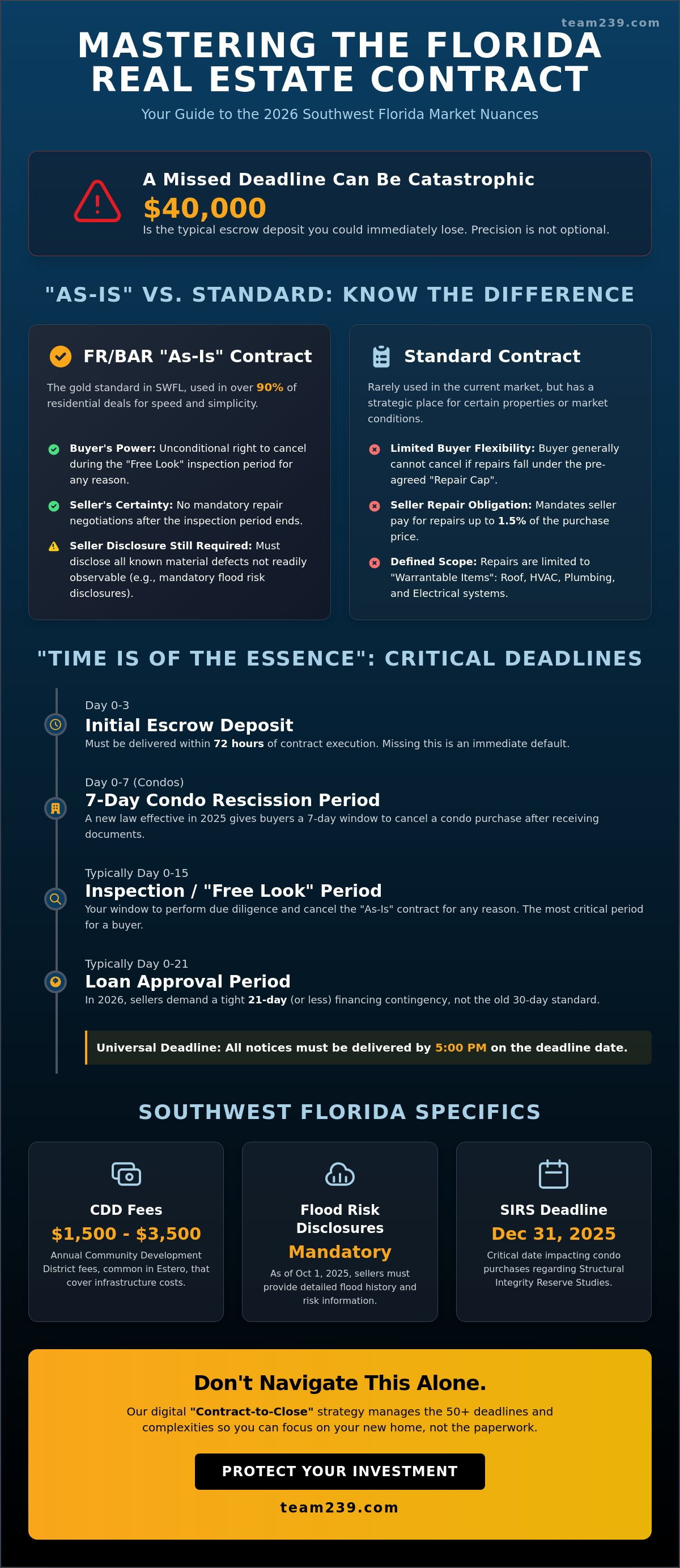
Understanding the Florida real estate contract starts with recognizing the origin of the paperwork. Most transactions in Southwest Florida utilize standardized forms developed by a joint committee of Florida Realtors and the Florida Bar, commonly known as FR/BAR. As of May 2026, the "ASIS-7x Rev. 12/24" version is the dominant framework used in over 90% of residential deals in Naples and Bonita Springs. This collaborative real estate contract provides a balanced legal structure that prioritizes transaction speed and transparency.
The primary reason the "As-Is" version has become the regional default is simplicity. It removes the friction of mandatory repair negotiations. In a high-velocity market like Estero or North Naples, sellers want certainty. They prefer to know that once the inspection period ends, the deal is moving toward a closing without surprise invoices for leaky faucets or aging appliances. For buyers, the trade-off is a powerful "walk-away" right that offers ultimate flexibility during the due diligence phase.
Decoding the "As-Is" Clause in 2026
There is a common misconception that "As-Is" means the seller can hide property flaws. This is legally incorrect. Under the landmark Florida Supreme Court case Johnson v. Davis, sellers must disclose all known material defects that aren't readily observable. In 2026, this includes the mandatory flood risk disclosures that became effective on October 1, 2025.
The real power for the buyer lies in the "Free Look Period." This is the inspection contingency. It functions as an unconditional right to cancel the contract for any reason, or no reason at all, provided the notice is delivered before the deadline. In luxury markets like Marco Island, savvy buyers use this window to bring in specialized structural engineers or seawall inspectors without the pressure of being locked into the purchase if the findings are less than perfect.
When to Use the Standard Residential Contract
While rare in modern SWFL transactions, the Standard Residential Contract (CR-6) still has a strategic place. Unlike the "As-Is" version, the Standard contract includes a "Repair Cap" concept. This typically mandates that the seller must pay for repairs to "Warrantable Items" up to 1.5% of the purchase price. On a $1,000,000 home in an older Naples community, this means the seller is contractually obligated to spend up to $15,000 on structural or mechanical issues.
Predictability: Sellers in a balanced market may use a Standard contract to signal that their home is in peak condition.
Warrantable Items: This list specifically covers the roof, HVAC, plumbing, and electrical systems.
Forced Closing: If repairs fall under the 1.5% cap, the buyer generally cannot cancel the contract solely based on those defects.
Choosing between these forms depends on your risk tolerance. Our team analyzes the specific property age and current market demand to recommend the contract structure that best protects your capital. Whether you're eyeing a 1980s villa in Park Shore or a 2026 new construction in Estero, the right form sets the tone for the entire transaction.
Critical Contingencies: Protecting Your Escrow Deposit
Your escrow deposit is the financial weight behind your promise to buy. In the 2026 Southwest Florida market, understanding the Florida real estate contract means knowing exactly when that money is at risk. The process begins with the "3-day rule." Once the contract is signed by both parties, you typically have 72 hours to deliver your initial deposit to the escrow agent. Missing this window puts you in immediate technical default. It's a small detail that can derail a deal before the ink is even dry.
Beyond the initial deposit, contingencies act as your safety valves. These clauses allow you to exit the deal with your deposit intact if specific conditions aren't met. In a high-interest environment, the financing contingency is the most vital. While many buyers still believe in the "30-day" myth, 2026 sellers in Naples and Bonita Springs often demand a loan approval period of 21 days or less to keep the transaction moving. Relying on Key clauses in a Florida real estate contract ensures you don't accidentally waive your right to a refund if your lender hits a snag.
The Financing Period and Loan Approval
The 2026 FR/BAR revisions clarified that "Loan Approval" is a formal, written commitment from your lender. It's not a simple pre-qualification letter. You're contractually bound by a "Good Faith" requirement, meaning you can't intentionally sabotage your loan to back out of the deal. If you don't provide written notice of loan approval or a written cancellation by the deadline, your deposit becomes non-refundable in most cases. This is why our team tracks these dates with surgical precision.
The inspection period is your next hurdle. While the contract defaults to 15 days, the competitive norm in Estero has shifted to 10 days. Shortening this window makes your offer more attractive to sellers without sacrificing your ability to conduct thorough due diligence. If the results are unsatisfactory, you must cancel in writing before the clock strikes 5:00 PM on the final day.
The Appraisal Gap Strategy
In rapidly appreciating neighborhoods, the bank's appraisal might come in lower than the agreed purchase price. This creates a "gap" that the buyer must cover in cash if they want to proceed. We often integrate specific appraisal gap language into the additional clauses section to set clear limits on your exposure. For a deeper look at local pricing trends, check out our Naples Florida Homes for Sale: The Complete 2026 Buyer’s Guide.
Managing these moving parts requires more than just a signature; it requires a strategy. If you want to ensure your escrow is never in jeopardy, let our residential resale experts audit your next offer before you submit it.
Southwest Florida Nuances: CDDs, HOAs, and Coastal Disclosures
Standard forms only get you so far. In Southwest Florida, the real complexity lives in the addendums. Whether you're eyeing a beachfront condo in Marco Island or a lifestyle community in Estero, these attachments modify your rights and financial obligations. Truly understanding the Florida real estate contract requires a deep dive into the regional riders that govern how we live and pay for infrastructure in the 239 area code. These documents aren't just paperwork; they're the blueprints for your monthly carrying costs.
The Impact of CDD and HOA Fees on Your Contract
Community Development Districts (CDDs) are a staple of North Naples and Estero developments. Unlike a standard HOA fee, a CDD is a non-ad valorem assessment that appears on your annual property tax bill. These fees typically range from $1,500 to $3,500 annually and pay for the community's initial infrastructure like roads and utilities. During the contract phase, the seller must disclose these costs. We always verify these figures through an estoppel letter to ensure no delinquent dues follow you after closing.
The HOA and Condominium riders are equally critical. A major legislative shift occurred on July 1, 2025, extending the buyer's cancellation period for condo resales from three days to seven days after receiving the required documents. This "right of rescission" is your ultimate safety net. It allows you to review the association’s financial health, including the Structural Integrity Reserve Study (SIRS) which all associations were required to complete by December 31, 2025. For those exploring the latest developments, our New Construction Homes in Bonita Springs, FL: The Complete 2026 Buyer’s Guide breaks down how these fees scale in brand-new communities.
Waterfront and Environmental Addendums
Buying on the water in Marco Island or Naples requires specialized due diligence. If the property is seaward of the Coastal Construction Control Line (CCCL), you'll face strict state regulations regarding renovations. The CCCL disclosure is a mandatory part of the contract for coastal homes. It warns you that the property's condition is subject to stringent environmental protections that may limit your ability to expand a deck or rebuild a pool.
Seawall and Dock Inspections: Standard home inspectors often skip these structures. We recommend a separate addendum to ensure these high-cost items are structurally sound.
Flood Insurance: As of October 1, 2025, Florida law mandates formal disclosure of all past flood history. This data is vital for calculating your 2026 insurance premiums.
Statutory Requirements: Radon gas and lead-based paint (for homes built before 1978) are non-negotiable disclosures that protect your health and the validity of the contract.
Mastering these nuances prevents the "sticker shock" that many out-of-state buyers face. We ensure every rider is cross-referenced with local municipal data so your investment remains secure from the first day of the inspection period to the final signature at closing.
The Closing Timeline: "Time is of the Essence"
In Florida law, the phrase "Time is of the Essence" is the most unforgiving sentence in your agreement. It transforms every date on the calendar from a target into a hard legal cliff. If a deadline passes without action, even by a few minutes, the non-defaulting party can often terminate the deal or claim the escrow deposit. Understanding the Florida real estate contract requires a surgical approach to the calendar. Unlike some states that allow for "reasonable" delays, Florida expects performance exactly when promised.
Calculating these dates is where many buyers stumble. Deadlines are generally based on calendar days, not business days. If your inspection period ends on a Sunday, it actually ends on that Sunday. The only exception is the "5:00 PM rule." If a deadline falls on a Saturday, Sunday, or national legal holiday, the performance period extends to 5:00 PM on the next business day. However, this only applies to the final day of a period, not the milestones in between. We use digital tracking tools to ensure every stakeholder is aligned with the local time in Naples, preventing any technical breaches.
Key Milestones from Effective Date to Closing
The timeline starts on the "Effective Date," which is the day the last party signs and communicates their acceptance. From there, the clock starts ticking on three critical phases:
Day 1 to 3: You must deliver the initial escrow deposit to the title company or attorney.
Day 10 to 15: This is the inspection "drop-dead" date. As we noted earlier, 10 days is the competitive standard in Estero for 2026.
Day 30 to 45: You'll complete the loan commitment and title search. By this point, the title company verifies there are no liens or 2025 homestead tax issues.
Force Majeure and Hurricane Extensions
Living in Southwest Florida means accounting for the weather. The "Force Majeure" clause protects both parties if a hurricane or other "Act of God" prevents the closing. In 2026, insurance availability has become a primary trigger for these extensions. If a tropical storm enters the "box" and carriers suspend binding new policies, the contract deadlines are typically extended for up to seven days after insurance becomes available again. If your Naples home is damaged by a storm before closing, the seller is generally responsible for repairs up to a specific percentage of the purchase price, or the buyer may elect to cancel.
The final hurdle is the pre-closing walkthrough, which typically happens within seven days of the closing date. This is your chance to verify that the seller has maintained the property and hasn't removed any fixtures. If you're ready to secure a property with a team that treats your timeline with engineering precision, connect with our closing concierge today.
Why Team239 is Your Best Asset in Contract Negotiations
Negotiating a property deal in Southwest Florida involves more than just a high offer price. It's about the architecture of the agreement. While understanding the Florida real estate contract provides you with a baseline of legal knowledge, applying those clauses in a high-stakes bidding war requires a strategic partner. We don't just fill out forms; we engineer transactions. Our team treats every contract as a unique digital product, optimizing for risk mitigation and capital protection from the moment the first signature is captured.
The "Contract-to-Close" concierge service we provide is designed to eliminate the friction of modern real estate. A typical residential transaction in Naples or Estero involves over 50 individual deadlines, from escrow deposits to the delivery of the Structural Integrity Reserve Study. Missing a single one can jeopardize your deposit or your right to cancel. We manage this complexity through a holisitic approach that combines engineering precision with creative problem-solving, ensuring you stay on the offensive throughout the entire escrow period.
Tech-Forward Transaction Management
We leverage a modern, paperless transaction stack to keep your deal moving at the speed of the 2026 market. You'll receive real-time updates on your contingency deadlines, so you're never left wondering if your deposit is secure. This digital-first strategy allows for seamless coordination with Naples’ top title companies and real estate attorneys. By integrating technology into the workflow, we provide a level of transparency and speed that traditional, legacy agencies simply can't match. If you're planning a move from out of state, our Moving to Southwest Florida in 2026: The Ultimate Relocation Guide offers a deeper look at how we streamline the transition for our clients.
Ready to Make an Offer in Naples or Bonita?
Winning in competitive golf course communities or securing a prime new construction lot requires more than luck. It requires a data-driven negotiation strategy. We analyze recent closed sales and current inventory levels to ensure your offer is aggressive enough to win but structured enough to protect your equity. Having Kristin and Jonathan Van Heukelom on your side means you have strategic thinkers who understand both the "how" and the "why" behind every contract clause.
We believe that the best transactions are built on a foundation of trust, transparency, and professional excellence. Our goal is to make the process of understanding the Florida real estate contract the easiest part of your journey. When you're ready to secure your piece of the Florida lifestyle with a team that values your investment as much as you do, let Team239 guide your next SWFL home purchase.
Secure Your Southwest Florida Investment
Success in the 2026 Naples and Bonita Springs markets requires more than just finding the right home. It demands a surgical approach to the paperwork. We've explored how the "As-Is" framework provides flexibility, why the 7-day condo rescission period acts as a vital safety net, and how to navigate the unforgiving "Time is of the Essence" clause. Mastery of these details ensures that understanding the Florida real estate contract becomes your greatest competitive advantage in a high-stakes environment.
Led by Kristin and Jonathan Van Heukelom, our team leverages over 10 years of local expertise to guide buyers through the Naples, Bonita Springs, and Estero luxury markets. As a top-performing team at MVP Realty Associates, LLC, we specialize in high-stakes negotiations and tech-forward transaction management. We protect your capital by managing every deadline with engineering precision. Don't leave your escrow deposit to chance. Download our 2026 SWFL Contract Checklist and Start Your Search today. We're ready to help you win.
Frequently Asked Questions
What is the "Effective Date" of a Florida real estate contract?
The Effective Date is the specific day the last party signs the contract and delivers a copy to the other party. It's the trigger for every deadline in your transaction, from the initial escrow deposit to the inspection window. If the seller signs on a Monday but doesn't communicate that acceptance until Tuesday, Tuesday becomes your official Day Zero.
Can a buyer cancel a Florida real estate contract during the inspection period?
Yes, if you're using the standard "As-Is" contract, you can cancel for any reason or no reason at all. You don't have to prove there's a defect or justify your decision to the seller. As long as you deliver written notice of cancellation before 5:00 PM on the final day of your period, your deposit is protected.
What happens if my escrow deposit is late?
A late escrow deposit puts you in immediate technical default of the agreement. The seller gains the right to terminate the deal and accept a backup offer without further notice to you. In the fast-paced 2026 Southwest Florida market, we recommend initiating wire transfers at least 24 hours before the deadline to avoid bank processing delays.
Are verbal offers and counteroffers binding in Florida?
No, verbal agreements are not enforceable for the sale of real property in Florida. The Statute of Frauds requires all real estate contracts to be in writing and signed by all parties to be legally binding. A verbal "yes" from a seller doesn't stop them from signing a different written offer that arrives five minutes later.
What is a CDD fee and how does it appear in my contract?
A Community Development District (CDD) fee is a non-ad valorem assessment used to pay for a community's infrastructure, such as roads and utilities. It appears as a mandatory disclosure in the contract and is collected annually with your property taxes. In Estero and North Naples, these fees typically range from $1,500 to $3,500 and are separate from your HOA dues.
How long does a seller have to respond to an offer in Naples, FL?
There's no legal default response time, so we always include a specific "Time for Acceptance" in the offer. This is usually set for 24 to 48 hours. If the seller doesn't sign by that deadline, the offer automatically expires. In 2026, many luxury sellers in Naples respond within 12 hours to keep the transaction moving.
Can I use a New York real estate contract for a Florida property?
No, out-of-state contracts are not compatible with Florida's specific legal requirements and statutes. Understanding the Florida real estate contract requires using the state-approved FR/BAR forms, which were updated as recently as January 1, 2025. Using a New York form would likely result in an unenforceable agreement and create significant legal risks for your deposit.
What is the "Time is of the Essence" clause and why does it matter?
This clause means that every deadline in the contract is a firm legal requirement with no grace periods. If you miss a deadline by even one minute, you've breached the contract and could lose your escrow deposit. It's the most critical reason why we use digital tracking to manage the 50 plus milestones in a typical Southwest Florida transaction.
Comments