
New Construction Closing Process Checklist Florida: Your 2026 Guide
- Team 239

- 9 hours ago
- 13 min read
Your closing date is more than a deadline; it's the final moment of leverage you'll ever have with your builder. While the excitement of a 2026 new build is undeniable, the reality of navigating a new construction closing process checklist Florida buyers face can be overwhelming. You've likely spent months watching your home rise from the dirt, yet you're probably worried about "punch list" items being ignored once the ink is dry or getting blindsided by Florida-specific costs like the $0.70 per $100 documentary stamp tax.
It's natural to feel some friction between the builder's timeline and your own need for perfection. We're here to bridge that gap. This guide promises to help you master every financial and physical step of the journey, ensuring a smooth, on-time closing with zero surprises. We'll explore the critical differences between title companies and legal counsel, dive into specific SWFL tax structures like the 0.20% intangible tax, and provide a roadmap for a defect-free walkthrough that holds your builder accountable.
Key Takeaways
Understand how the Certificate of Occupancy (CO) triggers your legal obligations and starts the final 30-day countdown to your move-in date.
Execute a two-stage inspection strategy using a new construction closing process checklist Florida to identify and fix defects before you sign the final papers.
Decode the mandatory three-day review rule for your Closing Disclosure and accurately calculate Florida-specific costs like documentary stamps and intangible taxes.
Identify the critical differences between title companies and attorneys to ensure your settlement agent provides the protection your investment deserves.
Navigate the post-closing transition by mastering the 1-2-10 warranty structure, ensuring your builder remains accountable for structural and mechanical integrity.
Table of Contents
Pre-Closing Milestones: The 30-Day Countdown
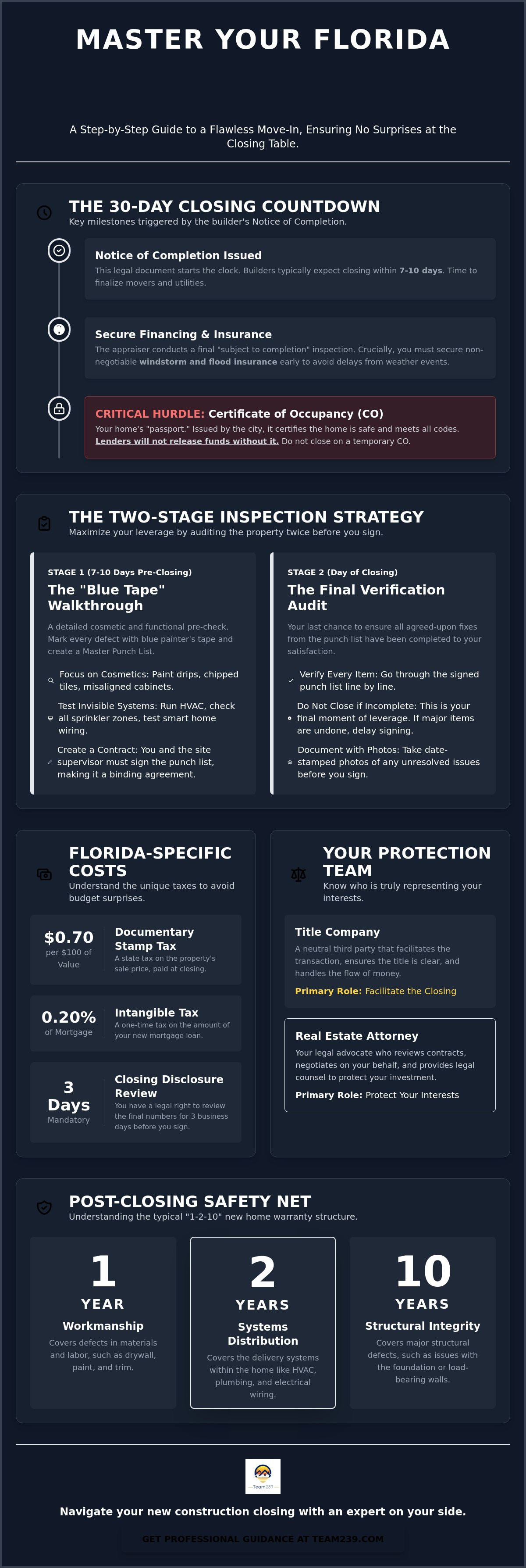
The builder's Notice of Completion isn't just a status update; it's a legal trigger. This document officially signals that the structural phase is over and the administrative phase has begun. It serves as the catalyst for the closing process, setting a firm deadline for your final funding. In the Florida market, builders typically expect you to close within seven to ten days of this notice. If you're following a new construction closing process checklist Florida, this is your cue to finalize your movers and switch your utilities. It starts the clock. You're no longer just a spectator; you're a buyer on a deadline.
The appraisal process for a new build requires precision. Lenders often order "subject to completion" appraisals. This means the appraiser evaluates the home based on the plans and specs, then returns for a final inspection once the home is 100% ready. Coordination is key. If the builder hasn't finished the driveway or landscaping by the time the appraiser visits, they can't sign off. This creates a bottleneck that can delay your funding by weeks.
Insurance in the Sunshine State is a unique challenge. By June 2026, windstorm and flood coverage are non-negotiable for most lenders. You'll need to provide an elevation certificate to your agent early to get an accurate quote. Don't let this slide until the final week. Carriers often pause binding if a tropical system enters the Gulf, which can derail your entire timeline. Secure your policy as soon as you have a firm closing date.
The Certificate of Occupancy (CO) Hurdle
Think of the CO as your home's passport. Without it, the house doesn't legally exist as a residence. It's a document issued by the local building department certifying that the home meets all codes and is safe to live in. Lenders won't release a single dollar without it. In high-growth areas like Collier and Lee Counties, the backlog for final inspections can be significant. Builders might try to push the closing date based on their internal schedule, but you shouldn't budge. If they ask you to close on a "temporary" CO, they're asking you to take a massive financial risk. Stick to your guns.
Locking Your Mortgage Rate
Construction delays, often called "builder drift," are the enemy of a good interest rate. With 30-year fixed rates sitting around 6.63% in mid-2026, protecting your monthly payment is a priority. Builder drift can easily push a June closing into August. If your rate lock expires, you're at the mercy of the current market. Always ask about "float down" options. This feature lets you keep your locked rate but switch to a lower one if the market improves before you sign. Coordinating this between builder-affiliated lenders and outside firms requires constant communication. Don't assume the builder's lender is tracking your construction delays for you.
The Two-Stage Walkthrough: Blue Tape vs. Final Audit
Closing on a new build isn't a single event. It's a sequence of quality gates. Many buyers make the mistake of treating the final walkthrough as a quick victory lap, but in the Florida real estate closing process, your leverage is highest before you sign the final settlement statement. You need to view this phase as a two-stage audit: the cosmetic "Blue Tape" session and the functional "Final Verification."
The first stage happens seven to ten days before closing. This is when you and the builder's representative walk every inch of the property. You'll use blue painter's tape to mark every paint drip, chipped tile, or misaligned cabinet door. This is also the time to test the "invisible" systems. In Southwest Florida, your HVAC system and irrigation are lifelines. Run the air conditioning at full blast to check for duct leaks. Cycle through every zone of the sprinkler system. If you've opted for smart home integrations, ensure the hubs and hardwired connections actually talk to each other. If these aren't right now, they'll likely stay broken long after you move in.
The Blue Tape Strategy
In the SWFL heat, stucco and seals are your primary defense. Pay close attention to hairline stucco cracks and window seals. While small cracks can be normal settling, anything wider than a credit card needs professional evaluation. Document every issue on a Master Punch List. This document is a critical component of your new construction closing process checklist Florida. Both you and the site supervisor must sign this list. It creates a contractual obligation for the builder to remediate these items before the keys change hands. If you feel overwhelmed by the technical details, professional buyer representation can help you navigate these builder negotiations.
Hiring a Third-Party Inspector
Don't assume a "new" home is a "perfect" home. Municipal inspectors only check for minimum code compliance; they don't check for quality or longevity. Hiring an independent inspector provides an unbiased layer of protection. For Florida builds, request thermal imaging. This technology identifies moisture intrusion behind walls and gaps in insulation that the naked eye misses.
Phase Inspections: These occur during framing or before drywall.
Final Inspection: This happens just before your blue tape walkthrough.
Leverage: Use the inspector's report to demand specific repairs or closing credits if structural deficiencies are found.
The second stage, or the Final Verification, occurs usually 24 hours before closing. This is your "trust but verify" moment. Your only goal here is to ensure every item on the signed Master Punch List was completed to your satisfaction. If the builder hasn't finished the repairs, you have the right to delay closing or request an escrow holdback. Never accept a verbal promise that they'll "swing by next week" to fix it. Once the builder has their money, their sense of urgency disappears.
Florida-Specific Closing Costs and Financials
The financial phase of your new construction closing process checklist Florida journey is where the numbers get real. Unlike a resale transaction where the seller typically covers the documentary stamp tax on the deed, new construction contracts in Florida often shift this burden to the buyer. This isn't just a minor line item. At $0.70 per $100 of the purchase price, a $750,000 home in Naples carries a $5,250 tax just for the deed transfer. If you're financing, you'll also face a documentary stamp tax on the mortgage at $0.35 per $100, plus an intangible tax of 0.20% on the total loan amount. These costs are non-negotiable with the state, so your budget must account for them from day one.
Your Closing Disclosure (CD) is the final blueprint of your transaction. This five-page document outlines every penny moving through the escrow account. By law, you must receive this at least three business days before you sign the final papers. This 72-hour window is your time to verify that the builder's promised credits for using their preferred lender actually appear on the ledger. If the numbers don't match your initial Loan Estimate, don't wait until the closing table to speak up. A single discrepancy can reset the three-day clock, potentially delaying your move-in date.
CDDs and Impact Fees in Naples & Bonita Springs
Many resort-style communities in Naples and Bonita Springs utilize a Community Development District (CDD) to fund infrastructure like roads and utilities. This fee appears on your annual property tax bill, but the initial "impact fees" are often settled at closing. You might also encounter a "capital contribution" fee. This is a one-time payment to the HOA, often equal to several months of dues, used to build the community's reserve fund. When negotiating your contract, ask for builder credits specifically to offset these SWFL-specific entry costs. It's a common strategy that can save you thousands in cash-to-close.
The 3-Day Rule and Wire Fraud Prevention
The mandatory three-day review period for your CD is a hard stop for financed buyers. It's designed to prevent "bait and switch" lending, but it also serves as your final safety check. During this window, you'll receive wire instructions for your final cash-to-close. Real estate fraud is a sophisticated threat in 2026. Never trust wire instructions sent via email without verbal verification. Call your title company using a known number from their official website to confirm every digit of the routing and account numbers. In Florida, most settlement agents require a wire transfer for any amount over $1,500; certified checks are rarely accepted for final closings due to immediate funding requirements.
The Closing Table: Title Companies vs. Attorneys
The settlement agent acts as the conductor for your final performance at the closing table. They manage the escrow account, ensure all conditions of the contract are met, and facilitate the legal transfer of the deed. While the builder's preferred title company often handles the bulk of new construction transactions, you have the right to understand exactly who is representing your interests. Integrating a review of the settlement agent's role into your new construction closing process checklist Florida is a smart move to avoid last-minute friction. Their job is to ensure that the "clear title" promised by the builder is actually delivered.
Owner's title insurance is your primary shield. While lenders require a policy to protect their own investment, an owner's policy protects your equity. In new construction, this is vital because it covers you against "mechanic's liens." If a subcontractor or material supplier wasn't paid by your builder, they can file a claim against your property even after you've moved in. Your title insurance policy ensures that any such claims are the title company's problem, not yours. It's a one-time fee paid at closing that offers protection for as long as you own the home.
Modern technology has simplified the signing ceremony. Florida law fully supports Remote Online Notarization (RON), allowing you to sign your documents from a laptop in another state. This is a game-changer for 2026 buyers who are relocating from the Midwest or Northeast. If you choose to close in person, bring two forms of government-issued ID. If you're using a Power of Attorney, it must be pre-approved by the title company and the lender at least 48 hours in advance. Don't leave this to the last minute; lenders are notoriously strict about the specific language used in these documents.
Title Search on New Land
Land that was recently a forest or a swamp still has a paper trail. A title search uncovers old easements, mineral rights, or utility access that could restrict how you use your backyard. The most critical risk in 2026 is the construction lien. A title search ensures the builder has provided "final lien waivers" from every major vendor involved in the project. "Gap" coverage is also essential. This protects you during the short window between the final title search and the moment the deed is officially recorded with the county, ensuring no new claims can be filed against the property in the interim.
Why Southwest Florida Buyers Often Hire Attorneys
In Florida, title companies can't provide legal advice; they only facilitate the transaction. This is why many buyers in luxury markets like Naples and Bonita Springs choose to hire a real estate attorney. Builder contracts are notoriously one-sided, often written by the developer's legal team to limit their own liability and maximize their control over the timeline. An attorney can review these complex documents and negotiate terms that a standard title company simply cannot touch. Learn why you need a realtor for a new construction home to help manage these professional relationships and ensure you aren't signing away your rights.
If you're ready to ensure your interests are protected throughout the final stages of your build, contact our team for expert buyer representation.
Post-Closing: Warranties and Homeowner Transition
The handshake at the closing table marks the beginning of your life in the new home, but it also signals the start of your formal warranty period. You'll walk away with your keys and a comprehensive Homeowner Manual. This manual is a vital resource. It contains your specific paint codes, subcontractor contact lists, and the specific protocols for emergency repairs. Successfully managing this transition is the final stage of your new construction closing process checklist Florida. It ensures that the "new car smell" of your home doesn't fade into the frustration of unaddressed repairs.
Setting up utilities in Naples, Bonita Springs, and Fort Myers requires proactive scheduling. You should contact Florida Power & Light (FPL) and local water providers like Lee County Utilities or Collier County Water at least 48 hours before your closing date. Builders typically schedule the utility shut-off for the day of closing. If your accounts aren't ready to take over, you could face reconnection fees or a dark house on move-in day. This administrative handoff is simple but essential for a stress-free first night.
Navigating the Builder Warranty
Most Florida builders operate within a 1-2-10 warranty framework. This standard structure provides tiered protection for your investment:
1-Year Workmanship: Covers cosmetic items like trim, paint, and drywall cracks caused by settling.
2-Year Systems: Covers "behind the wall" components, including electrical, plumbing, and HVAC ductwork.
10-Year Structural: Protects against major defects in the foundation or load-bearing walls.
We strongly recommend scheduling an independent "11-month inspection." This allows a professional to identify any issues that surfaced during the first year of the home's life before your workmanship warranty expires. When you find an issue, always submit your claim through the builder's official digital portal. This creates a time-stamped paper trail that holds the builder accountable, even if their service department is backed up.
The Florida Homestead Exemption
Your property tax bill is a major component of your long-term carrying costs. As a permanent Florida resident, you can decrease your property's assessed value by up to $50,000 through the Homestead Exemption. The deadline to file is March 1st of the year following your purchase. This isn't just a one-time discount. It triggers the "Save Our Homes" cap, which limits annual increases in your assessed value to 3% or the Consumer Price Index, whichever is lower. This cap provides massive tax stability for your SWFL investment. If you're moving from a high-tax state, these savings are a highlight of Relocating to Southwest Florida: The Complete Guide. Don't leave this money on the table; set a calendar reminder the moment you get your keys.
Take Command of Your Florida New Build
Mastering the final stages of a new build requires more than just signing papers; it requires a strategic mindset. You now have the tools to navigate the critical 30-day countdown, from the Certificate of Occupancy trigger to the two-stage walkthrough audit. By following a comprehensive new construction closing process checklist Florida homeowners can ensure every cosmetic defect is corrected and every financial disclosure is accurate before the keys change hands. Protecting your equity means looking beyond the closing table to long-term benefits like the Homestead Exemption and robust warranty management.
Success in high-end communities like Toll Brothers or custom luxury builds depends on having local advocates who understand the nuances of the Southwest Florida market. Kristin and Jonathan Van Heukelom of Team239 bring over 10 years of specialized experience to your side of the table. We've spent a decade helping buyers navigate CDD fees in Naples and complex builder contracts in Bonita Springs. We don't just facilitate sales; we provide the expert representation you need for a seamless, results-oriented transition.
Work with Team239 to navigate your SWFL new construction purchase and step into your new home with total confidence. Your Florida lifestyle deserves a defect-free start.
Frequently Asked Questions
How long does the closing process take for new construction in Florida?
The administrative phase of the new construction closing process checklist Florida usually spans 30 to 45 days once the builder issues a Notice of Completion. This period includes the final appraisal, the issuance of the Certificate of Occupancy, and the mandatory three-day review of your Closing Disclosure. While the physical build takes months, the legal transfer moves quickly once the home is deemed habitable.
Do I need a real estate attorney for a Florida new construction closing?
Florida law doesn't require you to hire a real estate attorney; a title company can handle the settlement. However, luxury buyers in Naples often hire counsel to review one-sided builder contracts. Title companies facilitate the transaction, but they cannot provide legal advice or negotiate terms on your behalf if a dispute arises during the final walkthrough.
What are the typical closing costs for a new build in Naples, FL?
Buyers should budget between 2% and 5% of the home's purchase price for closing costs. In a new build, you'll likely pay the $0.70 per $100 documentary stamp tax on the deed, which sellers usually cover in resale deals. Other costs include the 0.20% intangible tax on your mortgage and any community-specific capital contributions or impact fees required by the developer.
What happens if the builder misses the closing date?
Most builder contracts include delay clauses that protect the developer from missed deadlines due to labor shortages or weather. You rarely have the right to cancel or receive compensation for a late delivery unless the delay exceeds a specific timeframe, often two years. It's vital to maintain a flexible living arrangement and a rate lock extension to account for these common construction shifts.
Can I do a remote closing for my Florida home?
You can absolutely close on your Florida home from out of state using Remote Online Notarization (RON). This technology allows you to sign and notarize legal documents via a secure video call. You'll need to coordinate with your title company at least two weeks in advance to ensure your lender approves the digital format and that your identity verification is processed correctly.
What is a punch list and when should it be completed?
A punch list is a detailed inventory of minor repairs or cosmetic flaws identified during your blue tape walkthrough. You should complete this list seven to ten days before your closing date. The builder is contractually obligated to address these items before your final verification, which happens 24 hours before you sign the final papers and take possession.
Is a home inspection necessary for a brand-new house?
A professional home inspection is essential because municipal inspectors only check for minimum code compliance. An independent inspector uses tools like thermal imaging to find moisture intrusion, insulation gaps, and electrical issues that are invisible to the naked eye. This report provides the objective data you need to hold the builder accountable before your workmanship warranty period begins.
How do Florida doc stamps work on a new construction deed?
Florida documentary stamp taxes on a deed are calculated at a rate of $0.70 for every $100 of the purchase price. While this is traditionally a seller expense in resale transactions, new construction contracts almost always shift this cost to the buyer. For a $500,000 home, this tax adds $3,500 to your cash-to-close, making it a critical line item to verify early.
Comments