
Tax Implications of Owning a Vacation Home in Florida: 2026 Guide

What if the tax implications of owning a vacation home in Florida depend more on how you use it than what you call it? A home you enjoy personally and rent to guests can be subject to different rules, and the balance of personal and rental use matters. Florida’s lack of individual income tax may simplify one part of the picture, but it doesn’t remove federal tax considerations or local property and rental taxes.
If you’re weighing a Florida getaway, it helps to understand the tax questions before you buy. This 2026 guide explains the main tax categories, how personal and rental use can affect reporting, and what to consider when you sell. Use it as a starting point, not individualized tax advice. A qualified tax professional can apply current rules to your circumstances.
We’ll cover how rental days and personal days affect reporting, what records to keep, which property and rental taxes to consider, and how a future sale may be taxed. That context can also help you evaluate whether a home’s intended use fits your plans as you compare properties and communities across Southwest Florida.
Table of Contents
What are the tax implications of owning a vacation home in Florida?
The tax implications of owning a vacation home in Florida depend on more than the property’s label in a listing. Florida has no individual state income tax, but owners may still need to consider federal income-tax rules, local property taxes, rental-related taxes, and the tax treatment of a future sale. Federal rules can affect how rental income and eligible expenses are reported. The property’s actual use and ownership details help determine which rules to review.
In short, intended use and actual use shape the tax questions to review. A home kept for personal getaways raises different questions from a property held primarily to earn rental income. If you use it yourself and rent it to guests at other times, the details may call for a mixed-use analysis. Treat a listing description as a starting point, not a tax classification.
How is a Florida vacation home classified for tax purposes?
Tax treatment follows ownership facts and actual use, including how days are divided between personal occupancy and rental activity. A property described as a “vacation home” might be used personally, operated as a rental, or serve both purposes during the year. These distinctions can affect income reporting and expense treatment. Keep clear records rather than relying on the listing language. The IRS’s Publication 527, Residential Rental Property, and current IRS guidance are primary references to review with a qualified tax professional.
Which taxes should owners consider?
Federal income tax: Rental income and eligible expenses may be subject to federal rules. Eligibility and allocation depend on use and individual circumstances. Florida’s lack of individual income tax doesn’t eliminate federal obligations.
Property tax: Florida property taxes are assessed locally, so the bill depends on the property and its jurisdiction. Vacation homes generally don’t receive the homestead exemption reserved for qualifying permanent residences. For context on Florida's property tax structure, review how homestead treatment differs from non-homestead property. Florida’s non-homestead assessment increase is generally capped at 10% annually, excluding school district taxes.
Rental taxes: Owners offering short-term stays should consider state and county rental-related taxes separately from property taxes. Requirements can vary by location and rental arrangement. Review current rules with Florida and county tax authorities.
Sale-related taxes: Florida doesn’t impose a state capital gains tax, but a sale may trigger federal tax on gain. If the property was rented and depreciation was claimed, depreciation recapture may also matter. A tax professional can assess how your ownership, use, and records affect the outcome.
How do personal use and rental days change vacation-home taxes?
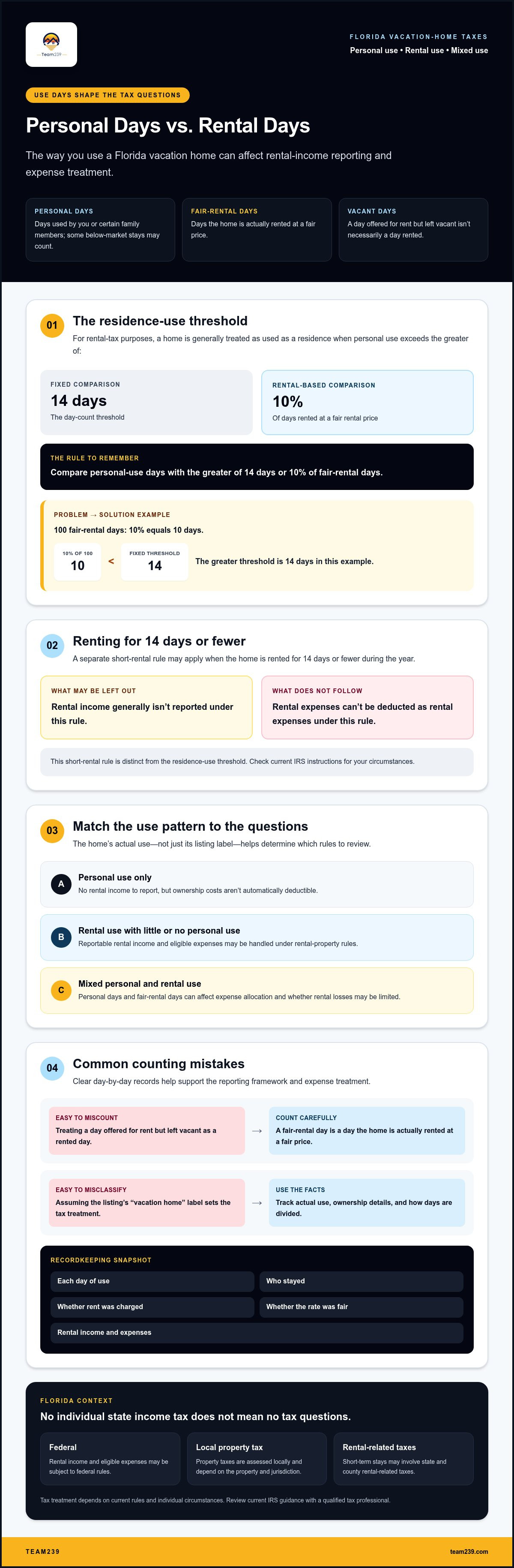
The tax implications of owning a vacation home in Florida can change with the number of days you use it, rent it at a fair price, or leave it vacant. The IRS generally treats a home as used as a residence for rental-tax purposes if personal use exceeds the greater of 14 days or 10% of the days it’s rented at a fair rental price. If you rent the home for 14 days or fewer during the year, the rental income generally isn’t reported, though rental expenses can’t be deducted as rental expenses under that rule. Check current IRS instructions for your circumstances.
What changes when you rent out a Florida vacation home?
Rental income may need to be reported federally, and eligible expenses may be allocated to the rental activity. Schedule E is commonly used to report rental real estate income and expenses, but the right treatment depends on the facts and current IRS guidance. Passive-activity limits and rental-loss rules can also affect whether a loss is currently deductible. Review the IRS rules for vacation homes and discuss your situation with a qualified tax professional.
How do personal-use days affect deductions?
Personal-use days generally include days you or certain family members use the property, including some stays when rent is below fair market value. Fair-rental days are days the home is actually rented at a fair price. Keep the categories distinct: a day offered for rent but left vacant isn’t necessarily a day rented. Use the current IRS definition when counting.
For example, if a home is rented at a fair price for 100 days, 10% is 10 days. The personal-use threshold is the greater of 14 days or 10% of fair-rental days, so it is 14 days in this example. Personal use above that level can make the home a residence under the test. This doesn’t determine every deduction. Mortgage interest, property taxes, and operating costs aren’t automatically deductible as rental expenses. Allocation and loss treatment depend on current rules and individual facts.
Accurate use records help determine the applicable reporting framework. Log each day, who stayed, whether rent was charged, and whether the rate was fair market value. When comparing a property with your plans, consider its likely personal and rental use alongside its location. Explore Southwest Florida homes with Team239.
What Florida property and rental taxes should vacation-home owners compare?
Property and rental taxes can vary by location, so a statewide estimate won’t tell the whole story. Florida property taxes are assessed locally: the county property appraiser determines assessed values, while local taxing authorities set the millage rates used to calculate tax bills. A home’s location, assessed value, exemptions, and local tax rates all matter. Review each property separately when comparing vacation homes.
How do Florida property taxes apply to a second home?
A vacation home generally isn’t eligible for Florida’s homestead exemption, which is intended for qualifying primary residences. A second home may therefore be treated as non-homestead property for assessment purposes. Florida generally caps annual assessment increases for non-homestead property at 10%, but the cap doesn’t apply to school district taxes. Review the relevant county property appraiser’s current assessment, exemptions, and tax information rather than relying only on a seller’s prior bill.
What should owners know before offering short-term rentals?
Rental taxes are separate from property taxes. For stays of six months or less, Florida’s state transient rental tax is 6% of the total rental amount, including cleaning fees. A county discretionary sales surtax may also apply, commonly ranging from 0.5% to 1.5%, and counties can impose a separate Tourist Development Tax, or “bed tax,” with rates that vary by location. Confirm current requirements with the Florida Department of Revenue and the county where the property is located.
The tax implications of owning a vacation home in Florida also depend on where and how you plan to rent it. State, county, and municipal rules may differ. Tax collection doesn’t establish whether a rental is permitted under local zoning, registration or licensing requirements, or a homeowners’ association or condominium’s governing documents. Treat permission and tax compliance as separate checks before budgeting expected rental income.
For property taxes: Compare the current county assessment and applicable exemptions for each property.
For rental taxes: Identify state, county, and local obligations based on the property’s location and rental pattern.
For rental permission: Review local requirements and community rules independently of tax registration.
For buyers comparing homes in Naples, Bonita Springs, Estero, Marco Island, and Fort Myers, location can shape both carrying costs and rental plans. Include these checks in your property comparison, then have a qualified tax professional review how the rules apply to your circumstances.
How can you plan records, deductions, and a future sale?
Good records do more than support an annual tax return. They help show how the home was used, how rental income and expenses were handled, and what may affect your tax basis if you sell. The tax implications of owning a vacation home in Florida can change as personal use, rental activity, and ownership plans evolve. A consistent recordkeeping routine makes it easier to organize the relevant details.
Which records should a vacation-home owner keep?
Keep dated records that distinguish personal stays from rental activity. At the end of each year, organize the information in a secure digital folder or with your tax files:
1. Log use days: Maintain a calendar showing personal stays, fair-rental days, and periods the home was vacant. Note who stayed and the purpose of any unusual use.
2. Reconcile rental activity: Save rental agreements, booking statements, payment records, and income summaries. Match them to the dates on your calendar.
3. Sort expenses: Keep invoices and receipts for property costs. Separate rental-related expenses from personal costs, and don’t assume an expense is deductible just because it relates to the home.
4. Record improvements separately: Preserve receipts and descriptions for major upgrades or additions apart from routine maintenance. Improvement costs may be relevant when calculating basis at sale.
5. Preserve tax documents: Keep filed returns and any depreciation schedules. These can help explain prior reporting and support future calculations.
Expense eligibility and allocation depend on current federal rules and your ownership and use facts. Ask a qualified tax professional how to handle shared costs, rental losses, and any amounts claimed as deductions.
What tax questions arise when selling a vacation home?
A sale calculation may begin with adjusted basis, which generally reflects the cost of acquiring the property plus qualifying capital improvements, with adjustments that can include depreciation. The difference between adjusted basis and the amount realized may result in a gain or loss, but the calculation depends on the transaction and the home’s history.
If you rented the property and claimed depreciation, some of that depreciation may be subject to recapture under federal rules. Don’t assume the primary-residence gain exclusion applies to a vacation home. Eligibility depends on the applicable ownership and use requirements. A like-kind exchange under Section 1031 may be a specialized option for qualifying investment or business property, but it requires a current eligibility review and isn’t a general tax deferral for a personal vacation home.
Before setting a sale strategy, review your records and expected transaction with a qualified tax professional. If you’re still comparing properties, explore Southwest Florida homes with Team239 as you weigh intended use and long-term ownership plans.
How should tax considerations shape a Florida vacation-home purchase?
Start with the plan, not just the property. The tax implications of owning a vacation home in Florida can differ depending on whether you expect to use it personally, rent it to guests, or combine both. Those plans can help guide which locations and communities to consider, which local requirements to research, and what records to keep. Taxes are one part of the decision, alongside insurance, association rules, maintenance, and other carrying costs.
What should you decide before buying a second home?
Use this checklist to connect your intended use with the home and its location:
Set your use plan: Decide whether personal stays, rental income, or a mix will guide your ownership. Estimate how often you expect to occupy or rent the property.
Compare locations and communities: Consider whether the home’s setting fits your likely occupancy, and review applicable association or community restrictions before relying on rental income.
Research local obligations: Look into property-tax assessments and any state, county, or municipal rental requirements that could apply to your intended rental pattern.
Build a full ownership budget: Include insurance, association costs, maintenance, utilities, and other recurring expenses, not only expected taxes or rental revenue.
Plan for documentation: Decide how you’ll track personal-use days, rental days, income, expenses, and improvements from the start.
For a broader look at local purchase considerations, read the Naples home-buying guide. A home that fits your intended use on paper still needs to work as a complete ownership decision.
Who can help with each part of the decision?
Different questions call for different expertise. Team239 helps buyers compare residential properties and communities in Southwest Florida and navigate the purchase process. A qualified tax professional can interpret federal and state tax rules for your personal circumstances. For current local assessments and rental requirements, use official county and state sources.
Keep those roles clear. A real estate team can help you evaluate a property and its location, while tax conclusions should come from a qualified tax professional familiar with your facts. This approach connects your purchase goals with the right due diligence.
For context on communities and day-to-day life in the region, explore the Southwest Florida lifestyle guide. The guide offers another perspective as you compare homes in Naples, Bonita Springs, Estero, Marco Island, and Fort Myers.
Make Your Florida Home Purchase with a Clear Plan
The tax implications of owning a vacation home in Florida depend in large part on how you actually use the property. Personal and rental days can affect federal reporting and expense treatment, while local property and rental taxes vary by location. Keep organized records from the start, and review deductions or future-sale questions with a qualified tax professional who understands your circumstances.
Taxes are only one part of ownership planning. Consider your intended use alongside insurance, community rules, and ongoing costs before choosing a home. A thoughtful plan can help you compare properties and make decisions that fit your goals.
Team239 helps buyers evaluate residential resale and new-construction properties across Naples, Bonita Springs, Estero, Marco Island, and Fort Myers. Explore Southwest Florida homes with Team239 to discuss your property goals and purchase plans.
Frequently Asked Questions
Is Florida tax-friendly for vacation-home owners?
Florida has no individual state income tax, but that doesn’t remove federal tax obligations or local property-tax responsibilities. Federal taxes may apply to rental income or a sale, while property taxes are assessed locally. Short-term rentals may also involve state and local rental taxes, depending on the property’s location and rental arrangement. If you’re comparing homes in Naples, Bonita Springs, Estero, Marco Island, or Fort Myers, review current requirements with official sources and ask a qualified tax professional how they apply to your situation.
Can I deduct expenses for a Florida vacation home?
Some expenses may be deductible, but there’s no automatic deduction simply because you own a vacation home. Eligibility can depend on whether you use the property personally, rent it out, or combine both, as well as current federal rules. Personal and rental use may affect how shared expenses are allocated, and rental losses can be limited. Keep receipts and dated use records, then have a qualified tax professional review your specific expenses before claiming deductions.
How many days can I rent my vacation home without reporting the income?
Under a federal rule, rental income generally doesn’t need to be reported when a home is rented for 14 days or fewer during the year. That limited-rental-use rule doesn’t automatically remove other tax or reporting responsibilities. If you rent for more days, different reporting rules may apply. Fair-rental days, personal-use days, and current IRS definitions matter, and state or local rental-tax requirements can apply independently. Verify the current rules before relying on a day-count threshold.
What happens if I use my vacation home and rent it out?
A home used personally and rented to guests may fall under rules that allocate income and expenses between those uses. The number and type of personal-use and fair-rental days can affect federal tax treatment and whether rental losses are limited. Keep a dated occupancy calendar, rental agreements, income records, and expense receipts. Then ask a qualified tax professional to assess your actual use pattern under current IRS guidance rather than assuming the home fits one category.
Do vacation homes qualify for Florida’s homestead exemption?
A vacation home generally isn’t treated like a qualifying permanent Florida residence for homestead purposes, but eligibility depends on the owner’s circumstances and current rules. Don’t assume a second property qualifies. Contact the property appraiser for the county where the home is located to review current requirements and any applicable exemptions. Homestead treatment concerns property taxes. It’s separate from federal income-tax rules for rental income, deductions, or a future sale.
Do I have to collect taxes if I rent my Florida vacation home short-term?
Short-term rentals may involve Florida sales-tax and local tourist-tax requirements, but the applicable obligations depend on the location and rental arrangement. Review current guidance from the Florida Department of Revenue and the relevant county or municipality before accepting bookings. Also review licensing, zoning, and community or association rules separately. Tax registration or collection doesn’t by itself establish that a rental is permitted under local requirements or property restrictions.
What taxes might I owe when I sell a Florida vacation home?
A sale may raise federal tax questions involving gain, adjusted basis, purchase and improvement costs, ownership history, and any prior rental use. Depreciation claimed during rental periods may also affect the tax calculation. Don’t assume a primary-residence exclusion or another tax treatment applies without checking your eligibility under current law. Keep purchase documents, improvement receipts, prior tax returns, and depreciation schedules, then consult a qualified tax professional before setting a sale strategy.
Comments