
What are CDD Fees in Florida Real Estate? The 2026 Homeowner’s Guide
Updated: Aug 3
What if that "extra tax" on your Florida dream home isn't actually a dealbreaker, but the secret behind its resort-style amenities? While browsing new listings, you've likely wondered: what are CDD fees in Florida real estate and how do they impact your monthly bottom line? It's common to feel a sense of sticker shock when you see an additional $2,400 to $3,600 added to your annual tax bill, but these fees are simply a transparent financing tool for the community's infrastructure. They allow developers to build high-end roads, parks, and pools without inflating the initial purchase price of the home.
We understand that the line between HOA responsibilities and CDD assessments often feels blurred. You want to ensure your 2026 home purchase is a strategic move, not a financial burden. This guide will clarify exactly what you're paying for and provide a framework to compare different communities with confidence. We'll explore the difference between bond repayments and maintenance costs, helping you secure a Florida lifestyle that fits your long-term budget. By the end, you'll have the data needed to decide if a CDD community aligns with your investment goals.
Table of Contents
What is a CDD in Florida Real Estate? Defining the Basics
To understand what are CDD fees in Florida real estate, you must first look at the entity behind them. A Community Development District (CDD) isn't a private club or a neighborhood committee. It's a localized, special-purpose government framework. Think of it as a mini-government created specifically to build and maintain a community's core systems. Instead of the city or county paying for new roads and sewers, the district takes on that responsibility. This structure is the backbone of most master-planned communities across the Sunshine State, providing a scalable way to manage rapid growth.
These districts focus on the "bones" of a neighborhood. While you might only see the beautiful landscaping, the CDD is responsible for the essential infrastructure that makes modern living possible. This includes:
Major roadways and connector streets
Water management systems and underground utilities
Street lighting and conservation areas
High-end, resort-style amenities like clubhouses and aquatic centers
The Legal Framework: Florida Statute Chapter 190
Florida Statute Chapter 190, the Uniform Community Development District Act of 1980, provides the legal foundation for these districts. This law grants developers the authority to propose a district, which then issues municipal bonds to fund massive infrastructure projects. These bonds allow for the construction of high-quality facilities that a single developer might struggle to finance alone. Governance falls to a Board of Supervisors. Initially, the developer controls this board; however, as residents move in, the seats transition to the homeowners. This ensures that those who live in the community eventually manage its long-term vision and budget. It's a transparent, public process that keeps the community's evolution in the hands of its stakeholders.
Why CDDs are Exploding in 2026 Florida Markets
How CDD Fees are Structured: Debt Service vs. O&M
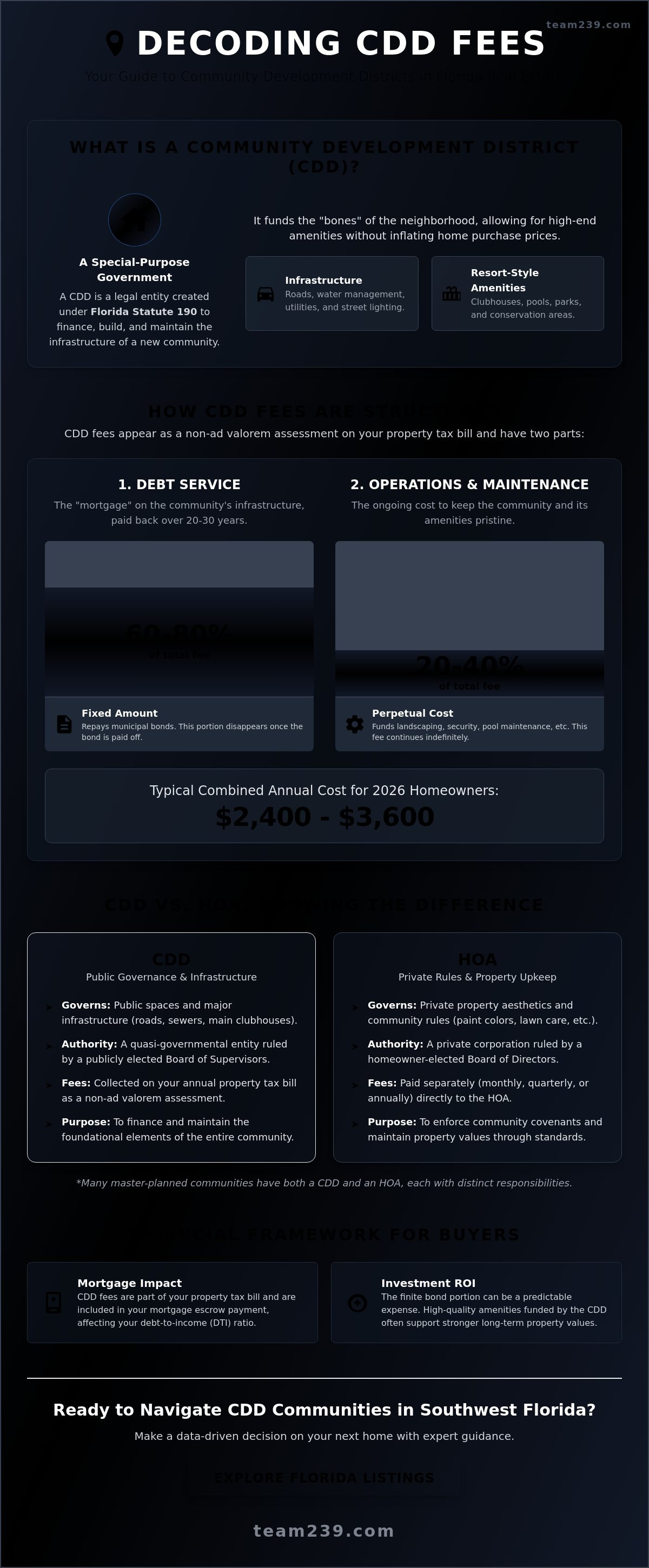
Understanding what are CDD fees in Florida real estate starts with looking at your annual tax bill. These costs aren't a single, flat fee. They're a hybrid of two very different financial obligations. These assessments are listed as "non-ad valorem," meaning they aren't based on your home's value but on the specific benefit your property receives from the community's infrastructure. In the early stages of a development, the debt service portion typically accounts for 60% to 80% of the total fee, while the remaining 20% to 40% goes toward daily operations. For a typical Florida homeowner in 2026, this combined total often ranges between $2,400 and $3,600 annually.
The Debt Service Component: The "Mortgage" on the Land
The debt service is essentially the community's collective mortgage. When a developer builds a neighborhood under the authority of Florida Statutes Chapter 190, they issue municipal bonds to fund the heavy lifting: roads, sewers, and major utilities. These bonds usually have a 20 to 30-year repayment term. The debt is allocated per lot based on the property type. A sprawling estate home will naturally carry a higher debt portion than a smaller townhome. You do have the option to pay off your specific lot's bond portion in a lump sum. While this saves you years of interest and lowers your annual tax bill, it also ties up liquid capital. Once the bond is fully retired after its 20 or 30-year term, this portion of the fee disappears entirely from your tax bill.
Operations & Maintenance: Keeping the Community Pristine
The Operations and Maintenance (O&M) portion is the permanent side of the equation. It funds the "lifestyle" that draws people to Florida. This includes lake management, professional security, pool chemicals, and the manicured landscaping found in luxury enclaves. Unlike the fixed debt portion, O&M fees fluctuate based on the district's annual budget. In 2026, it's common to see O&M costs rise by 3% to 5% annually to account for inflation and rising service costs. If you're seeking new construction buyer representation, we can help you analyze the historical O&M trends in specific Southwest Florida neighborhoods. This data ensures you aren't surprised by budget hikes three years after moving in. When you know exactly what are CDD fees in Florida real estate and how they're managed, you can invest with total clarity.
CDD vs. HOA: Knowing the Critical Differences
Many homebuyers assume a neighborhood has either an HOA or a CDD. In reality, modern Southwest Florida developments often utilize both to manage different aspects of the community. While they might feel similar to your bank account, they operate under entirely different legal frameworks. An HOA is a private, non-profit corporation. A CDD is a public, special-purpose government entity. This distinction changes everything from how you pay to who controls the neighborhood's future.
When you're evaluating what are CDD fees in Florida real estate, look at your payment method first. You pay your HOA fees directly to the association or a management company, usually on a monthly or quarterly basis. Your CDD fees, however, appear as a non-ad valorem assessment on your annual property tax bill. If you have an escrow account, your mortgage company handles the CDD payment along with your taxes; you remain responsible for writing separate checks for the HOA. This separation is vital for your monthly budgeting.
The "Who Pays for What" Breakdown
The division of labor between these two entities is usually based on scale. The CDD typically handles the "heavy" infrastructure. This includes the main entry roads, the master drainage systems, and the street lighting. The HOA focuses on the "soft" side of community life. They enforce architectural standards, manage the social calendar, and oversee private neighborhood gates. In many Naples communities, the CDD might own the clubhouse, while the HOA manages the staff and events inside it. Reading a real estate listing carefully is essential. You need to combine the annual tax assessment with the monthly HOA dues to find your true monthly carrying cost.
Legal Protections and Enforcement
The consequences for missing a payment differ significantly between the two. Because CDD fees are part of your property taxes, failing to pay can eventually lead to a tax deed sale. This is a government-level enforcement action. HOA non-payment, while still serious, follows a private foreclosure process. Governance also looks different. HOA boards are composed of volunteer neighbors who make decisions in private sessions. CDD supervisors are elected officials who must follow strict government protocols. CDD board meetings are open to the public to ensure full legal transparency for all district residents. This "Sunshine Law" requirement means you can review every dollar spent on community maintenance, providing a level of oversight that private HOAs don't always match.
The Financial Impact: Mortgages, Resale, and ROI
Financial planning for a Florida move requires looking far beyond the initial sales price. When buyers ask what are CDD fees in Florida real estate, they often overlook how these assessments change their actual buying power at the bank. Because these fees are collected on your annual property tax bill, lenders treat them as a fixed housing expense. This directly impacts your Debt-to-Income (DTI) ratio. If you're pushing the upper limits of your budget, a high CDD assessment could be the difference between an approval and a denial.
Loan Qualification and Purchasing Power
The math is straightforward but often surprising. A $500,000 home in a high-amenity CDD community might be more difficult to finance than a $550,000 home in an older neighborhood without those fees. This happens because a $3,000 annual CDD assessment adds $250 to your monthly "carrying cost" in the eyes of a lender. That $250 could have covered the interest on a larger mortgage. To navigate this, you need to work with lenders who understand the Florida tax structure and can help you strategize your down payment. Balancing your monthly budget often means looking at the total cost of ownership rather than just the mortgage principal and interest.
Evaluating Long-Term ROI in CDD Communities
Many buyers worry that a CDD fee will make their home harder to sell in the future. However, historical data in 2026 shows that communities with robust, district-funded infrastructure often see higher demand and faster appreciation. The "resort-style" lifestyle created by these funds is exactly what modern buyers are seeking. When you compare carrying costs across Southwest Florida, you'll see that the value of the amenities often outweighs the annual fee. If you're weighing these financial variables, our Naples Florida Homes for Sale: The Complete 2026 Buyer’s Guide provides a deeper look at how different neighborhoods stack up. Understanding what are CDD fees in Florida real estate allows you to treat your home as a strategic asset rather than just a place to live.
Are you ready to explore the best investment opportunities in the current market? Contact us for residential resale representation to ensure your next Florida home purchase is financially sound.
Navigating CDD Communities in Naples and Southwest Florida
In the Southwest Florida market, the conversation isn't just about the home's floor plan; it's about the financial ecosystem supporting it. Identifying what are CDD fees in Florida real estate becomes especially critical when you're looking at high-growth areas like Naples, Estero, and Bonita Springs. In these regions, almost every major new construction project utilizes a CDD structure. This allows developers to mitigate risk while delivering the high-end infrastructure that Florida buyers expect. At Team239, we don't just show you houses. We audit the true cost of ownership by analyzing the district's financial health. We ensure the amenities you're buying into are sustainable for your long-term investment goals.
Local Market Spotlight: Naples and Bonita Springs
In high-demand enclaves like Ave Maria or Pelican Landing, CDD fees are a standard part of the residential landscape. In Collier County, these districts are the primary engine for funding large-scale infrastructure, such as advanced stormwater management and regional utility connections. In 2026, typical fees in the Naples area range from $1,500 to $4,000, though luxury communities can see these assessments reach $5,000 annually. These costs reflect the premium nature of the communal assets, from guard-gated entries to championship golf courses. If you're looking further north, our New Construction Homes in Bonita Springs, FL: The Complete 2026 Buyer’s Guide breaks down specific district costs for that thriving submarket.
Your CDD Due Diligence Checklist
Before you sign a contract on a property within a district, you need a clear financial roadmap. We recommend a three-step audit for every client to avoid surprises at the closing table. First, request an Estoppel Letter. This document is the only way to see the exact remaining bond balance on your specific lot, which is vital if you're considering a lump-sum payoff. Second, analyze the O&M history. We look at the last three years of Operations and Maintenance costs to identify any aggressive upward trends or upcoming capital improvement projects that could spike your bill. Finally, we perform a community-specific cost-benefit analysis. We compare the CDD community against non-CDD alternatives to determine if the lifestyle and infrastructure justify the annual assessment. When you understand what are CDD fees in Florida real estate in the context of your specific neighborhood, you can move forward with total confidence.
Don't let complex fee structures derail your Florida dream. Contact Team239 today to find the perfect SWFL home with fees that fit your lifestyle and your budget.
Secure Your Future in a Southwest Florida Lifestyle Community
Deciding to buy in a district managed neighborhood is about choosing a specific quality of life. Now that you've mastered what are CDD fees in Florida real estate, you can view them as a transparent investment in your community's roads, utilities, and resort style amenities. These assessments aren't hidden costs; they're the engine that drives property values in high demand areas like Naples and Bonita Springs. While the debt service portion eventually retires, the ongoing maintenance ensures your neighborhood stays competitive and pristine for years to come.
Strategic home buying requires a partner who looks beyond the aesthetic appeal and into the district's financial health. Team239 is a family led team under MVP Realty Associates with over 10 years of local expertise. We're specialists in new construction buyer representation, helping you audit bond balances and O&M trends before you commit. We'll ensure your 2026 investment is as sound as it is beautiful. Find Your Dream Home in Southwest Florida with Team239 and start your next chapter with total financial clarity. Your Florida dream is within reach, and we're here to help you navigate every detail.
Frequently Asked Questions
Are CDD fees permanent in Florida?
Only the Operations and Maintenance (O&M) portion of the fee is permanent. The debt service portion, which pays for the community's initial infrastructure, typically has a fixed term of 20 to 30 years. Once the municipal bonds are fully repaid, that specific part of the assessment is removed from your property tax bill, leaving only the ongoing maintenance costs.
Can I deduct CDD fees from my federal income taxes?
In most cases, you cannot deduct these fees on your federal income tax return. The IRS generally classifies CDD assessments as payments for specific local benefits or improvements rather than general ad valorem taxes. It's best to consult with a qualified tax advisor to understand how these payments impact your specific financial situation.
What happens if I don’t pay my CDD fees?
Because these fees are collected on your annual property tax bill, the consequences of non-payment are severe. The county tax collector can issue a tax certificate against your property, which could eventually lead to a tax deed sale. This process is handled by the government and moves much faster than a typical private foreclosure by an HOA.
Do CDD fees ever go down over time?
Yes, your total annual payment will drop significantly once the bond debt is retired at the end of its 20 or 30 year term. While the O&M portion may fluctuate or increase slightly to account for inflation, the elimination of the debt service portion usually results in a lower overall bill for the homeowner.
How do I find out if a specific property has a CDD fee?
The most reliable way to find this information is to check the county property appraiser’s website and view the latest tax bill for the address. You should look under the non-ad valorem assessment section. This transparency ensures you know exactly what are CDD fees in Florida real estate for any home you are interested in purchasing.
Is it better to buy a home with a CDD or an HOA?
The choice depends on your preference for amenities versus carrying costs. CDD communities often provide superior public infrastructure and resort-style facilities that are managed with government level transparency. HOA only communities might have lower fees, but they often feature fewer amenities and may require private special assessments for road or drainage repairs in the future.
Can the CDD Board increase my fees without a vote?
The Board of Supervisors can adjust the O&M portion of the fee during their annual budget process without a community wide referendum. However, they are required by law to hold public hearings where residents can provide input. The debt service portion is fixed and cannot be increased once the bonds are issued.
What is the difference between an ad valorem and a non-ad valorem tax?
Ad valorem taxes are calculated based on the assessed value of your property. Non-ad valorem assessments, such as CDD fees, are flat charges based on the specific service or benefit provided to your lot. When researching what are CDD fees in Florida real estate, remember that these assessments don't change just because your home's market value increases.
Comments