
How to Prevent a Home Sale From Falling Through: A 2026 SWFL Seller’s Guide

Updated: Aug 1
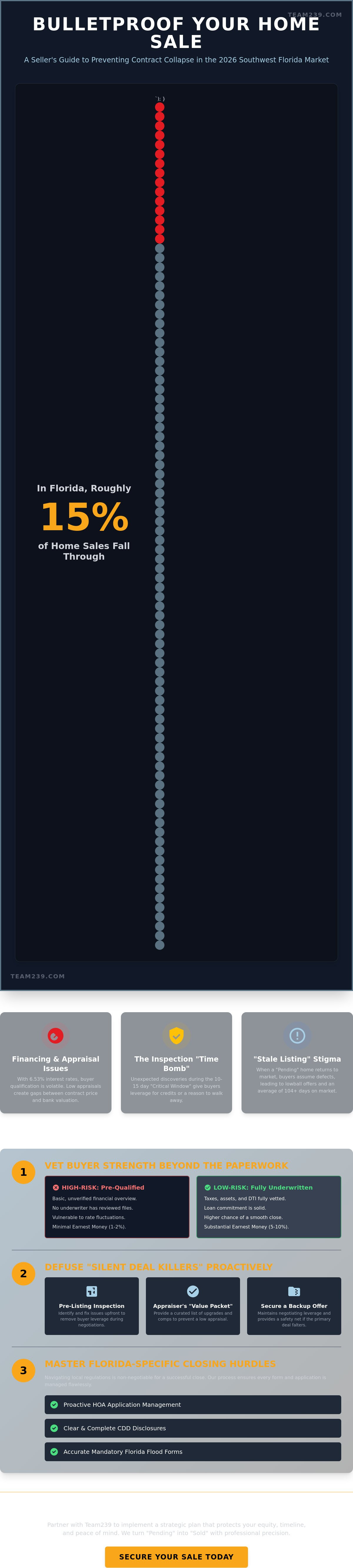
Roughly 15% of Florida residential contracts currently fail to reach the finish line. It's a staggering figure that highlights just how fragile the 2026 Southwest Florida market can be, especially as tighter lending standards and buyer-favorable trends take hold. You've likely felt that nagging worry that a sudden financing glitch or an aggressive inspection report could derail your plans at the eleventh hour. Learning how to prevent a home sale from falling through is the only way to protect your equity and your moving timeline.
We've built a strategic roadmap designed to bulletproof your contract and ensure a seamless closing. This guide covers everything from vetting buyer reliability in a 6.53% interest rate environment to mastering the latest mandatory flood disclosure laws. You'll discover how to minimize repair credits, secure a reliable backup buyer, and maintain total control over the transaction. We're here to help you turn that "pending" sign into a successful closing with precision and professional confidence.
Table of Contents
Why Real Estate Deals Collapse in Southwest Florida
A "fallen through" sale occurs when a signed purchase agreement fails to reach the final table. In the 2026 Southwest Florida market, this isn't just a minor inconvenience; it's a structural risk to your financial goals. Data from early 2026 suggests that roughly 10% to 15% of residential contracts in Florida fail to close. In competitive pockets like Naples and Bonita Springs, where luxury valuations and complex financing meet, the stakes are even higher. Understanding how to prevent a home sale from falling through requires a clinical look at the "Critical Window." This 10 to 15 day period immediately following the execution of the contract is where most deals die, usually due to inspection discoveries or initial financing hurdles.
As the deal progresses through the closing process, every day your home stays off the market represents a compounding risk. If the buyer walks away after three weeks, you haven't just lost a buyer; you've lost the market momentum that only a "New Listing" status provides. We focus on identifying these cracks before they become chasms, ensuring that the transition from contract to keys is handled with professional precision.
The "Stale Listing" Stigma in Naples and Estero
When a property returns to the market after being "Pending," buyers immediately ask what's wrong with it. They often assume there's a hidden defect or a structural issue even if the buyer simply had cold feet. This "stale" reputation can lead to lower subsequent offers and increased days on market, which currently averages about 104 days in some South Florida sectors. To combat this in areas like Naples or Marco Island, our strategy involves securing a backup offer immediately. It maintains your leverage and provides a safety net that keeps the sale's momentum alive without sounding defensive to new prospects.
The Cost of a Failed Sale in the 2026 Market
A failed sale is an expensive lesson. Beyond the emotional stress, the financial carrying costs for a Naples luxury home add up quickly. With Florida's average annual homeowner's insurance premium sitting at approximately $3,815 and Lee County's property tax rate at 0.78%, every month of delay costs thousands in unrecoverable expenses. If a deal collapses after 45 days, you've paid for those six weeks of ownership and missed the opportunity to sell during a more favorable market window. In a 2026 environment where mortgage rates hover around 6.53%, buyer sentiment can shift in a matter of weeks. Time is the enemy of every real estate deal. The longer a contract lingers, the more chances there are for external variables to disrupt your progress.
While managing carrying costs is vital, sellers should also be aware of how professional service fees impact their bottom line; for a broader perspective, Associated Real Estate allows you to explore Real Estate Transaction Commissions to see how these costs are handled in other active regions.
Securing the Financial Foundation: Financing and Appraisals
Financing failure remains the primary reason real estate transactions collapse. In May 2026, with the 30-year fixed mortgage rate sitting at 6.53%, buyer qualification has become more volatile than in previous years. A standard pre-approval letter is no longer enough to guarantee a closing. To master how to prevent a home sale from falling through, you must look past the paperwork and verify the buyer's actual liquidity. This is especially true in the Southwest Florida luxury sector, where "cash offers" frequently require a formal Proof of Funds to ensure the assets aren't tied up in non-liquid investments or pending business exits.
Our Luxury Property Listing Services prioritize this financial vetting process from day one. We don't just wait for the lender's commitment letter. We actively engage with the buyer's financial team to confirm that the deal is built on solid ground.
Verifying Buyer Strength Beyond the Paperwork
A "Pre-Qualified" buyer is vastly different from one who is "Fully Underwritten." The latter has already had their taxes, assets, and debt-to-income ratios scrubbed by an actual underwriter. Your listing agent should call the buyer's lender personally. They need to ask if the appraisal has been ordered, if there are any outstanding conditions, and if the buyer's current debt-to-income ratio can withstand a minor rate fluctuation. Additionally, pushing for a substantial Earnest Money Deposit (EMD) acts as a litmus test. A buyer willing to put 5% or 10% down as a deposit is far less likely to walk away than one offering a minimal amount.
Navigating Low Appraisals in a Luxury Market
In high-demand areas like Naples and Bonita Springs, market prices often move faster than the historical data appraisers use. This creates an "appraisal gap" where the bank's valuation comes in lower than the contract price. To prevent this from killing the deal, we provide the appraiser with a "Value Packet." This includes a curated list of upgrades, receipts for recent renovations, and the most relevant high-value comps that justify your price point. Accurate valuation is a universal priority for high-end real estate; for a look at how experts handle property estimation and sales in international markets like Geneva, check out JSRE Sàrl. If the gap persists, you generally have three paths forward:
The buyer brings additional cash to the table to cover the difference.
The seller agrees to reduce the price to the appraised value.
Both parties meet in the middle to bridge the shortfall.
A proactive strategy involves negotiating an "Appraisal Gap Guarantee" in the initial contract. This clause requires the buyer to cover a specific dollar amount if the appraisal comes in low. It provides a safety net that protects your bottom line and keeps the transaction moving toward the finish line despite bank-level conservatism.
Defusing the Inspection Time Bomb
The inspection period is the most common exit ramp for buyers in Southwest Florida. It is the moment where emotional excitement meets cold, hard reality. In 2026, buyers are more cautious than ever, often using the inspection report as a secondary negotiation tool to drive prices down. Learning how to prevent a home sale from falling through during this phase requires a shift from a reactive to a proactive mindset. If you wait for the buyer's inspector to find a leak or an aging HVAC system, you've already lost the upper hand.
Southwest Florida presents unique challenges that can derail a contract in days. Roof wear, moisture intrusion, and aging mechanical systems are the most frequent deal-killers in our tropical climate. While homeowner's insurance rates in Florida are beginning to stabilize in 2026, with Citizens and Florida Peninsula seeing average reductions of over 8%, carriers remain strict about roof age. If your roof is nearing its 15 or 20-year mark, it might be uninsurable for the buyer. This kills the deal instantly because the buyer cannot secure a mortgage without a binding insurance policy.
The Case for a Pre-Listing Inspection
A pre-listing inspection in Southwest Florida typically costs between $400 and $600. While some sellers hesitate to spend this upfront, it is a strategic investment that can prevent a massive price drop during escrow. By uncovering issues like outdated electrical panels or evidence of past moisture before the home goes live, you have the luxury of time. You can shop for competitive repair quotes or choose to disclose the issue upfront. This transparency builds immediate trust. When you present a completed repair list to a prospective buyer, you eliminate their primary leverage for a last-minute price reduction.
Handling Repair Demands Strategically
The "As-Is" contract is a common misunderstanding in Florida real estate. Even with this structure, buyers have the right to inspect and cancel if they aren't satisfied. When repair demands arrive, categorize them immediately. Focus on safety and code issues, such as structural leaks or HVAC failures. Cosmetic items should be handled with a firm "no."
Offering a "Closing Credit" is almost always superior to performing repairs yourself. It removes the liability of a "bad repair" coming back to haunt you after the closing. It also keeps the timeline moving. Repairs take time to schedule and inspect; credits happen instantly at the closing table. This approach ensures you maintain momentum and prevents the deal from stalling over minor maintenance items.
Mastering Florida-Specific Closing Hurdles
Florida real estate involves unique administrative layers that can catch even experienced sellers off guard. If you're strategizing how to prevent a home sale from falling through, you must look beyond the purchase price and focus on the regulatory fine print. In Southwest Florida, the "open permit" trap is a frequent deal-killer. A minor renovation from years ago with an unclosed permit in Collier or Lee County can halt a title transfer instantly. Resolving these discrepancies before the buyer’s title company finds them is essential for maintaining your closing timeline.
Flood zone transitions also play a massive role in 2026. Since the mandatory flood disclosure law took effect in late 2024, sellers must be transparent about a property’s water history from the start. While 2026 has seen average insurance rate reductions from carriers like Citizens and Security First, a sudden high-premium quote for a buyer can still trigger a cancellation. Providing elevation certificates and insurance history early removes this uncertainty and keeps the buyer committed.
Managing HOA and Condo Association Approvals
Gated communities in Naples and Bonita Springs often require board approval for new owners. This process involves background checks, credit reviews, and occasionally in-person interviews. It is a silent deal-killer because the timeline is entirely out of your control. To mitigate risk, ensure the buyer receives the "Condo Docs" or HOA bylaws the moment the contract is signed. This starts the statutory review clock immediately. In many SWFL communities, a "Right of First Refusal" clause exists, where the association can step in to match the buyer's offer. We track these deadlines with engineering precision to ensure no association delays derail your progress.
Clearing Title and CDD Fee Disclosures
We recommend performing a preliminary title search the day you sign your listing agreement. This uncovers old liens or clerical errors that could take weeks to fix. Transparency is also key regarding Community Development District (CDD) fees. These fees are common in master-planned developments and fund the premium Southwest Florida lifestyle that attracts buyers to the region. Disclosing these costs, along with any upcoming assessments for golf course or clubhouse renovations, prevents "sticker shock" during the final weeks of the transaction.
Ready to bulletproof your transaction? Our Residential Resale Representation team specializes in navigating these local complexities to ensure a smooth, on-time closing.
Partnering for a Seamless Closing in SWFL
Closing a real estate transaction in Southwest Florida requires more than just a signed agreement. It demands a rigorous, systems-based approach to ensure that initial excitement translates into a successful wire transfer. One of the most effective ways how to prevent a home sale from falling through is by fostering transparent communication between the listing agent and the buyer’s agent. This relationship is the "glue" that holds the deal together when friction arises during the final walkthrough or when a lender requests one last document. When agents work as partners rather than adversaries, logistical hurdles are solved before they become deal-killers.
We also leverage digital marketing to maintain a "Backup Buyer" list for every listing. By keeping interest high even after a contract is signed, we ensure you never lose your leverage. If the primary buyer develops cold feet or their financing fails in the 6.53% interest rate environment, we often have a qualified secondary option ready to step in. This strategy minimizes your days on market and protects your equity from the stigma of a returned listing.
The Role of Transaction Management
A standard Florida real estate contract contains over 50 specific deadlines. Missing just one can give a buyer a legal "out" to reclaim their deposit and walk away. Our transaction management protocol tracks every milestone with precision. We ensure all contingencies, from financing to HOA approval, are cleared in writing. We don't rely on "silence" as a confirmation of progress. By coordinating closely with local title companies in Naples and Fort Myers, we streamline the signing process and ensure all documents are ready well before the closing date.
How Team239 Protects Your Equity
Our approach to how to prevent a home sale from falling through starts with a "Vetting the Buyer" protocol. We look beyond the standard pre-approval letter to confirm the buyer's actual liquidity and commitment. Our deep understanding of the Naples Florida homes for sale guide allows us to attract high-quality buyers who are genuinely invested in the region.
Additionally, our local expertise in new construction homes Bonita Springs helps us manage expectations for resale sellers by understanding the current competitive landscape. The final walkthrough shouldn't be a source of anxiety. We guide you through the preparation process to avoid last-minute disputes over cleanliness or left-behind items, ensuring a professional hand-off.
Secure Your Success in the Southwest Florida Market
Winning in the 2026 real estate landscape requires more than just a signed contract; it requires a bulletproof strategy from day one. You've learned that the secret to how to prevent a home sale from falling through lies in proactive vetting, transparent disclosures, and precise transaction management. By addressing inspection deal-killers early and verifying buyer liquidity beyond a simple letter, you stay in control of your equity and your timeline. A successful closing is the result of intentional preparation rather than good luck.
With over 10 years of experience in the Naples and SWFL luxury market, Team239 brings a unique blend of technical precision and local insight to every transaction. As a family-led team with deep roots in Bonita Springs and Estero, we maintain one of the highest contract-to-close ratios in Collier County. We don't just list properties; we engineer results through strategic partnership and modern digital expertise.
Contact Team239 to Bulletproof Your Home Sale and ensure your transition is as smooth as the Florida sunset. You've worked hard to build your home's value, and we're here to help you protect it through to the final signature.
Frequently Asked Questions
What is the most common reason a house sale falls through?
Financing failure remains the leading cause of contract collapses. In the 2026 market, tighter lending standards and the 6.53% average 30-year fixed mortgage rate mean even pre-approved buyers can face rejection during the final underwriting phase. Debt-to-income ratios are being scrutinized more heavily now than in previous years, making it essential to verify a buyer's financial stability before signing.
Can a seller sue a buyer for backing out of a deal in Florida?
While Florida law technically allows for "specific performance" lawsuits, most residential contracts limit the seller's remedy to the earnest money deposit. Suing a buyer is often a slow and expensive process that keeps your home tied up in legal limbo. Most sellers find it more efficient to retain the deposit as liquidated damages and immediately move to a backup offer.
How long does a buyer have to back out after an inspection?
The cancellation window is defined by the "Inspection Period" in your specific contract. While the Florida Far-Bar default is often 15 days, many Naples and Bonita Springs sellers negotiate this down to 7 or 10 days. During this timeframe, a buyer can typically cancel for any reason and receive a full refund of their earnest money deposit.
What happens to the earnest money deposit if the sale falls through?
The fate of the deposit depends on the timing of the cancellation. If the buyer backs out within a valid contingency window, such as the inspection or financing period, the money is usually returned to them. However, if the buyer defaults after these contingencies have cleared, the seller typically has the right to claim the deposit as compensation for the lost time.
How can I prevent a low appraisal from killing my sale?
Securing an "Appraisal Gap Guarantee" during initial negotiations is the most effective strategy. This clause commits the buyer to bringing additional cash to the closing table if the bank's valuation comes in below the purchase price. Providing the appraiser with a detailed list of recent upgrades and local comps also helps ensure the valuation reflects the true market price.
Is an "As-Is" contract safer for a seller in Southwest Florida?
An "As-Is" contract limits your legal obligation to perform repairs, but it doesn't prevent a buyer from walking away. It's a common myth that these contracts are "final." In reality, the buyer can still use the inspection period to request price reductions or credits, and they maintain the right to cancel if those demands aren't met.
Should I accept a buyer who has to sell their own home first?
This is known as a "Sale of Property" contingency and it carries significant risk. If you accept such an offer, you should always include a "Kick-out Clause." This allows you to keep marketing the property and gives the original buyer a short window, often 48 to 72 hours, to remove their contingency if you receive a better offer from someone else.
How does a backup offer work and should I have one?
A backup offer is a legally binding contract that automatically moves into the primary position if the first deal fails. Having one is a vital part of how to prevent a home sale from falling through because it maintains your leverage. It prevents the "stale listing" stigma and ensures you don't have to start your marketing efforts from scratch if the initial buyer defaults.
Comments