
What Happens to Escrow Money if a Deal Falls Through in Florida? (2026 Guide)

Updated: Aug 1
In Florida real estate, the contract is king; your escrow return is determined by milestone mastery rather than just fairness. You've likely spent months searching for the perfect property, only to watch the deal stall at the final hour. Now, you're left wondering exactly what happens to escrow money if deal falls through Florida and whether your hard earned deposit is gone for good. It's a high stakes situation where confusion over FAR/BAR contract language can lead to devastating financial losses. In April 2026 alone, seven licensees had their licenses revoked for mishandling these very funds, proving that even the professionals can't afford to be careless.
We know that a failed luxury transaction is stressful enough without the added fear of losing thousands of dollars. This guide provides a clear roadmap to recovering your funds and understanding your legal rights under 2026 statutes. You'll learn who keeps the earnest money and how to navigate the process without ending up in a court battle. We'll explore the $50,000 FREC dispute threshold and the 90 day mediation window to ensure you have the strategic edge needed to protect your investment.
Table of Contents
What is Escrow and Who Holds the Money in Florida?
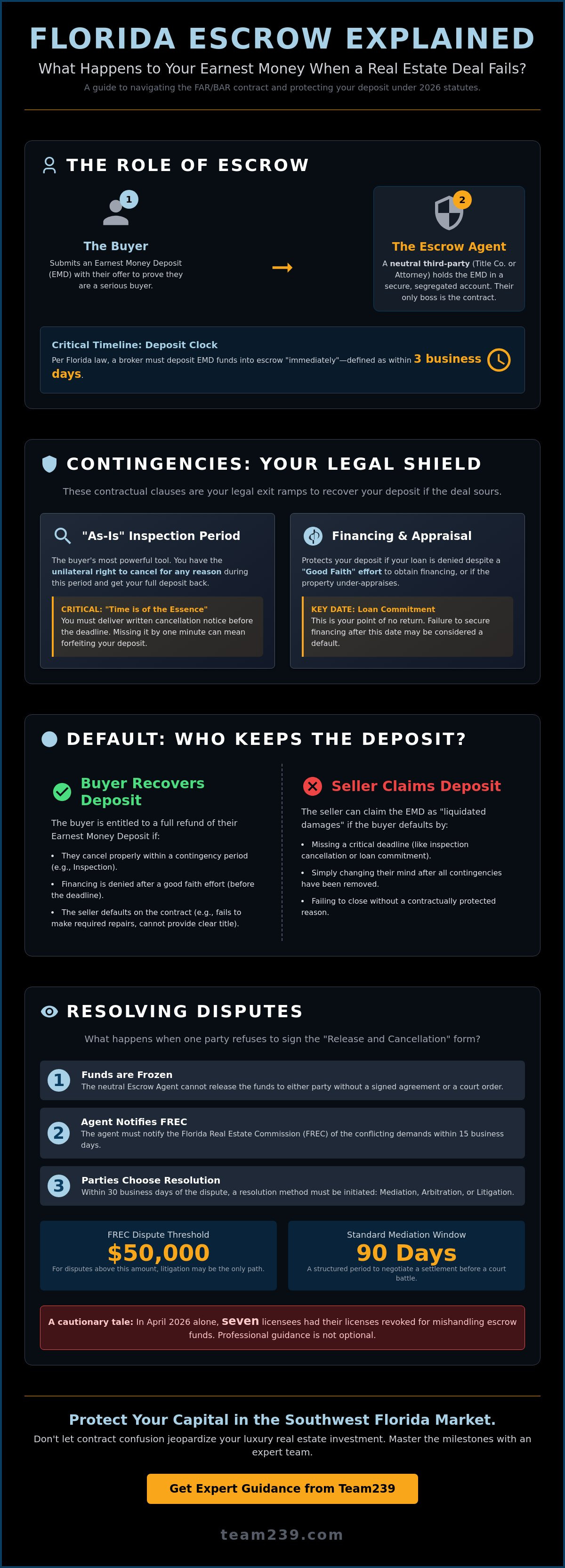
Escrow isn't a mere formality or a "gesture" of good faith. In the Florida real estate ecosystem, it's a critical financial buffer. To understand What is Escrow?, you must view it as a secure holding area for your Earnest Money Deposit (EMD). This capital proves you're a serious buyer. Once you submit your offer, this money is moved into a segregated account, separate from the broker's operating funds. Florida law is incredibly strict about this separation. Rule 61J2-14.010(2) allows a broker to maintain up to $1,000 of personal funds in a sales escrow account to keep it active, but your deposit must remain untouched for any other purpose. Under Rule 61J2-14.008(3), a broker must deposit these funds "immediately," which the state defines as within three business days. This timeline ensures your capital remains protected from the moment the transaction begins.
Understanding exactly what happens to escrow money if deal falls through Florida starts with identifying the Escrow Agent. This is typically a title company or a real estate attorney. They act as a neutral gatekeeper. They don't work for the buyer, and they don't work for the seller. Their only boss is the contract itself. Because of this neutrality, the agent cannot unilaterally release funds. Even if one party clearly breached the agreement, the agent requires a signed "Release and Cancellation" from both sides before moving a single cent. This prevents the "he-said, she-said" disputes from turning into an immediate financial loss.
The Neutral Third-Party Rule
Your Realtor doesn't actually "have" the money. While a real estate associate must deliver the deposit to their broker by the end of the next business day, the funds quickly move to the designated escrow account. Florida Statute 475.25 and § 651.033 govern these professional obligations. The title company must maintain strict compliance with the contract terms. They are legally prohibited from playing favorites. This protection is vital; it ensures that your funds aren't subject to the whims of the other party. If the title company fails to follow these rules, they face severe regulatory penalties.
Earnest Money vs. Down Payment
Escrow is a portion of your total purchase price, not an additional fee. At closing, this deposit is credited toward your down payment. In the Naples and Bonita Springs luxury markets, these deposits often represent a significant percentage of the transaction value to show serious intent. This EMD functions as "liquidated damages." If a buyer defaults without a legal excuse, the seller typically keeps this amount as compensation for taking the home off the market. It's a high stakes commitment that demands precise management of every contractual milestone. Understanding this distinction helps you view the deposit as a strategic tool rather than just a cost of doing business.
How Contingencies Protect Your Escrow Deposit
Contingencies aren't just fine print; they are the legal firewalls protecting your capital. In the Florida market, most residential transactions utilize the FAR/BAR "As-Is" contract, which includes a "Time is of the Essence" clause. This means deadlines are absolute. Missing a window by a single minute can transform a protected exit into a costly default. Understanding these milestones is the only way to truly grasp what happens to escrow money if deal falls through Florida. When you navigate these timelines with precision, the contract works for you. If you ignore them, the seller gains a legal claim to your deposit.
The 'As-Is' Inspection Clause
The inspection period is the most versatile shield in a buyer's arsenal. Under the standard "As-Is" agreement, you have the unilateral right to cancel the contract for any reason. You don't need to prove the roof is leaking or the HVAC is failing. If you simply decide the floor plan doesn't suit your lifestyle, you can walk away with your full deposit intact. The inspection period serves as a vital "free look" window for Florida buyers to evaluate their investment without risk. However, the clock is relentless. You must deliver written notice of cancellation to the seller or their agent before 11:59 PM on the final day of your agreed-upon window. Failure to do so effectively "locks in" your deposit regarding physical condition issues.
Financing and Appraisal Safeguards
Financing contingencies in 2026 require high-level coordination between your lender and your legal team. The Loan Commitment Date is your point of no return. Prior to this date, if your mortgage is denied despite a "Good Faith" effort, your escrow remains protected. This effort involves providing all requested documentation to your lender on time and maintaining the financial status quo. If a denial happens after this date without a proper extension, your deposit is suddenly at high risk. Appraisal gaps also play a significant role. If a property appraises below the contract price, it triggers a legitimate path for an escrow return, provided the appraisal contingency was not waived. Legal frameworks, such as those discussed in Resolving Escrow Disputes, clarify how these safeguards function when a deal stalls. Partnering with luxury real estate agents who track these specific milestones daily is the best strategy for maintaining your "milestone mastery" and keeping your funds secure.
Buyer Default vs. Seller Default: Who Keeps the Money?
Determining what happens to escrow money if deal falls through Florida often comes down to identifying which party breached the contract's "milestone" framework. In a standard Florida residential agreement, the escrow deposit serves as "liquidated damages" in the event of a buyer default. This is a strategic protection for buyers; it caps the seller's recovery at the amount already in escrow. It prevents the seller from suing for further financial damages if the deal collapses. For a seller, this deposit is the primary compensation for the time and market opportunity lost while the property was under contract. It's not a penalty; it's a pre-agreed valuation of the seller's risk.
If a dispute escalates, brokers must follow Florida's official escrow dispute procedures. These rules ensure that funds aren't distributed arbitrarily. When the deal fails because a buyer simply gets "cold feet" after the inspection period has closed, the seller typically has a clear path to the funds. Conversely, if a seller fails to deliver a clear title or refuses to complete contractually obligated repairs, the buyer is entitled to a full return of their capital. The path to recovery is paved by the specific language in your contract rather than general notions of fairness.
When the Buyer is at Fault
A buyer's default isn't always a dramatic walk-away; it's often a failure of technical execution. Missing the financing commitment date without providing a written notice or failing to deliver a required second deposit are common triggers for forfeiture. Once contingencies are waived or deadlines pass, the deposit transitions from a protected asset to at-risk capital. In the luxury market, where deposits are substantial, these technicalities carry immense weight. If you're out of contract and haven't secured an extension, you've essentially handed the seller a legal claim to your EMD.
When the Seller Breaches the Contract
Sellers can't simply change their minds because they received a higher offer. Seller's remorse isn't a legal exit. If a seller refuses to close without a valid reason, the buyer doesn't just get their money back; they may have the right to sue for "Specific Performance." This legal action seeks to force the seller to complete the sale as agreed. Additionally, if the seller can't provide a clear title by the closing date, they've breached the agreement. In these cases, the buyer typically receives a full refund of their escrow deposit along with potential reimbursement for legal fees incurred during the process.
Resolving Escrow Disputes: When Parties Won't Sign
The "Release and Cancellation" form is the definitive solution for most failed transactions. It's a mutual agreement that instructs the escrow agent exactly how to distribute the funds. However, when emotions run high, one party may refuse to sign, effectively freezing the capital. This deadlock is often the most stressful phase of a failed sale. If you're stuck in this position, understanding what happens to escrow money if deal falls through Florida requires looking beyond the contract into state regulatory procedures. Escrow agents have specific reporting requirements when they receive conflicting demands. If a broker is holding the funds, they are typically required to notify the Florida Real Estate Commission (FREC) of the dispute promptly. This reporting triggers a formal process designed to prevent funds from sitting in limbo indefinitely.
Stalemates don't just affect the buyer and seller; they put the escrow agent in a difficult legal position. Under Florida law, the agent cannot play judge. They must remain neutral until both parties agree in writing or a legal authority provides a directive. This is why the "Release and Cancellation" is often called the golden ticket. Without it, the money remains locked in a non-interest-bearing account, benefit to no one. Moving past this hurdle requires a strategic understanding of the mediation and litigation paths common in the Southwest Florida market; for an example of how professionals navigate such complexities, you can check out Brennans Solicitors.
Mediation and the FAR/BAR Process
Most FAR/BAR contracts mandate mediation as the first step in resolving a stalemate. This is a non-adversarial process where a neutral third party helps both sides reach a compromise. In Florida, if a dispute is submitted to mediation, the process must be successfully completed within 90 days. Industry reports suggest that approximately 80% of these disputes are settled during this phase, avoiding the need for a judge. It's a results-oriented move that saves time and preserves the majority of the deposit for the rightful party. Mediation allows for creative settlements that a court might not offer, such as splitting the deposit in a way that reflects the unique circumstances of the failed deal.
Interpleader: When the Court Decides
When mediation fails or the disputed amount exceeds $50,000, the situation often moves toward an interpleader action. In these cases, FREC will not issue an Escrow Disbursement Order (EDO). Instead, the escrow agent deposits the funds with the local clerk of courts and asks a judge to decide the winner. This is the least desirable outcome. The title company or attorney is usually entitled to deduct their legal fees and court costs directly from the escrow deposit before handing it over to the court. In smaller disputes, these legal costs can consume a significant portion of the total funds. Reaching a settlement is almost always more profitable than a protracted court battle. If you're facing a stubborn seller or buyer, consulting with expert luxury real estate agents can provide the tactical guidance needed to resolve the conflict before it reaches the courtroom.
Protecting Your Deposit in the Southwest Florida Market
In the high velocity markets of Collier and Lee County, the margin for error is razor thin. Protecting your capital requires more than just a signed agreement; it demands a strategic choice of partners. Selecting a reputable title company in Naples or Bonita Springs is your first line of defense. These entities act as the impartial stewards of your wealth. When you're managing a luxury transaction, the complexity scales with the purchase price. This makes the question of what happens to escrow money if deal falls through Florida even more critical. You need a team that treats your deposit with the same engineering precision used in modern product development. Precise execution during the escrow phase prevents the stress of a failed transaction from turning into a total financial loss.
Success in this market relies on a clear roadmap. To ensure a smooth closing, follow this final checklist for Collier or Lee County:
Verify the escrow agent has received and cleared the initial deposit within three business days.
Confirm the title company is not holding more than $5,000 of its own funds in a property management account or $1,000 in a sales account.
Monitor the loan commitment date with digital alerts to prevent accidental contingency waivers.
Ensure all "Release and Cancellation" documents are signed immediately if a deal fails to avoid the $50,000 FREC dispute threshold.
The New Construction Exception
New construction escrow rules differ significantly from residential resales. While resale transactions typically use the FAR/BAR contract, builders use proprietary forms that heavily favor the developer. In many cases, builder deposits become non-refundable after a very short rescission period. You won't have the same "As-Is" flexibility found in traditional deals. Understanding these nuances is essential before committing to new construction homes in Bonita Springs. Builders often use your deposit to fund construction milestones, making the recovery of funds nearly impossible if you change your mind later in the process.
Expert Representation in Naples and Marco Island
Our team understands that luxury transactions require a holisitic, system level approach. Jonathan and Kristin Van Heukelom utilize advanced digital tracking to ensure no contingency deadline is ever missed. This technical thoroughness is why clients trust us with their Naples luxury real estate investments. We stay ahead of shifting regulations, such as the vacated FinCEN reporting rules, to provide you with the most current strategic advice. By combining local market knowledge with a commitment to transparency, we protect your interests from the first deposit to the final signature. If you're ready to move forward with a partner who prioritizes your financial security, contact our luxury real estate agents today to begin your journey with confidence.
Mastering the Florida Escrow Milestone
Navigating the technicalities of the FAR/BAR contract requires more than just luck; it demands milestone mastery. By understanding the neutral role of the escrow agent and the strict deadlines of the "As-Is" period, you're positioned to protect your capital. You now have the clarity to understand exactly what happens to escrow money if deal falls through Florida and how to leverage mediation before a dispute escalates. Whether you're navigating a luxury resale or a complex new construction project, the right representation ensures your earnest money remains a strategic asset rather than a liability.
As a family-led team with MVP Realty Associates, we bring over 10 years of Southwest Florida market expertise to every transaction. We specialize in luxury and new construction contracts, providing the digital precision needed to safeguard your interests in Collier and Lee County. Protect your investment—contact Team239 for expert Naples real estate guidance today. We're here to help you move forward with confidence, ensuring your next real estate move is both secure and successful.
Frequently Asked Questions
Is the escrow deposit refundable in Florida during the inspection period?
Yes, your escrow deposit is fully refundable during the inspection period if you provide written notice of cancellation before the deadline. Under the standard FAR/BAR "As-Is" contract, you can walk away for any reason or no reason at all. This window serves as your primary protection, allowing you to recover your funds without needing to prove any defects in the property or justify your decision to the seller.
How long does a seller have to return escrow money after a deal falls through?
There is no fixed statutory deadline for a seller to sign a release, but once both parties execute a "Release and Cancellation," funds are typically disbursed within 2 to 5 business days. If a dispute arises, Florida brokers must notify the Florida Real Estate Commission within 15 business days. Understanding what happens to escrow money if deal falls through Florida depends largely on how quickly both sides reach an agreement or enter the mandatory mediation process.
What happens if a buyer fails to make the second escrow deposit on time?
Failing to make the second escrow deposit on time constitutes a technical breach of the contract. This default allows the seller to terminate the agreement and potentially claim the initial deposit as liquidated damages. Because Florida contracts prioritize "Time is of the Essence," even a 24 hour delay can put your entire transaction and previous deposits at risk. It's vital to track these milestones with digital precision to avoid an accidental default.
Can a seller keep my escrow if I lose my job and can't get a loan?
Your deposit remains protected only if you are still within the financing contingency period and have made a "Good Faith" effort to secure the loan. If you lose your job after the Loan Commitment Date has passed without a written extension, you may forfeit your escrow. Sellers are generally not required to return funds for a buyer's financial change of status once the contingency window closes and the deposit becomes non-refundable.
Who pays for the interpleader action if an escrow dispute goes to court?
The escrow deposit itself typically pays for the initial legal fees and court costs of an interpleader action. The title company or attorney filing the action is usually entitled to deduct their expenses directly from the funds before depositing the remainder with the court. This means a significant portion of your capital could be consumed by legal bills before a judge even begins to review the merits of your case.
Does the title company decide who gets the escrow money in a dispute?
No, a title company cannot decide who receives the funds in a dispute. They act as a neutral third party and are legally prohibited from playing judge or favoring one client over another. They can only release the money if both parties sign a mutual release, or if they receive a final judgment from a court or an Escrow Disbursement Order from the Florida Real Estate Commission.
Can I back out of a Florida real estate contract if the house appraises low?
You can back out and recover your deposit if the property appraises below the purchase price, provided your contract includes an appraisal contingency. This safeguard allows you to terminate the deal if the lender refuses to fund the full amount or if the seller refuses to adjust the price to match the appraised value. It's a vital tool for ensuring you don't overpay or lose your escrow due to a valuation gap.
What is a 'Good Faith' dispute in Florida real estate law?
A "Good Faith" dispute occurs when both parties have a legitimate, contractually based claim to the funds that hasn't been resolved through standard communication. In Florida real estate law, this triggers specific broker reporting requirements to the state. It distinguishes a sincere legal disagreement over contract interpretation from a party simply being difficult or refusing to sign a release without any valid contractual justification.
Comments