
Red Flags to Look for When Buying a Florida Home: The 2026 Buyer's Checklist
Updated: Aug 3
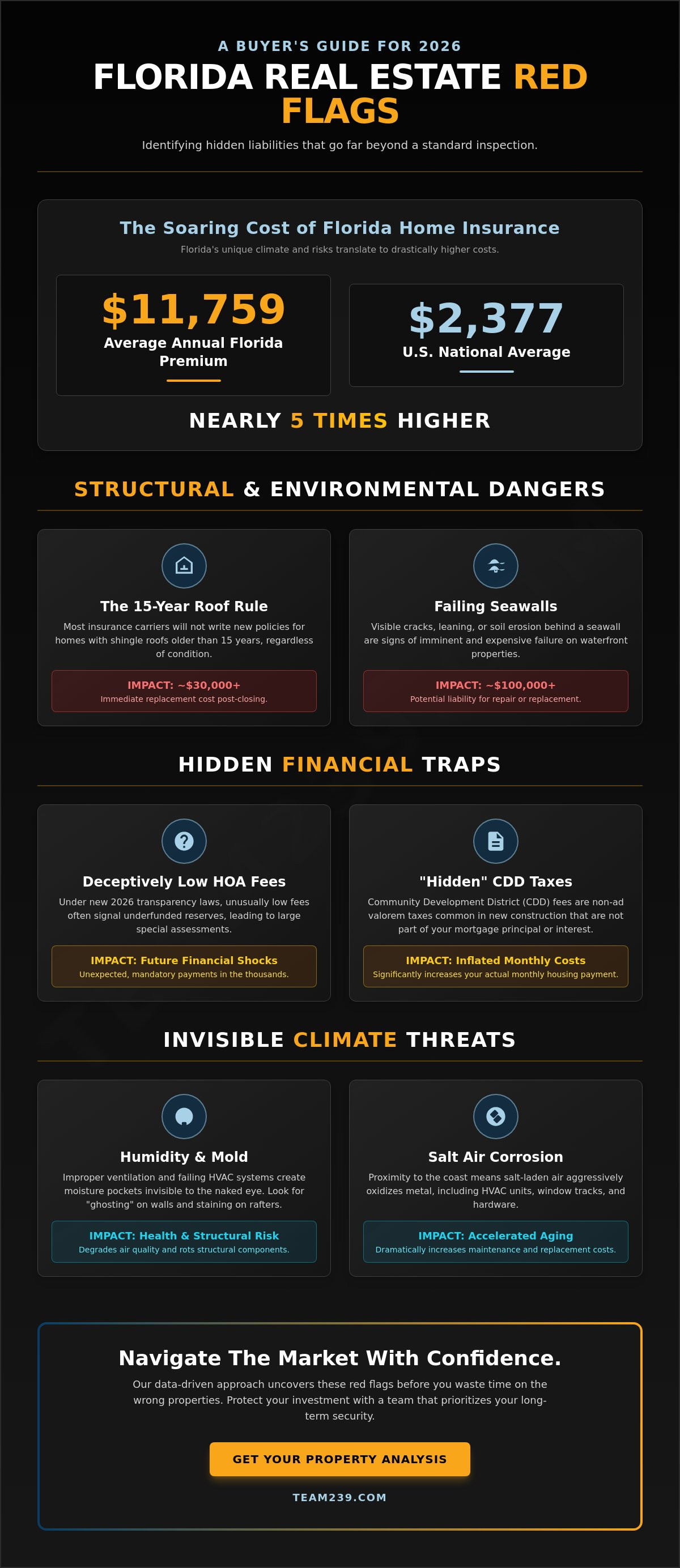
Did you know the average Florida homeowner now pays $11,759 annually for insurance, which is nearly five times the national average? While the market is showing signs of stabilization in 2026, the real danger isn't just the premium; it's the hidden liabilities tucked away in property records and structural gaps. Identifying the critical red flags to look for when buying a Florida home requires a specialized lens that goes far beyond a standard walkthrough or a fresh coat of paint.
It's understandable if you're feeling uneasy about high risk flood zones, skyrocketing costs, or the long term structural integrity of a post-hurricane property. You deserve a home that offers security and growth, not a recurring financial crisis. We believe in a transparent, data driven approach to real estate that prioritizes your long term peace of mind over a quick sale.
This guide will show you exactly how to evaluate a property's true health before you sign. We'll cover the new 2026 HOA transparency requirements, the impact of upcoming building code changes, and the financial warning signs hidden in mandatory condo reserve studies. You'll gain a clear, professional roadmap to navigate the Florida market with absolute confidence.
Table of Contents
Beyond the Surface: Why Florida Real Estate Requires a Unique Lens
Buying a home in the Sunshine State isn't like buying property anywhere else. The environment here is aggressive. The physical red flags to look for when buying a Florida home are often invisible to the untrained eye because the climate works against a building's structure 24/7. Intense UV rays, 90 percent humidity, and salt-laden breezes accelerate the aging process of standard building materials. A home that's only ten years old in Florida can easily show the wear and tear of a thirty-year-old property in the Midwest.
Most buyers rely on a standard 4-point inspection. While this is a requirement for securing insurance, it's the bare minimum. It only evaluates the roof, electrical, plumbing, and HVAC systems. It doesn't account for the structural integrity of the foundation or the micro-cracks in the stucco that lead to water intrusion. In coastal markets, we often see "lipstick on a pig" renovations where high-end finishes mask systemic issues like salt-damaged wiring or outdated hurricane protection. Real value in 2026 isn't found in the quartz countertops; it's found in the systems that protect the interior from the elements.
The Humidity and Mold Connection
Improper ventilation is a silent killer for Florida homes. When you walk through a property, check the attic spaces and crawl areas for signs of compressed insulation or dark staining on the rafters. These indicate that the home isn't breathing correctly. Pay attention to "ghosting" on the walls, which appears as faint, dark streaks that follow the studs. This often signals a failing HVAC system that can't manage the moisture load. Thermal imaging is a non-negotiable for Florida inspections because it detects moisture pockets and insulation gaps that are invisible to the naked eye.
Salt Air Corrosion: The Invisible Killer
Proximity to the Gulf of Mexico changes your maintenance budget immediately. Salt air doesn't just impact the view; it causes premature oxidation on everything it touches. Check the outdoor HVAC condenser units for salt-related pitting on the delicate fins. If the metal looks brittle or "eaten away," the unit is likely near the end of its lifespan regardless of its age. You should also inspect window tracks and door hardware for white, powdery residue or rust. Understanding Climate Change Risks in Florida is essential for modern buyers, as rising sea levels and increased storm frequency make these corrosive environmental factors even more relevant to your long-term investment. Identifying these red flags to look for when buying a Florida home early can save you tens of thousands in unexpected repairs after closing.
Structural and Environmental Red Flags: Roofs, Floods, and Hurricanes
In Florida, a home's structural health is directly tied to its financial viability. If you ignore the red flags to look for when buying a Florida home regarding the roof or flood elevation, you might find yourself with a property that's nearly impossible to insure. The "15-Year Roof Rule" is a harsh reality in 2026. Most private carriers won't touch a shingle roof older than 15 years, regardless of its physical appearance. This creates an immediate financial burden for buyers who didn't budget for a $30,000 replacement shortly after closing. Our team helps you navigate these technical details before you ever step foot on the property. If you're looking for a partner who understands these local nuances, check out how we handle residential resale representation.
Hurricane mitigation is another critical layer of due diligence. Beyond just having "shutters," you need to analyze the quality and age of the protection. The 9th Edition of the Florida Building Code, effective December 31, 2026, incorporates the ASCE 7-22 standards. These update how wind loads are calculated and require structures within five miles of tidal waters to withstand speeds of at least 160 mph. If a home still relies on heavy plywood or outdated metal panels, you aren't just looking at a safety issue; you're looking at significantly higher insurance premiums. In some master-planned communities, structural infrastructure like drainage and shared embankments is governed by Community Development Districts (CDDs), which adds another layer of oversight you must investigate.
Roof Age and Insurance Eligibility
Identify the difference between 3-tab shingles and architectural shingles immediately. 3-tab shingles are often uninsurable after 10 to 12 years in the Florida sun. Look for granule loss, which appears as bald spots on the shingles or piles of "sand" in the gutters. This isn't just cosmetic wear; it triggers policy cancellations because the shingle can no longer protect the fiberglass mat from UV degradation.
Flood History and Elevation Certificates
A fresh coat of paint can hide water lines, but it can't hide a CLUE report. You must request this "Comprehensive Loss Underwriting Exchange" report to see any past water claims on the property. Be wary of homes with "finished" ground floors in AE or VE flood zones. If that living space is below the base flood elevation, it's likely unpermitted and could lead to massive FEMA compliance issues or the inability to secure a mortgage. Stick to X zones if you want to avoid mandatory flood insurance, but remember that 2026 FEMA map updates have shifted many "safe" properties into high-risk categories.
Finally, don't confuse sandy soil "settling" with foundation failure. Vertical hairline cracks in stucco are common as Florida homes shift on sandy pads. However, horizontal cracks or stair-step patterns in the brickwork or interior drywall suggest a deeper structural issue that requires a specialized engineer, not just a standard inspector.
The Financial Red Flags: CDDs, HOA Reserves, and Insurance Gaps
A Florida home's physical structure is only half the story. The other half lives on the balance sheet. In 2026, the financial red flags to look for when buying a Florida home are often found in the fine print of property tax bills and association disclosures. A house can have a brand new roof and impact windows, but if it's tied to an underfunded association or a massive infrastructure bond, your investment is at risk. Transparency is your greatest asset here. We focus on uncovering these liabilities long before you reach the closing table.
While our focus is on uncovering hidden risks in Florida, investors seeking high-transparency opportunities in other premier global markets can learn more about Union Square House (USH) for expert guidance in the Dubai real estate sector.
CDD vs. HOA: Understanding Your Total Carrying Cost
If you're exploring new construction in areas like Bonita Springs or Estero, you'll likely encounter Community Development District (CDD) fees. Unlike a standard HOA, a CDD is a multi-million dollar bond used to pay for the community's infrastructure, like roads and utilities. This fee appears on your annual property tax bill and can add thousands to your yearly expenses. A major red flag is a bond that still has 20 or 25 years of repayment remaining. This debt stays with the property, not the seller. To get a full picture of these obligations, you should review the total cost of living in Naples, Florida to ensure your budget accounts for more than just a mortgage payment.
HOA Financial Health and Special Assessments
Low HOA fees used to be a selling point. In 2026, they're a massive red flag. Following the structural safety legislation prompted by the Surfside collapse, Florida now requires strict "Milestone Inspections" and fully funded reserves for structural components in buildings of a certain age and height. If an association hasn't conducted a recent Reserve Study or has historically kept fees low by ignoring long-term maintenance, a "Special Assessment" is inevitable. This can result in a surprise bill of $50,000 or more for roof replacements or seawall repairs. You should also utilize HUD Resources for Florida Homebuyers to find approved housing counselors who can help you interpret association financial health and identify potential fiscal traps.
Insurance uninsurability is the final financial hurdle. Even if you can afford the $11,759 average annual premium, some homes are blacklisted by private carriers due to past claims or specific neighborhood risks. If a property has had three or more water damage claims in the last five years, it might be functionally uninsurable. Always verify insurance eligibility during your inspection period. Don't assume that because a house is currently insured, a new policy will be issued to you at the same rate or even at all. Modern buyers need to see the "loss run" reports to ensure they aren't buying into a permanent insurance gap.
Neighborhood and Local Red Flags Specific to Southwest Florida
The local environment in Southwest Florida creates a specific set of neighborhood red flags to look for when buying a Florida home that don't exist in inland markets. When you're scouting Naples or Marco Island, the community's health is just as important as the property's four walls. A sudden influx of "For Sale" signs in a single cul-de-sac isn't always a coincidence. In 2026, this often signals an upcoming neighborhood-wide special assessment or a change in local zoning that could allow for high-density development nearby. We use real-time market data to spot these inventory spikes before they become your problem.
Mangrove overgrowth is a uniquely Floridian challenge. While these trees are vital for coastal protection, they are strictly protected by state law. If a seller promises you a "clear water view" that's currently blocked by a thicket of mangroves, be skeptical. Obtaining the permits to trim them is difficult, and the regulations are incredibly specific. If you don't do your homework, you might be stuck with a "waterfront" home where you can't actually see the water. Similarly, short-term rental saturation is a major concern. If 40 percent of your neighbors are rotating Airbnb guests, your property's quiet enjoyment and long-term resale value may suffer.
Waterfront and Canal Maintenance
Seawall integrity is the $100,000 red flag. Look for bowing in the concrete or "weep holes" that are clogged or overflowing with soil. If the land behind the wall is sinking, the tie-backs have likely failed. Repairing or replacing a seawall is one of the most expensive maintenance items in Southwest Florida. An unserviced boat lift with rusted cables or a grinding motor also suggests years of deferred maintenance. Check out our Naples waterfront homes guide to understand the specific upkeep required for these luxury investments.
Gated Community Restrictions
Southwest Florida is famous for its gated communities, but they come with unique constraints. Some associations have "Rules and Regs" that feel overly restrictive, such as banning pickup trucks in driveways or limiting the number of days you can host guests. Golf communities carry even higher financial risks. Many require a mandatory equity membership that can cost six figures upfront, often with no guarantee of a full refund when you sell. Analyzing the entry and exit traffic flow is also vital. High-density communities often suffer from bottlenecking during "season," turning a five-minute errand into a thirty-minute ordeal.
If you want a team that uses local data to identify these red flags to look for when buying a Florida home before you even book a tour, we're ready to help. Our relocation consulting ensures you find a neighborhood that aligns with your lifestyle and financial goals without the hidden surprises.
Navigating the SWFL Market with Team239
The data doesn't lie, but it often hides in plain sight. Identifying the red flags to look for when buying a Florida home requires more than a casual walkthrough; it demands a systematic, digital-first approach. At Team239, we don't just show properties. We conduct a rigorous technical audit of every listing to protect your capital and your peace of mind. Our "Digital Expert" methodology leverages real-time market analytics and hyper-local data to spot anomalies in pricing, insurance history, or neighborhood turnover before you ever schedule a showing.
Local knowledge is our strongest tool in Naples, Bonita Springs, and Marco Island. We've built a vetted network of Florida-specific inspectors and insurance specialists who understand the 2026 regulatory landscape. These professionals know exactly where to look for the subtle signs of salt-air corrosion or foundation settling mentioned earlier. This professional representation is especially critical for new construction homes in Bonita Springs. Many buyers mistakenly believe that a new build is "red flag free," but builder contracts are designed to protect the developer, not the buyer. We ensure your interests remain the priority throughout the construction and closing process.
The Team239 Difference
We bring a level of engineering precision to market analysis that is rare in the real estate industry. Our team doesn't just identify problems; we quantify them. When our inspections uncover red flags to look for when buying a Florida home, we use that data as leverage. We help you negotiate specific repair credits or price reductions based on the actual cost of remediation in the 2026 market. This results-oriented strategy ensures you never overpay for a property with hidden liabilities. Our commitment to your success is a long-term partnership that extends well beyond the day you get your keys.
Your Next Steps to a Safe Florida Purchase
Securing a property in Southwest Florida shouldn't feel like a gamble. You can take immediate action to protect your investment by downloading our 2026 SWFL Buyer’s Checklist. This resource consolidates the structural, environmental, and financial warning signs we've discussed into a single, actionable document. If you're ready to move forward, we invite you to schedule a targeted consultation to discuss the specific nuances of communities in Estero or Fort Myers. Contact Team239 today for expert guidance on your SWFL home search and let us help you navigate the market with total confidence.
Secure Your Future in the Sunshine State
Success in the 2026 Florida real estate market depends on your ability to look past the aesthetic appeal and analyze the underlying data. From the critical "15-Year Roof Rule" to the fiscal health of HOA reserves, understanding the red flags to look for when buying a Florida home is the only way to ensure a sustainable investment. You shouldn't have to navigate these complex structural and financial landscapes alone. A safe purchase requires a partner who combines technical precision with deep local roots.
Since 2014, Team239 has provided expert guidance across the Naples and Bonita Springs luxury and new construction markets. As a family-led team, we prioritize transparency and a digital-first approach to help you identify liabilities before they become expensive surprises. We're committed to your long-term growth and security in Southwest Florida. Our methodology is designed to turn uncertainty into an actionable strategy for your next home.
Ready to find a property that meets your high standards? Start Your SWFL Home Search with Team239 today for a professional, data-driven experience. We look forward to building a successful partnership and helping you move forward with absolute confidence.
Frequently Asked Questions
What is the most common red flag in a Florida home inspection?
The most common red flag is typically an aging roof or evidence of past water intrusion. Inspectors frequently find that HVAC systems are undersized for the intense Florida humidity, which leads to hidden moisture issues in attic spaces. These functional failures are the primary red flags to look for when buying a Florida home because they directly impact your ability to secure a standard insurance policy at a reasonable rate.
How old can a roof be to still get homeowners insurance in Florida in 2026?
In 2026, most private insurers require a shingle roof to be less than 15 years old to qualify for a new policy. While tile or metal roofs have longer lifespans, shingle roofs nearing the 15 year mark often trigger non-renewal notices. Even if the roof appears physically sound, the actuarial age is what determines your eligibility and premium costs in the current market.
Are CDD fees a deal-breaker when buying in Southwest Florida?
CDD fees aren't a deal-breaker, but they are a critical financial variable you must include in your monthly carrying cost. These fees represent a long term bond for community infrastructure and appear on your property tax bill. You should evaluate how much of the bond principal remains and how many years are left on the repayment schedule before committing to a purchase in a CDD governed community.
What should I look for in Florida HOA meeting minutes?
You should look for any discussion regarding "special assessments," "reserve studies," or "unfunded mandates" in the meeting minutes. These documents reveal the board's plan for addressing aging infrastructure or new state safety requirements. A red flag is an association that repeatedly defers maintenance or lacks a clear timeline for structural inspections required by recent legislation.
Is a cracked driveway a major red flag in Florida?
A cracked driveway is usually a cosmetic issue caused by Florida’s sandy soil settling over time. It's rarely a structural concern for the home itself. However, you should be concerned if the cracks are wider than a quarter inch or if they align with stair-step cracks in the home's exterior stucco, which could indicate foundation instability rather than simple settling.
How do I know if a Florida home has had previous flood damage?
The most reliable way to identify past flood damage is by requesting a "CLUE" report and the property's FEMA claims history. These records list every insurance claim filed on the address over the last five to seven years. You should also look for "ghost" water lines inside cabinets or behind baseboards, which a fresh coat of wall paint might fail to cover during a quick renovation.
What are the red flags for a Florida condo building's structural health?
The biggest structural red flags for a condo building are a missing "Milestone Inspection" report or an underfunded reserve account. Following 2021 legislative changes, buildings must prove they have the funds to maintain structural integrity. If an association hasn't updated its mandatory online portal with these documents by the 2026 deadlines, it suggests a lack of transparency and potential financial liability for new owners.
Should I avoid buying a home in a FEMA high-risk flood zone?
Buying in a high risk flood zone requires a higher risk tolerance and a larger budget for mandatory flood insurance. You should prioritize homes with an elevation certificate showing the living floor is well above the base flood elevation. Identifying these environmental red flags to look for when buying a Florida home helps you avoid properties where future FEMA map changes could make the home difficult to sell.
Comments