
What to Look for in a Hurricane Proof House in Naples: The 2026 Buyer’s Checklist
Updated: Aug 3
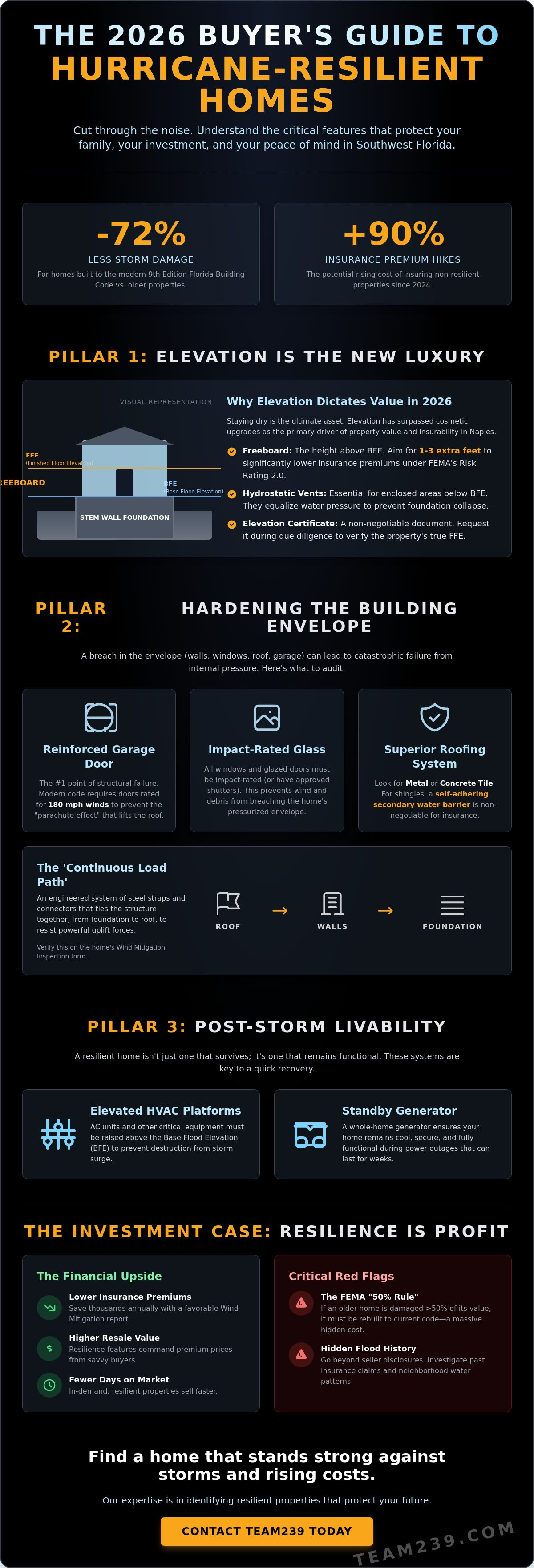
Did you know that homes built to the modern Florida Building Code experience 72% less damage during major storms than older properties? You've likely felt the sting of property insurance premiums rising by as much as 90% since 2024. It's natural to feel skeptical about whether a "hurricane-rated" label is just marketing fluff or a genuine shield for your investment. When you're determining what to look for in a hurricane proof house Naples, you need more than just a realtor's word; you need hard data and engineering reality.
We understand that protecting your family and your capital is your top priority in 2026. This guide cuts through the noise to reveal the critical structural features, elevation secrets, and new building codes that define a truly resilient Southwest Florida home. We'll provide a practical checklist for your next home tour, covering everything from the 9th Edition Florida Building Code standards to the financial impact of FEMA's Risk Rating 2.0. By the end, you'll have the confidence to make a secure real estate purchase that stands strong against both the elements and rising costs.
Table of Contents
The First Pillar: Elevation and the 'New Normal' of Flood Zones
In the Naples real estate market of 2026, elevation has officially surpassed the kitchen remodel as the most critical factor in property valuation. Buyers no longer just ask about sunset views; they ask for the Elevation Certificate before even booking a tour. This shift is driven by a new reality where staying dry is the ultimate luxury. Understanding Base Flood Elevation (BFE) is your first step. BFE is the regulatory requirement for the height that floodwaters are predicted to reach during a 100 year storm. However, savvy 2026 buyers look for "Freeboard," which is the additional height built above the BFE. Extra feet of freeboard don't just provide peace of mind; they're a primary lever for reducing premiums under FEMA's Risk Rating 2.0.
When you're evaluating what to look for in a hurricane proof house Naples, you must master the local flood maps. The 2024 FIRMs for Collier County, with their targeted 2026 revisions, categorize neighborhoods into risk zones. Zone AE and VE are high-risk areas where flood insurance is mandatory. Zone X is often labeled "low risk," but don't let that label create a false sense of security. Approximately 25% of National Flood Insurance Program claims originate from Zone X. In Southwest Florida, water doesn't always follow the lines on a map, making elevation your most reliable defense regardless of the zone.
Understanding Finished Floor Elevation (FFE)
The stem wall foundation is the gold standard for Naples luxury homes because it lifts the living space while maintaining a traditional, high-end aesthetic. Unlike a simple monolithic slab, a stem wall allows for higher FFE and better integration of hurricane-proof building techniques into the architectural design. You can find the specific FFE on the property’s Elevation Certificate, a document every serious buyer should request during the due diligence period. For maximum safety and insurance efficiency, the FFE must be at least 1 to 3 feet above the BFE to account for localized surge variations.
Hydrostatic Vents and Flood Openings
A resilient home doesn't just block water; it manages it. Hydrostatic vents are essential in garages or any enclosed areas below the flood level. These specialized openings allow floodwaters to flow in and out automatically, equalizing the pressure on both sides of the walls. Without them, the sheer weight of standing water can cause a foundation to buckle or collapse entirely. In coastal VE zones, look for breakaway walls designed to fail under pressure without compromising the home's main structural columns. These features ensure that the "building envelope" remains standing even if the lower levels take on water.
Hardening the Building Envelope: Wind and Debris Protection
Your home's envelope isn't just a shell; it's a pressurized system. If that system is breached, internal pressure can literally lift the roof off the walls. Understanding what to look for in a hurricane proof house Naples requires a shift in perspective from aesthetics to engineering. Historically, the garage door is the most common point of structural failure. Modern 2026 standards require reinforced garage doors that can withstand wind speeds of up to 180 mph without buckling. If the garage door fails, the wind enters the home and pushes upward on the roof while the wind outside pulls it up, creating a "parachute effect" that few structures can survive.
The evolution of the Florida Building Code has transformed Southwest Florida construction. While 'Post-Andrew' standards from 1994 set a high bar, the 'Post-Ian' 9th Edition code taking effect in late 2026 raises it further. It mandates stricter wind load calculations and more robust roof attachments. For buyers, this means choosing between metal, which offers superior wind resistance, or concrete tile, which provides the weight and aerodynamics needed for coastal storms. High-quality asphalt shingles are still viable, but only if they include a self-adhering secondary water barrier to prevent leaks if the primary shingles are lost. When you're evaluating what to look for in a hurricane proof house Naples, the presence of these secondary barriers is a non-negotiable for insurance eligibility.
The 'Continuous Load Path' Strategy
A home is only as strong as its connections. The 'Continuous Load Path' strategy uses hurricane straps and clips to tie the roof to the walls, and the walls to the foundation. You can verify these connections by looking at a home's Wind Mitigation Inspection form, specifically the updated OIR-B1-1802 version. Pay close attention to the roof shape. Aerodynamically, a 'Hip Roof' with four sloping sides suffers up to 40% less damage than a 'Gable Roof.' This design naturally deflects wind upward rather than catching it like a sail, making it the preferred choice for wind-prone regions.
Impact Glass: Beyond the Rating
Impact-rated windows are the gold standard for 2026 buyers. When touring homes, look for the 'Miami-Dade Notice of Acceptance' (NOA) labels etched into the window frames. This ensures the glass can survive a strike from a nine-pound 2x4 moving at 50 feet per second. Beyond safety, investing in resilience through impact glass offers massive secondary benefits like 99% UV protection and significant noise reduction. Remember, even one non-rated window creates a vulnerability. If that single pane fails, the resulting internal pressurization can compromise the entire structure. If you're unsure about a property's current ratings, our expert buyer representatives can help you audit the building envelope before you sign.
Mechanical Redundancy: Ensuring Post-Storm Livability
A truly resilient home isn't just a fortress that survives the wind; it's a functional habitat that remains operational when the grid fails. When determining what to look for in a hurricane proof house Naples, you must look beyond the walls to the systems that power your life. In a post-storm environment, the humidity and heat of Southwest Florida become immediate threats to both the property and its occupants. Mechanical redundancy ensures that your investment continues to provide comfort and safety even when municipal services are interrupted.
Start your evaluation with the HVAC system. Salt air is highly corrosive, and storm surge can destroy a ground-level compressor in seconds. Modern luxury builds in Naples now utilize elevated aluminum or concrete platforms to keep units well above the Base Flood Elevation. Additionally, look for smart home integration featuring water leak sensors and remote-controlled main shutoffs. These digital safeguards allow you to protect your interior from burst pipes or minor intrusions from anywhere in the world. For life-safety, many 2026 buyers prioritize dedicated safe rooms. These are typically reinforced interior closets or bathrooms with poured concrete walls and impact-rated doors, providing a final layer of protection if the building envelope is compromised.
Powering Through the Aftermath
Water and Waste Resilience
Flooding isn't just about water coming through the front door; it's about what comes up through the pipes. Backflow preventers are essential components that keep municipal sewage out of your home during heavy rain or surge events. We also recommend looking for homes with secondary water filtration systems that can handle compromised municipal supplies. Tankless water heaters are the preferred choice in flood-prone areas. They're typically mounted higher on walls, saving them from floor-level water damage while providing a more compact footprint than traditional tanks.
The Resale Inspection: Spotting Red Flags in Older Homes
Vetting a resale property requires a different set of skills than buying new construction. While a 2026 build follows the latest 9th Edition Florida Building Code, homes built between 2002 and 2023 often have hidden vulnerabilities. When you're determining what to look for in a hurricane proof house Naples, you must look beyond the fresh paint and staging. A seller's disclosure only documents what they know; it doesn't account for what they've missed or chose not to investigate. You need a forensic approach to the inspection process to protect your capital.
The "50% Rule" is a critical regulation that every Naples buyer must understand. If the cost of repairs or improvements to a home exceeds 50% of its market value, the entire structure must be brought into compliance with current floodplain regulations. This can turn a simple "fixer-upper" into a multi-million dollar liability. If you're eyeing a luxury property in a high-risk zone, consult our Luxury Homes for Sale in Naples FL: The 2026 Insider’s Guide to see how this rule impacts specific neighborhoods. Non-compliant additions, like enclosed lanais or unpermitted guest suites, are also major red flags. These spaces are often the first to fail in a storm and may be entirely excluded from your insurance coverage.
Visual Cues of Prior Storm Damage
Don't rely solely on paper reports. Inspect crawl spaces and the areas behind baseboards for "tide lines," which are faint stains indicating past water intrusion. Use the smell test. A musty, earthy odor in a home that looks pristine suggests mold issues that weren't properly remediated after a surge event. Look for structural cracks in the exterior masonry. These aren't always just "settling" cracks; they can indicate foundation movement caused by the massive weight of storm surge. If you find these signs, it's time to dig deeper into the property's history.
The Wind Mitigation Inspection
The Wind Mitigation Inspection is your most powerful financial tool. As of April 1, 2026, the official OIR-B1-1802 form requires even more detailed documentation of a home's protective features. A licensed inspector will verify the roof's age, the strength of deck attachments, and the presence of impact protection on all openings. This single document can save you 20% to 30% on your annual insurance premiums, potentially putting thousands of dollars back in your pocket every year. For a deeper look at how these inspections affect your purchase, check out our Naples Florida Homes for Sale: The Complete 2026 Buyer's Guide. If a property lacks a current wind mitigation report, our resale specialists can help you schedule a forensic audit before you make an offer.
The 2026 Investment Case: Why Resilience is Profit
Investing in a storm-resilient home in Naples isn't just about safety; it's a calculated financial strategy. By 2026, the local market has reached a tipping point where resilience features are the primary drivers of liquidity. Homes that meet or exceed "Post-Ian" standards spend significantly fewer days on the market compared to older, unhardened properties. Buyers are increasingly willing to pay a premium for "peace of mind" construction, recognizing that a house engineered to withstand a Category 5 storm is a protected asset. This shift has changed the definition of what to look for in a hurricane proof house Naples, moving it from a list of optional upgrades to a mandatory requirement for capital preservation.
The 2026 insurance landscape has become the ultimate filter for real estate value. With Florida property insurance premiums increasing by up to 90% between 2024 and 2025 alone, the cost of ownership is now tied directly to the building's integrity. Some private carriers have even begun restricting new policies exclusively to homes built to the most recent codes. This means a resilient home doesn't just save you money on monthly costs; it ensures your property remains insurable and, therefore, sellable in the future. Beyond the balance sheet, the psychological benefit of living in Naples with confidence instead of "storm anxiety" is a value proposition that's hard to overstate.
Insurance Premium Reductions
Modern mitigation features provide a direct path to lowering your carrying costs. Under Florida Statute §627.0629, insurance companies must offer discounts for verified wind-resistant features. Homeowners who prioritize secondary water barriers and impact glass often see a 20% to 30% reduction in their total annual premiums. For a $5,000 annual policy, this equates to $750 to $1,750 in yearly savings. Additionally, Naples participates in the Community Rating System (CRS), a high-tier program that provides community-wide discounts on flood insurance based on local management practices. If you're planning a move, our Moving to Southwest Florida in 2026: The Ultimate Relocation Guide offers a deeper dive into these localized financial benefits.
Future-Proofing Your Equity
Building codes in Florida only move in one direction: stricter. By securing a home that already meets the 9th Edition Florida Building Code, you're essentially future-proofing your equity. Today's high-standard homes will be tomorrow's most sought-after resales as older inventory becomes increasingly expensive to insure or retrofit. We're seeing a massive shift toward "fortified" home designations, which serve as a gold-standard seal of approval for both lenders and insurers. This systemic approach to construction removes the uncertainty often associated with coastal living. Ready to find a storm-safe sanctuary? Contact Team239 for expert local guidance and let our strategic thinkers help you navigate what to look for in a hurricane proof house Naples in today's market.
Securing Your Naples Future With Resilient Real Estate
Navigating the Southwest Florida market in 2026 requires a shift from aesthetic desire to engineering precision. You've learned that true resilience is a three pillar system involving elevation, structural integrity, and mechanical redundancy. By prioritizing properties built to the latest code standards and understanding the nuances of the 50% Rule, you're doing more than buying a home. You're protecting your equity against rising insurance premiums and future storm events.
Knowing exactly what to look for in a hurricane proof house Naples is the first step toward a secure investment. However, the technical details of flood zones and wind mitigation forms are complex. That's where strategic expertise becomes your greatest asset. Led by local experts Kristin & Jonathan Van Heukelom, our team specializes in identifying high performance new construction and vetting resilient resale properties. We combine deep knowledge of Collier County flood zones with a modern, data driven approach to real estate.
Find Your Storm-Safe Dream Home in Naples with Team239. Your Southwest Florida sanctuary is within reach, and we're here to ensure it stands the test of time.
Frequently Asked Questions
Is it possible to make an older Naples home completely hurricane-proof?
No home is entirely hurricane-proof; the industry standard is "hurricane-resistant." While you can retrofit older properties with impact glass and secondary water barriers, they often lack the modern elevation heights required to survive major storm surge. When researching what to look for in a hurricane proof house Naples, remember that structural hardening is only half the battle if the foundation sits below current flood levels.
What is the '50% Rule' and how does it affect my renovation plans in Naples?
The 50% Rule is a FEMA regulation stating that if repair or improvement costs exceed 50% of a building's market value, the entire structure must be brought up to current flood code. In Naples, this often means the house must be physically elevated to the 2026 Base Flood Elevation. This rule makes significant renovations on older, low-lying homes a major financial and engineering challenge for buyers.
Which Naples neighborhoods have the highest natural elevation?
Neighborhoods situated along the "Coastal Ridge," such as Pine Ridge and certain sections of North Naples, generally offer the highest natural ground in the area. These locations sit on ancient sand dunes, providing a natural buffer against surge that isn't found in lower-lying coastal communities. However, you should still verify the specific elevation certificate for any individual lot to confirm its exact height above sea level.
Are concrete block homes better than wood frame homes for hurricanes?
Concrete block construction is the gold standard in Southwest Florida for its superior resistance to wind loads and flying debris. While modern wood frame homes can meet 180 mph wind codes, concrete doesn't rot, warp, or suffer from termite damage following water exposure. Most luxury builders in the 2026 market prioritize reinforced masonry for its long-term structural integrity and better insurance ratings.
How much can I save on insurance with a Wind Mitigation report?
A comprehensive Wind Mitigation report can lower your annual property insurance premiums by 20% to 30%. For a policy costing $5,000 per year, this equates to a yearly savings of $750 to $1,750. Insurance carriers use the OIR-B1-1802 form to verify features like "hip" roof shapes and roof-to-wall clips, which directly reduce the insurer's risk during a storm event.
What happens if a home is below the current Base Flood Elevation (BFE)?
Homes sitting below the BFE face substantially higher flood insurance premiums under FEMA's Risk Rating 2.0. These properties are also more vulnerable to storm surge damage and face strict limitations on improvements due to the 50% Rule. Understanding these elevation gaps is a vital part of what to look for in a hurricane proof house Naples to avoid unexpected carrying costs.
Do hurricane shutters increase the resale value of a Naples home?
Hurricane shutters provide essential protection, but they don't command the same resale premium as impact-rated windows. Modern buyers in 2026 value the "passive" protection of impact glass, which requires no physical labor before a storm. While shutters are better than no protection, homes with full impact-rated envelopes typically sell faster and at a higher price point than those relying on manual panels.
Can impact windows withstand a Category 5 hurricane?
Impact windows are engineered to survive Category 5 wind speeds and the impact of heavy debris. To earn a Miami-Dade Notice of Acceptance, the glass must withstand a strike from a nine-pound 2x4 lumber piece traveling at 50 feet per second. Even if the outer glass layers crack, the inner polymer interlayer stays intact, preventing the internal pressurization that often causes roofs to fail.
Comments