
Family-Friendly Neighborhoods in Bonita Springs (2026)

The community with the longest amenity list may not be the one that makes family life easiest. A pool or clubhouse can look appealing, but daily routines also depend on school assignments, travel time, recreation access, and the full cost of living in the neighborhood. Choosing among family friendly neighborhoods in Bonita Springs means looking beyond reputation and asking how each option fits your family’s priorities.
This guide compares Bonita Springs community styles and the practical details that can shape your decision. You’ll find ways to weigh school logistics, decide whether amenities suit your routine, and review association fees, property considerations, and storm readiness. School boundaries and enrollment details can change, so verify current information through Lee County School District resources as you narrow your options.
Use these considerations to build a focused shortlist, then assess each home and its community obligations before making a commitment. A neighborhood that works on paper should also make sense for your family’s everyday life.
Table of Contents
Why Bonita Springs Appeals to Families, and What “Family-Friendly” Should Mean
Choosing a home also means choosing how your family’s days will work. A neighborhood can have appealing amenities and still be a poor fit if school logistics, everyday errands, recreation, or community rules don’t match your priorities. The best family friendly neighborhoods in Bonita Springs are the ones that support your routines and suit the specific home you’re considering.
Bonita Springs is in Lee County in Southwest Florida, with regional connections to surrounding communities and destinations. That location can matter to families balancing school, activities, work, and time outdoors, but proximity alone doesn’t tell you how convenient a particular home will be. For a broader view of the area’s lifestyle and geography, explore this overview of Bonita Springs.
What makes a Bonita Springs neighborhood work for a family?
Separate everyday needs from amenities you might use only occasionally. A playground, sidewalk route, or nearby outdoor space may support a regular routine. A clubhouse or another shared feature may be worthwhile if your household will use it. Neither is automatically better. The right choice depends on your family’s habits, access to facilities, and the obligations attached to the community.
Before touring, rank your priorities. For example:
Outdoor time: Decide whether a yard, nearby recreation, or shared outdoor amenities matter most.
School logistics: Identify the schools or programs you’re considering, then verify current assignment and enrollment information through Lee County School District resources.
Community life: Consider whether organized activities and shared facilities fit your schedule and preferences.
Evaluate the home and its immediate surroundings, not just the community name. Street conditions, nearby activity, layout, storage, and usable outdoor space can vary from property to property, even within the same neighborhood. A short visit can reveal details that a listing or amenity summary won’t.
How to use this guide to narrow your search
Use the comparisons in this guide as a decision framework, not a universal ranking. Consider community style, recurring obligations, daily routes, and property-level details together. A lower-maintenance home may simplify one family’s routine, while another may prefer more private outdoor space or a different set of shared amenities. Your shortlist should reflect your priorities, not someone else’s idea of the “best” fit.
Details can change. Verify current school boundaries and enrollment information, and review each community’s amenities, access, fees, and rules before relying on them in your decision. The Southwest Florida lifestyle guide adds broader regional context as you compare locations. Once you have a shortlist, map the routes your household would use and assess each home on its own merits.
Compare Bonita Springs Neighborhood Styles by Family Routine
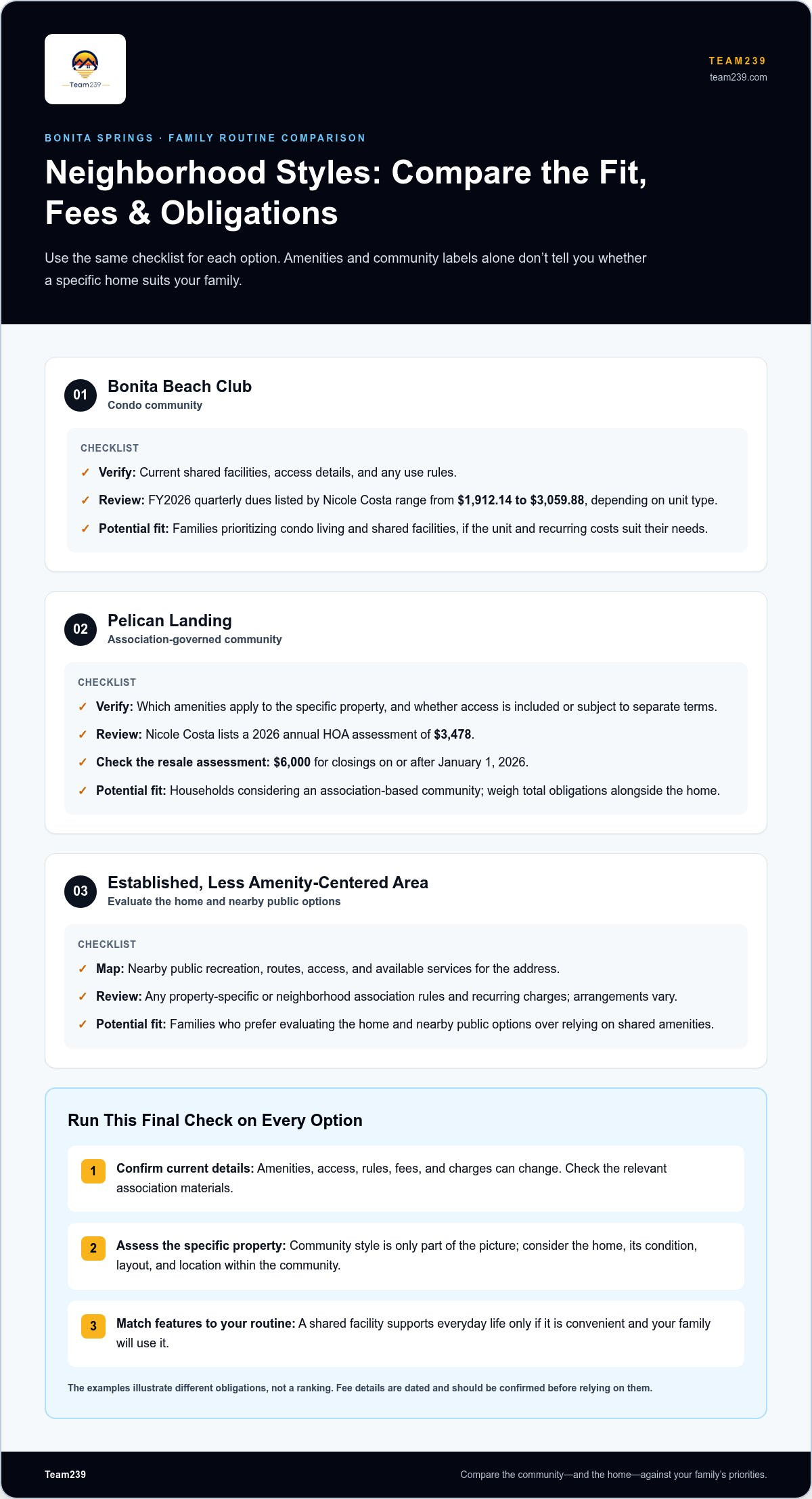
Neighborhood comparisons are more useful when you apply the same checklist to each option. Community style describes shared features and obligations. The fit of an individual home depends on the specific property, its condition, layout, and location within the community. Neither gated access nor a long amenity list tells you on its own whether a place suits your family.
The examples below illustrate different kinds of obligations, not a ranking. Fee details are dated because assessments and community arrangements can change. Confirm current access, amenities, rules, and charges in the relevant association materials before making a decision.
Gated and amenity-focused communities: what families should compare
For any gated community, verify how residents and visitors enter rather than assuming that a gate means greater safety. Then check which facilities are available, any access conditions, and the rules for household use. A pool, trail, or organized activity can support your routine only if it’s convenient and your family will use it. Amenities alone don’t guarantee engagement or value.
Established and less amenity-centered neighborhoods
In established areas, weigh the home and lot against nearby public recreation. Housing condition, streetscape, and service access can differ from one block or property to another, so assess the specific address rather than relying on a broad neighborhood label. If newer construction is also on your shortlist, compare it with existing-home options using this Bonita Springs new-construction home guide.
To compare family friendly neighborhoods in Bonita Springs, write down the features your household will use, the obligations you’re willing to take on, and the routes you’ll travel regularly. Then compare homes against that list. Team239’s local buyer representation helps connect neighborhood tradeoffs with property-level evaluation as you narrow your options.
How to Evaluate HOA Obligations, Safety, and Storm Readiness
A higher association fee doesn’t automatically mean better value, stronger security, or a better fit. Find out what the household receives, which rules apply, and whether the property’s obligations and risks make sense for your plans. Those questions matter as much as the amenities when assessing family friendly neighborhoods in Bonita Springs.
What should families review in HOA or community documents?
Read the governing documents and current financial materials for the specific association tied to the home. A master association and a sub-association may have separate rules or charges, so review the full structure rather than relying on a listing summary. Pay particular attention to:
Budgets and assessments: Understand recurring charges, how assessments are handled, and what the documents say about possible future costs.
Services and amenities: Identify what the association maintains and which facilities residents can access. Don’t assume a fee includes a specific service or amenity.
Restrictions: Check rules that could affect your household, such as property use, exterior changes, or other community requirements.
Reserves and maintenance: Review available financial and maintenance information to understand how the association plans for shared property responsibilities.
These details help you judge whether the arrangement suits your routine and budget. A community with more shared facilities may also have more rules or layered obligations. Compare the documents with how your family expects to use the property, rather than assuming that more amenities mean more value.
How to assess safety and hurricane-related property considerations
Community security features and personal safety are not the same thing. Gates, cameras, or controlled entry describe features of a community, not a guarantee of personal safety. Treat broad citywide ratings as context, not as a prediction about a particular street or home. Before relying on a safety claim, check its date, source, and geographic scope.
For flood research, enter the property location in FEMA’s Flood Map Service Center and review the available map information. FEMA maps are a research starting point, not a promise that a property will or won’t flood. Map products and information can change, so note the date you consult them and consider the property’s location alongside current records and disclosures.
Before committing, make a property-specific checklist. Review available seller disclosures and property records, and consider the home’s condition and storm-readiness features as part of the overall evaluation. Consider how flood and homeowners insurance may affect ongoing costs, since coverage and premiums depend on the individual home and circumstances. Keep these questions tied to the address; a neighborhood label alone can’t answer them.
With association documents and property research in hand, compare the home’s recurring obligations and location-specific considerations with your family’s priorities. This gives you a clearer basis for deciding whether the community works for everyday life and long-term ownership.
Research Schools, Parks, and Everyday Routes Before Touring
A map can help you shortlist homes, but it can’t show how an address will work across a real family week. Use a repeatable process: identify your household’s needs, verify current information, map common routes, and visit at times that reflect your routine. This makes it easier to compare family friendly neighborhoods in Bonita Springs based on practical fit rather than assumptions.
How to verify school information for a specific Bonita Springs address
Start with Lee County School District resources for current attendance boundaries, school assignment details, and enrollment steps. Boundary information is a starting point, not a decision about which program, transportation option, or school best meets your child’s needs. Check the school assignment for the specific property and the date you plan to enroll. School boundaries and enrollment details can change, so revisit official district information as your search progresses.
Be careful with third-party ratings. If you use them as one reference, check the source and date, and remember that a rating can’t capture every factor that matters to an individual family. Don’t infer school quality from a neighborhood’s reputation or proximity alone.
Map the family’s actual week, not just the map distance
List the trips your household makes regularly, then map them from each shortlisted address. Include work, childcare, school, groceries, healthcare, and recreation. Consider when you’d actually travel, since a route that looks simple on a map may feel different during school drop-off or a busy afternoon. Note the route and any access considerations that matter to your household.
Include public spaces in your assessment. Riverside Park and the Imperial River are local recreation examples to consider, but verify current access, facilities, and posted use information before planning around them. Visit at different times, if practical, and observe how easy it is to reach the space and whether the setting works for your family’s activities. Proximity doesn’t always mean convenient access, and a facility may not meet every need.
Before touring, compare your notes across addresses. Which errands cluster nearby? Where would a second caregiver or older child need to travel independently? Are there routes or recreation options you’d use often enough to shape your choice? These questions turn a broad search into a more useful shortlist.
Identify needs: Write down school, childcare, recreation, and service priorities.
Verify: Check district information and confirm current details for public spaces.
Map: Compare routine destinations using realistic travel times.
Tour: Visit candidate streets and nearby recreation at relevant times.
If your move involves coordinating decisions across a wider region, the Southwest Florida relocation guide offers broader planning context. Team239 helps buyers compare homes and neighborhoods across Southwest Florida, including Naples, Bonita Springs, Estero, Marco Island, and Fort Myers. For a property search grounded in your family’s school, route, and recreation priorities, work with Team239 on your home search.
Find a Bonita Springs Home That Fits Your Family with Team239
Your shortlist should connect the priorities you’ve identified with the realities of each property. Consider community obligations, school logistics, everyday routes, and home-level details together. A location that seems ideal at first may involve tradeoffs, such as rules that don’t suit your household or a layout that won’t support how your family uses the space. Clear criteria help you compare options consistently.
Turn your family’s priorities into a focused home search
Separate your needs into two lists: must-haves and nice-to-haves. Must-haves might include a workable school route, enough bedrooms, or outdoor space. Nice-to-haves could include a community pool or organized activities. This makes it easier to weigh real compromises instead of getting distracted by attractive features that won’t affect daily life.
Local context can connect community details with the specific home. Two properties in the same neighborhood may differ in layout, condition, access, or how well their features serve your routine. Team239’s buyer representation brings neighborhood comparison together with property-level evaluation and transaction support, helping you make informed comparisons as your search develops. If nearby Naples is also on your list, the Naples homes buyer’s guide can provide context for that part of your search.
Plan the next step with local buyer representation
Buyer representation means having support as you assess homes and move through the purchase process. That can include comparing properties against your priorities, considering how community obligations affect the fit, and coordinating transaction details as a potential purchase progresses. Negotiation is part of evaluating an offer in context, but no particular home, outcome, or financial result is assured.
Before your next viewing, bring your must-have list, questions about association documents, school information for the specific address, and notes on routes your household will use. This gives each tour a clear purpose. Afterward, compare what you learned with the property’s features and obligations, then refine your shortlist based on what matters most.
Team239 is a family-led Southwest Florida real estate team led by Kristin and Jonathan Van Heukelom, founded in 2014. If you’re ready to turn your research on family friendly neighborhoods in Bonita Springs into a focused home search, discuss your family’s priorities and next viewing steps with Team239.
Make Your Shortlist the Start of a Better Fit
Choosing among family friendly neighborhoods in Bonita Springs doesn’t require finding a place that checks every box. Identify the tradeoffs your household can live with and test them against the way you expect to spend your days. Before your next showing, choose your top two or three options and write down what you still need to learn about each one. That might be a route you haven’t driven, a community rule you haven’t reviewed, or a property detail that deserves a closer look.
Use each viewing to answer a specific question rather than letting first impressions make the decision. Notice how the home feels at the times your family would typically come and go, and consider whether its layout and surroundings support the routines you value. Comparing homes against the same priorities can make the next step clearer and help your family move forward with confidence.
Talk with Team239 about finding a Bonita Springs home that fits your family, and turn your shortlist into a focused next step. Your right fit starts with the details that matter most to you.
Frequently Asked Questions
What are the most family-friendly neighborhoods in Bonita Springs?
There isn’t one best choice for every household. The family friendly neighborhoods in Bonita Springs that may suit you depend on priorities such as private outdoor space, shared recreation, preferred home type, and how much community structure you want. Narrow your options by choosing a few non-negotiables, then compare actual properties against them. A neighborhood name can help you start a search, but it can’t replace reviewing a home’s location, layout, and obligations.
Is Bonita Springs a good place to raise a family?
Bonita Springs may suit families whose housing, school, recreation, and transportation needs align with what’s available in the area. Make the decision concrete: picture a typical school day, a rainy afternoon, and a weekend activity, then consider whether a potential home supports those routines. Also think about how your household’s needs may change over time, such as space for remote work or a teenager’s growing independence.
How do I check which school serves a Bonita Springs address?
Use Lee County School District resources to check the current assignment for the exact street address, then review enrollment instructions for the relevant school year. A nearby school isn’t necessarily the assigned school, and assignment information doesn’t determine program eligibility or transportation arrangements. If you’re considering a home before a move, save the district information you reviewed and verify it again closer to enrollment, since boundaries and procedures can change.
Are gated communities in Bonita Springs better for families?
Not automatically. A gate may shape how residents and visitors enter, but it doesn’t guarantee personal safety or make a community the right fit. Consider whether visitor access procedures work for caregivers, deliveries, and children’s friends, and whether shared streets or facilities suit your family’s habits. Compare those practical details with the home’s location and the community’s rules rather than treating gated status as a measure of quality.
What should families look for in a Bonita Springs HOA?
Read the current governing documents, budget, and meeting records, and focus on how the association’s rules affect your household. For example, check any provisions involving pets, parking, property changes, guests, or use of shared spaces. Review how assessments are described and whether more than one association applies to the property. This helps surface restrictions or obligations that a listing summary may not explain fully.
Can families find parks and outdoor recreation near Bonita Springs neighborhoods?
Yes, families can consider public spaces such as Riverside Park and recreation around the Imperial River, but verify current access and facilities before making them part of your routine. Check the managing agency’s current information for details such as hours, parking, amenities, and any use conditions. If a feature matters, visit in person and assess the route from a home you’re considering rather than relying only on a map.
How can I check flood risk for a home in Bonita Springs?
Search the property address in FEMA’s Flood Map Service Center and note the map information and date you reviewed. Treat the map as one research tool, not a guarantee about future flooding or insurance costs. For a fuller property-level picture, compare the map with available property records and seller disclosures, and consider the home’s drainage, elevation information, and insurance implications. Conditions can vary between nearby properties, so assess the specific address.
Comments