
Naples Condo Pet Rules: What Buyers Need to Know in 2026

A “pet-friendly” listing doesn’t guarantee your pet will be welcome under the condo association’s rules. In Naples, communities close to one another can set very different limits, and the details may not appear in the listing. Knowing the pet restrictions in Naples condos to know means looking beyond a headline and reviewing the documents that govern the specific property.
If you’re buying with a pet, get clear answers before making an offer. This guide explains how to identify the rules that matter, compare policies consistently, and assess whether a condo fits your household. Team239’s local knowledge of Naples and the surrounding market can help you evaluate condo documents alongside the property itself.
We’ll cover common restrictions, including pet limits, size or breed rules, and differences between owner and tenant policies. You’ll also learn why ordinary pet rules aren’t the same as assistance-animal accommodations, and which questions may need current document or legal review. The goal is to help you make an informed decision based on the association’s actual rules, not assumptions.
Table of Contents
Pet restrictions in Naples condos: why the written rules matter
A condo’s pet policy is the set of association rules that governs animals in private units and shared spaces. It may determine whether you can keep a particular pet, how many animals are allowed, and what’s expected in hallways, elevators, or outdoor areas. Because these rules affect daily routines, pet fit deserves the same attention as location, layout, and budget.
Rules can differ from one building to the next, even within the same Naples neighborhood. Each association has its own governing documents, adopted policies, and community needs. A nearby condo’s flexible approach doesn’t tell you what another building allows. Start with the association tied to the property you’re considering, then review its current rules before committing.
Where Naples condo pet rules are written
Look for the association’s declaration, bylaws, rules and regulations, and any amendments. Document names and how they work together can vary by association. For general background on condominium ownership and governance, see Understanding Condominiums and Their Governance. For your purchase, the documents for the specific community are what matter.
Keep formal association documents separate from a seller’s description or a listing summary. Summaries can be a useful starting point, but they may omit conditions, reflect an earlier policy, or use broad wording such as “pet-friendly.” Compare the summary with the relevant written provisions. If documents appear inconsistent or unclear, note the exact question rather than assuming the most favorable interpretation applies.
What a pet policy may regulate
Policies can cover more than whether pets are allowed. Review each category that could affect your household, and note whether the documents give a clear rule, describe a process, or leave the question unanswered.
Animal type: Which kinds of animals are permitted, and are any specifically excluded?
Number: Is there a limit on the number of animals per unit?
Size or weight: Does the policy set a measurement threshold or other size condition?
Registration and approval: Must residents submit information, request approval, or update records?
Shared spaces: Are leashes or carriers required in common areas, or are some spaces off-limits?
Conduct and cleanup: Are there rules for noise, waste disposal, or keeping animals under control?
These are examples of provisions to look for, not universal Naples condo rules. Read the wording closely: a policy may set a clear limit, refer to a separate rule, or leave an important detail unresolved. Before moving forward, build a documented picture of how the community’s requirements fit your household. That’s the practical way to assess the pet restrictions in Naples condos to know for a specific property.
How Naples condo pet rules work, and where assistance animals differ
Condo associations set community rules through governing documents and policies, while operating within applicable federal and state law. For ordinary pets, start with the association’s current documents. They may specify which animals are allowed and whether residents must register a pet or get approval. Don’t assume a rule from one community applies to another.
Keep two questions distinct: Does the association permit this household pet under its ordinary policy? And, if someone has a disability-related need for an assistance animal, what accommodation process applies? The questions involve different standards. An ordinary pet policy alone can’t answer the second one.
Ordinary pets and association approval
An association may require advance approval, registration, or records for an ordinary pet if its governing documents describe those steps. Check what must be submitted, who reviews it, and whether the process applies to owners, tenants, or both. A neighbor’s pet or an old listing doesn’t establish permission for your situation; the circumstances and policies may differ.
For each property, record the exact provision and the document it comes from. Note any deadlines or steps stated in the policy, and separate clear requirements from details that need clarification. This creates a reliable comparison across communities and helps you identify the pet restrictions in Naples condos to know before making a purchase decision.
Assistance animals and accommodation requests
An assistance-animal request is not simply an application to keep an ordinary pet. Under the federal Fair Housing Act, housing providers may need to make a reasonable accommodation for an assistance animal when the applicable requirements are met. HUD’s Fair Housing Act and Assistance Animals guidance explains the distinction. Calling an animal an assistance animal does not, by itself, make it one.
Florida Statute 760.27 also addresses assistance-animal accommodation requests in housing. The details can depend on the person’s circumstances and the information provided. If a disability or disability-related need isn’t apparent, a housing provider may be able to request reliable supporting information under applicable standards. A building’s ordinary pet rules alone don’t determine the outcome.
Keep the tracks separate: Compare ordinary pet permissions with the association’s process for accommodation requests.
Check current sources: Review the latest HUD materials and Florida law before relying on a legal interpretation, as requirements can change.
Get case-specific guidance: Neither a listing nor a general article can determine the outcome of an individual request.
Reviewing association documents can clarify property fit and transaction questions, while legal interpretation of an accommodation request may require separate, current guidance. Team239’s Naples condo buyer representation can help you assess a property alongside its documents and your household’s needs.
Compare Naples condo pet policies before choosing a community
A side-by-side comparison turns association documents into a practical decision tool. Don’t label a community simply “pet-friendly” or “not pet-friendly.” Compare the written terms with your animal, household routines, and likely use of shared spaces. A stricter policy may suit one buyer, while another household may need different limits or procedures. The goal is to find the right fit for you.
Compare the restrictions that affect daily life
Use one row per property, and record the document and section behind each answer. If the documents don’t resolve a point, mark it as a question instead of filling the gap with an assumption.
This format helps reveal differences a headline can hide. For example, two communities might allow the same type of pet but differ in the number allowed, approval steps, or where an animal can go. Review guest-pet and service-arrangement provisions when the documents address them. Don’t assume silence means permission.
Look beyond the headline when evaluating a condo
Compare listing language with the declaration, rules, and available amendments. Then check whether both building-level and broader community rules apply to the unit. Keep confirmed policy text distinct from open questions, especially if a summary uses broad wording or leaves out a procedure. That record makes the pet restrictions in Naples condos to know easier to assess across your shortlist.
For broader context on evaluating properties and purchase steps, use the Naples condo buying guide. Apply the same comparison framework to each option so your household’s needs, property priorities, and association requirements stay visible in one decision.
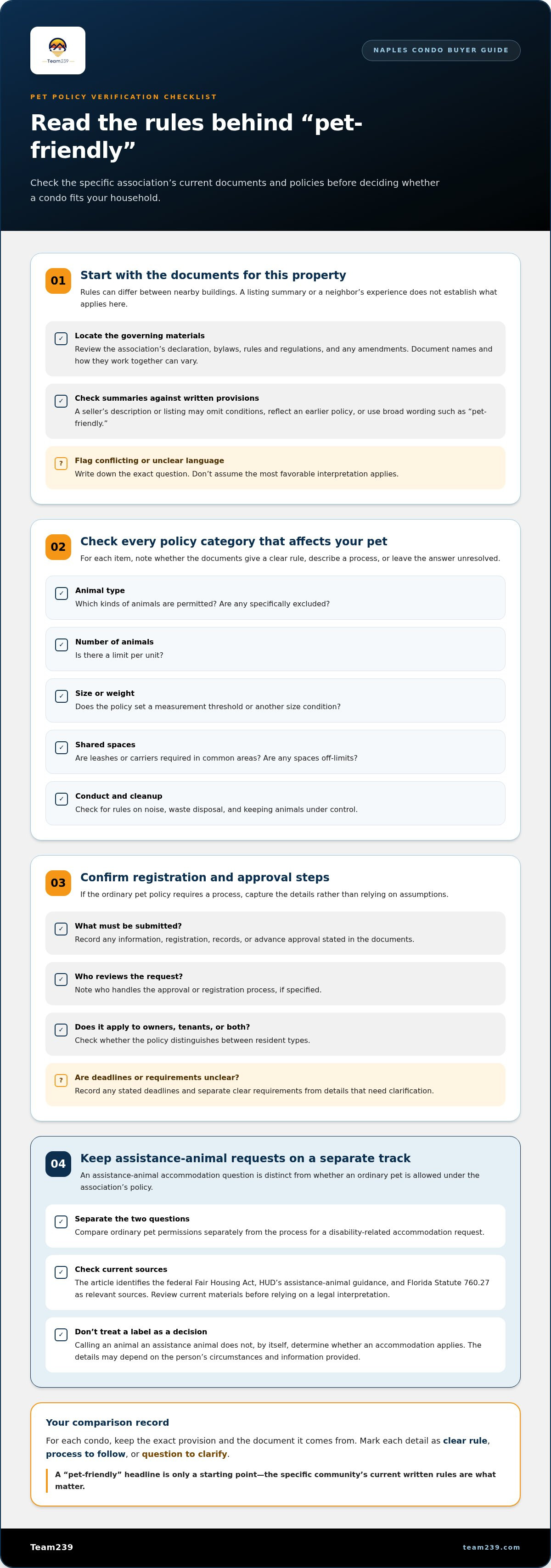
A buyer’s checklist for verifying pet restrictions in Naples condos
Use the same review process for every property. It helps you move from a general impression to a record of what the association’s current documents actually say. Listing language and verbal summaries can point you in the right direction, but they shouldn’t replace document review.
Use a repeatable document-review workflow
Follow these steps for each condo to compare policies consistently and spot missing information before moving forward.
Identify the association. Confirm which condominium association governs the unit. During the transaction process, request the applicable governing documents and check that they relate to the correct community.
Gather current documents. Review the declaration, bylaws, rules and regulations, and available amendments. Note each document’s date or version so you can distinguish current material from older copies.
Search for relevant provisions. Look for terms such as “pet,” “animal,” “owner,” “tenant,” “common area,” and “approval.” Read the surrounding text, including definitions, exceptions, and references to other rules or amendments.
Match the policy to your plans. Compare the exact wording with your animal’s type and size, the number of pets in your household, and how you expect to use shared spaces. Include relevant plans for guests or future changes to your household.
Record the source. For each requirement, save the document name, date or version, and section or page number. Mark whether the point is clearly stated, unclear, or not addressed in the materials you reviewed.
This record gives every property the same review standard. It also helps prevent broad wording such as “pets allowed” from obscuring details that could affect your daily routine. Keep the comparison with your other transaction notes.
Resolve policy questions before moving forward
Be specific about what remains unclear. Note the question, the provision that raised it, and which document or amendment may contain the answer. For example, if a rule mentions approval but doesn’t explain the process, record that gap rather than treating approval as automatic. Seek clarification during the transaction process, and keep written responses with any updated documents.
Current documents matter because association policies may be amended. Revisit your notes when new materials arrive, and confirm that any response refers to the same unit and association. A real-estate professional can help put document findings in transaction context; questions about legal meaning or an individual dispute are better addressed with qualified legal counsel.
If you’re weighing pet requirements alongside a move to the area, a Southwest Florida resident guide can add broader relocation context. For help comparing Naples properties and organizing the purchase steps, work with Team239 on your condo search. A consistent review makes the pet restrictions in Naples condos to know easier to verify before you commit.
Find a Naples condo that fits your household and pet needs
The right condo is more than a match on paper. Your pet’s needs, preferred location, purchase budget, and daily plans all matter, along with the association’s written requirements. Build your search around these factors together, so a promising location or feature doesn’t distract from a policy that may not suit your household.
Match the property search to your household
Create a short profile before comparing homes. Separate must-haves from preferences, then apply the same criteria to each option. Note your pets’ type and number, any size-related needs, how you expect to use shared spaces, preferred locations, and purchase priorities. This makes trade-offs easier to see and keeps your shortlist focused on properties that genuinely fit.
Pet needs: Record the policy details that matter to your household.
Location: Identify the areas and daily conveniences you value.
Property priorities: List the features you’re willing to prioritize or compromise on.
Purchase budget: Keep financial limits in view as you compare options.
Association documents: Track what each community’s current rules say and what remains unclear.
Local knowledge can help you compare options in Naples, Bonita Springs, Estero, Marco Island, and Fort Myers, but a neighborhood alone can’t tell you which rules apply. Association policies are specific to each community. Evaluate every property using its own documents and merits rather than assuming nearby buildings share the same pet rules.
Move from research to a confident purchase decision
Buyer representation can bring property comparison and transaction steps into one organized process. Team239 helps buyers assess condo options in light of their priorities and review association documents as part of evaluating property fit. Keep document review within your purchase due diligence, and raise unresolved wording or missing information before you commit.
Use the same household profile throughout your search, update your comparison as documents arrive, and distinguish confirmed rules from open questions. This makes the pet restrictions in Naples condos to know easier to weigh alongside location, features, and budget. A real-estate professional can support property and transaction decisions; legal interpretation is a separate matter.
Ready to explore properties with your household’s needs in mind? Explore Naples real estate with Team239.
Make your next move with confidence
Turn your household’s priorities into a focused Naples condo search. Keep your pet’s needs alongside the location, features, and budget that matter to you, and let each association’s current documents inform your decision. The pet restrictions in Naples condos to know are the ones that apply to the specific home you’re considering, not assumptions based on a listing or nearby building.
Team239 is a family-led real-estate team led by Kristin and Jonathan Van Heukelom, providing local representation across Naples and Southwest Florida. Founded in 2014, the team helps buyers compare property options and navigate transaction steps, while legal questions remain with qualified counsel.
Ready to explore homes that fit your plans? Explore Naples real estate with Team239 and take the next step toward a home that works for you and your pet.
Frequently Asked Questions
Can a Naples condo association limit the number or size of pets?
Yes. A Naples condo association may set limits on the number or size of ordinary pets through its governing documents, subject to applicable law. Check whether a limit applies per unit or household and how the policy defines size. Don’t assume two small pets are treated the same as one. This matters whether you’re comparing communities in Naples, Bonita Springs, Estero, Marco Island, or Fort Myers.
Are emotional support animals treated the same as pets in Florida condos?
Not necessarily. Under fair-housing rules, an emotional support animal may qualify as an assistance animal when it’s needed because of a disability, so the request isn’t handled simply under ordinary pet limits. Approval isn’t automatic, and an association may seek reliable supporting information when the disability-related need isn’t apparent. HUD guidance and Florida Statute 760.27 are relevant; check current sources or seek legal advice about a specific request.
Can a condo association change its pet restrictions after I buy?
Rules can change, so review the current documents and any amendments during your purchase process. Don’t rely on a previous owner’s experience as proof that the same terms will apply to you. Some associations may have transition or grandfathering provisions for existing pets, but the details and coverage can vary. Confirm which policy version is current and whether amendments affect new owners or pets added later.
What condo documents explain pet restrictions in Naples?
Start with the declaration, bylaws, rules and regulations, and amendments. Document names and how they relate can vary by association, so follow any cross-references to other policies. If a rule refers to an amendment you haven’t received, note that gap. Check the document date and confirm the materials relate to the specific condo association and unit you’re considering, not just a similarly named nearby community.
Can I bring a visiting pet to a Naples condo?
It depends on the association’s rules. A policy may treat a guest’s animal differently from a resident’s pet, or address short visits separately from longer stays. Check provisions covering guests, temporary animals, common areas, and approval steps. If the documents don’t clearly address your situation, record the exact question and seek written clarification during the transaction process before assuming a visiting pet is allowed.
Do pet restrictions apply to common areas in a condominium?
They may. An association’s rules can cover how animals move through shared areas, such as hallways, elevators, and outdoor spaces, and may set conditions like leash or carrier requirements. Check for separate restrictions on amenities or areas where pets may not be permitted. A rule allowing a pet inside a unit doesn’t, by itself, explain where that animal can go elsewhere in the building.
What should I do if a condo listing says pets are allowed?
Treat the listing as a starting point, not the full policy. The pet restrictions in Naples condos to know are the ones in the current documents for the specific association. Check what “pets allowed” means for your animal, number of pets, approval steps, and shared spaces. If an important detail is missing or unclear, get it clarified before committing rather than relying on a broad listing phrase.
Comments