
Buying a New Construction Home in Florida: A 2026 Buyer’s Guide
A new build is only as strong as the due diligence behind it. Buying a new construction home in Florida can seem straightforward: the home is new, the model is polished, and the builder lays out a path to closing. But the model isn’t the contract, and the purchase price doesn’t show the full cost of ownership.
Before you commit, consider builder terms, construction timelines, included features, and costs that vary by community. Insurance, property taxes, HOA dues, and CDD fees can all affect what a home costs to own. The right choice also depends on how the neighborhood fits your daily needs and longer-term plans.
This guide covers Florida-specific decisions to make before signing, including what to review in a builder contract, how to compare communities, and which costs and construction details deserve attention. You’ll also learn how buyer representation can help organize questions, compare options, and navigate negotiations. For a Southwest Florida search, Team239 brings local perspective across Naples, Bonita Springs, Estero, Marco Island, and Fort Myers.
Table of Contents
Buying a New Construction Home in Florida: What Makes the Decision Different?
How Florida New-Home Contracts, Timelines, and Buyer Representation Work
How to Compare Florida New Builds, Community Fees, and Long-Term Costs
A Practical Florida New-Construction Checklist Before You Commit
How Team239 Helps You Navigate a Florida New-Construction Purchase
Buying a New Construction Home in Florida: What Makes the Decision Different?
New construction is a home purchased from a builder while it’s being built or after construction is complete, rather than a previously owned resale home. That distinction affects what you can choose, when you can move, and which documents define what you’re buying. A home may look finished in a model or online, but the written specifications, contract terms, property, and community determine the details that matter.
What counts as a new construction home?
A completed quick-move-in home is already built or close to completion. Its layout, finishes, and included features are generally set, so you can see more of the actual home and may have less time to wait. A home built to order follows a different path: you select from the builder’s available plans and options, then construction proceeds in stages. Your choices may depend on how far along the home is when you purchase.
Construction stage affects both customization and timing. It can determine how much time you have to make selections and which walkthroughs are possible before closing. A nearly finished home may leave fewer opportunities to change finishes, while an earlier-stage build may involve more decisions and a longer wait. Since builders and communities don’t all offer the same paths, compare the specific home, timeline, and written terms instead of assuming every new build works alike.
Why Florida location and community details matter
Florida is not one uniform housing market. The history and influences on real estate in Florida provide context, but practical decisions come down to the property and its immediate surroundings. In Southwest Florida, a search across Naples, Bonita Springs, Estero, Marco Island, and Fort Myers can involve different county rules, neighborhood setups, and property characteristics.
Those differences can affect both ownership costs and daily life. Flood exposure varies by property, while insurance considerations depend on the home’s location and characteristics. Community fees also deserve attention: some neighborhoods have association costs, and some may include a Community Development District (CDD) assessment. Impact fees are another possible development-related cost, but they don’t apply in the same way to every home or community. Evaluate the details for the specific property.
Finishes alone make a weak basis for comparison. A bright kitchen or upgraded flooring may appeal, but weigh those features alongside location, contract terms, builder inclusions, and recurring community costs. Compare homes using the same criteria: what you’ll receive, when it will be ready, what the purchase documents say, and how the location may affect ownership over time. This broader view helps make buying a new construction home in Florida a decision based on fit, not just first impressions.
How Florida New-Home Contracts, Timelines, and Buyer Representation Work
A new-build purchase involves a series of decisions, not just choosing a home and closing. Builder documents set out deadlines, payments, choices, and procedures that can differ from familiar resale paperwork. A clear process helps keep those details connected from the first comparison through the final walkthrough.
What should buyers review before signing a builder contract?
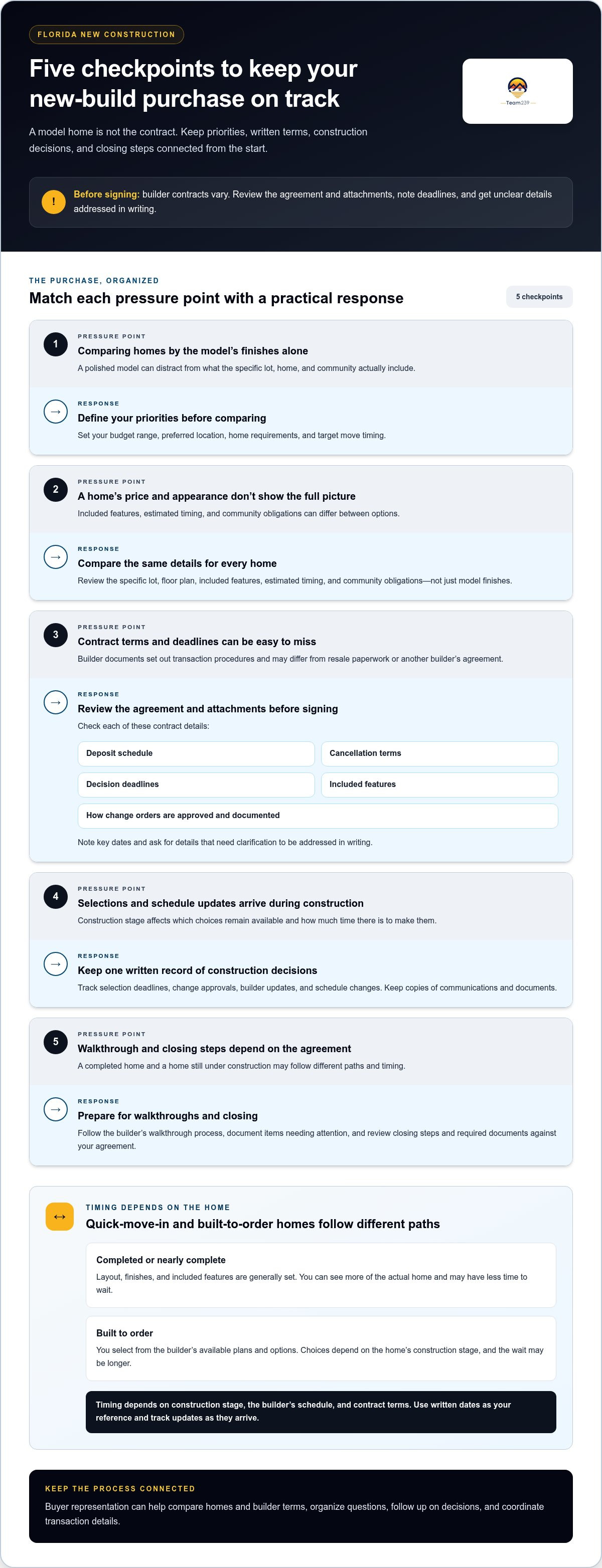
Builder contracts are specific to the builder and transaction, so don’t assume the terms match a resale agreement or another community’s paperwork. Review the deposit schedule, cancellation terms, decision deadlines, included features, and process for approving and documenting change orders. The agreement also sets out how its terms and remedies apply. Before committing, list your questions, key dates, and any details that need clarification in writing.
Use this sequence to keep the purchase organized:
1. Define priorities. Set your budget range, preferred location, home requirements, and target move timing before comparing options.
2. Compare homes and terms. Review the specific lot, floor plan, included features, estimated timing, and community obligations, not just the model’s finishes.
3. Review and sign the agreement. Read the contract and attachments, note every deadline, and make sure questions about features or selections are addressed in the written documents before signing.
4. Track construction decisions. Record selection deadlines, change approvals, builder updates, and schedule changes in one place. Keep copies of communications and documents.
5. Prepare for walkthroughs and closing. Follow the builder’s walkthrough process, document items that need attention, and review closing steps and required documents against your agreement.
How does a new-build timeline typically unfold?
Depending on the home and builder, milestones may include choosing a home or available options, signing the contract, making design decisions, receiving construction updates, completing walkthroughs, and closing. A completed home may move through these stages differently from one that still needs to be built. Timing depends on construction stage, the builder’s schedule, and contract terms. Use written dates as your reference and track updates as they arrive.
Buyer representation can bring structure to each step. A buyer’s agent can help compare homes and builder terms, organize questions, follow up on decisions, and coordinate transaction details. That support is especially useful when selections, deadlines, and construction communications overlap. It doesn’t replace reading the agreement; it helps you stay focused on what the documents say and what needs action next.
Team239 provides new-construction buyer representation in Southwest Florida, bringing local market analysis, contract negotiation, and transaction coordination together. If you’re weighing options in Naples, Bonita Springs, Estero, Marco Island, or Fort Myers, Team239’s buyer representation can help you compare options and approach the process with an organized plan.
How to Compare Florida New Builds, Community Fees, and Long-Term Costs
A fair comparison looks beyond the advertised price and model-home finishes. Create a comparison for each home, recording purchase terms, included features, possible one-time charges, recurring expenses, location, and property-specific risks. This makes differences easier to see and helps separate upfront costs from expenses you may continue to pay after closing.
Community charges vary by development and jurisdiction, so confirm the costs and payment terms for the specific property. Don’t use one community’s fees as an estimate for another. Keep written estimates and association or district documents with your comparison notes, and separate charges due at purchase from recurring costs.
Which community fees and taxes should buyers investigate?
A Community Development District, or CDD, is a local special-purpose government entity used in some developments to finance, build, or maintain community infrastructure and services. A CDD assessment may be collected through the property tax bill or another method, depending on the district. Not every home is in a CDD. Verify whether the property is included, which charges apply, and how they’re billed.
Impact fees are local charges associated with new development and public facilities. Their applicability, amount, and payment responsibility depend on the jurisdiction and transaction. Property taxes are also location-specific. Review county records and tax information for the parcel, and allow for the possibility that a future assessment may differ from figures based on a previous owner or undeveloped lot.
How should buyers assess property conditions and insurance factors?
Look up the home’s flood-map context by property, not just by city or neighborhood. A map is one input for due diligence, not a complete description of a home’s risk. Review relevant property records as well, and consider how the home’s site and construction align with applicable requirements.
For permits issued in 2026, the Florida Building Code’s 8th Edition is the current statewide standard. Its provisions include updated wind-resistance requirements. Review the home’s construction information and applicable local requirements rather than relying on a model’s appearance. Insurance availability and premiums depend on the property and buyer, so evaluate them for the specific home before finalizing your comparison. Reviewing these costs is an important part of buying a new construction home in Florida with confidence.
A Practical Florida New-Construction Checklist Before You Commit
A written checklist turns scattered documents and updates into a clear decision record. For each home, keep the builder’s specifications, signed agreement, selections, change orders, community documents, and key correspondence together. Check that the details align before you commit, then revisit the list as construction moves forward.
Home: Compare the property’s specifications with the model or sales materials. Record the lot, layout, included fixtures and finishes, and options you selected. Note what’s incomplete or needs follow-up.
Contract: Track deposits, deadlines, cancellation terms, included items, change-order procedures, and the builder’s stated construction milestones. Keep a calendar of actions and save documents that reflect agreed changes.
Community: Verify applicable association obligations, CDD assessments, impact fees, and other charges for the specific property. Review local property-tax information and the home’s flood-map context instead of relying on general area assumptions.
Financing: Review your lender’s requirements, the expected timing of loan and appraisal steps, and how construction timing fits your financing plan. Track any dates or conditions tied to the loan.
Closing: Confirm the documents and funds needed for closing, review the final figures, and keep a written record of open walkthrough items and agreed next steps.
What should buyers verify during construction and walkthroughs?
Use the signed agreement and its attachments as your reference. Compare them with selections and approved change orders, and keep a dated record of builder communications. During walkthroughs, note visible finishes, fixtures, doors and windows, access points, and incomplete or damaged items. Photograph observations where useful, and ask how they’ll be recorded and addressed. Inspection opportunities and procedures depend on the home, builder process, and contract.
Before each walkthrough, prepare a room-by-room list and bring your documents. If an item differs from the written specifications, record its location and describe the difference rather than relying on memory or a verbal exchange. That gives you a practical record for follow-up.
How can buyers compare Southwest Florida communities?
Compare how each location fits your routines: likely commute patterns, nearby amenities, community rules, and recurring obligations. Naples, Bonita Springs, Estero, Marco Island, and Fort Myers offer different choices, but no city is automatically the right fit for every buyer. Match the area and community to your priorities, then review the specific home and its local requirements.
For more regional context, Team239’s Southwest Florida new-construction guide covers community factors to consider alongside the home itself. Buying a new construction home in Florida takes coordinated due diligence. Team239 can help you compare options and organize your priorities across Southwest Florida. Discuss your new-build priorities with Team239.
How Team239 Helps You Navigate a Florida New-Construction Purchase
Choosing a new home means weighing more than a floor plan. You’re also comparing builder terms, community details, construction timing, and how each option fits your plans. Team239’s new-construction buyer representation brings those moving parts into one process, with local market analysis, contract negotiation, and transaction coordination.
What buyer representation can bring to a new-build search
Team239 helps buyers clarify priorities, compare homes and communities, and organize questions about purchase terms and included features. A consistent comparison can reveal meaningful differences between two homes that look similar in a model or listing. The team also supports communication and negotiation with the builder and coordinates transaction steps as the purchase progresses.
This guidance is part of real estate representation. It can help you understand the transaction and identify questions to address, but it isn’t legal or tax advice. For legal interpretation of contract language or advice about tax consequences, consult an appropriately qualified professional. Keeping those roles clear helps you get the right expertise for each decision.
Buying a new construction home in Florida involves details that can vary between communities and markets. Team239’s local knowledge helps buyers compare Southwest Florida options using practical criteria, not just a builder’s presentation. The goal is a better-informed choice, not a promise of a particular price, negotiation result, or closing outcome.
Start your Southwest Florida new-home search with a clear plan
Before touring homes or reviewing builder materials, write down your preferred locations, timing, home type, and must-have features. Separate essentials from preferences. For example, you might prioritize a particular commute or home layout while treating some finishes as flexible. This gives each comparison a clear basis and makes trade-offs easier to discuss.
Team239 serves buyers in Naples, Bonita Springs, Estero, Marco Island, and Fort Myers. Each location can offer a different mix of community settings, daily routines, and available homes. Kristin and Jonathan Van Heukelom lead the family-led team, bringing local perspective to the comparison and coordination process. Share your priorities early so the search can focus on properties and communities that align with them.
If you’re considering a new build in Southwest Florida, discuss your home-buying goals and next steps with Team239. A focused conversation can help turn your location preferences, timing, and home requirements into a practical search plan.
Turn Your Priorities Into a Confident Next Step
The strongest starting point isn’t a perfect floor plan. It’s a clear picture of how you want your home to support your life over time. Before moving forward, write down what you need now, what may change, and which trade-offs you’re comfortable making. That brief can keep an exciting model or limited-time decision from pulling focus away from the location, budget, and ownership details that matter.
Buying a new construction home in Florida is a major commitment, but you don’t have to make every decision at once. A thoughtful search gives you room to compare choices, ask focused questions, and move forward when the home and terms align with your goals.
Team239 provides buyer representation, contract negotiation, and transaction management for your Southwest Florida search. Plan your Florida new-construction search with Team239 and take the next step with a clearer sense of what fits.
Frequently Asked Questions
Is buying a new construction home in Florida different from buying a resale home?
Yes. A new-build purchase often uses a builder-drafted contract and may involve construction milestones, design selections, and change-order procedures that aren’t part of a typical resale transaction. A buyer purchasing before a home is finished, for example, may need to make selections by set deadlines, while someone choosing a completed home may focus on its existing specifications. Compare the documents and process for the specific property.
Can I use a real estate agent when buying a new construction home in Florida?
Yes, buyers can have their own real estate representation in a new-build purchase. A buyer’s agent can help compare properties and communities, organize questions, track transaction steps, and negotiate on the buyer’s behalf. The builder’s sales representative works within the builder’s sales process, so don’t assume that role provides independent buyer representation. Discuss representation early, before signing builder paperwork, and review how it fits the transaction.
What are CDD fees on a new construction home in Florida?
CDD fees are assessments connected to a Community Development District, which may finance or maintain infrastructure and services in a development. They don’t apply to every Florida home. For a property in a CDD, review the district’s disclosure and current assessment details; charges may relate to infrastructure bonds, operations, or both. Check how the assessment is billed and whether the amount or payment period can change.
Do new construction homes in Florida need an inspection?
An independent home inspection can give a buyer a separate assessment of the home’s condition, even when it’s newly built. Municipal building inspections and a builder’s walkthrough serve different purposes and shouldn’t automatically be treated as substitutes. Review inspection access and timing under the purchase agreement. If permitted, buyers may consider inspections at relevant stages as well as a final inspection before closing.
Are new construction homes in Florida built to withstand hurricanes?
Florida’s building standards include requirements intended to address hazards such as high winds, but no home is hurricane-proof. For permits issued in 2026, the Florida Building Code’s 8th Edition is the current statewide standard. Ask for the home’s permit and construction documentation, and review which wind-resistant features apply to that property. Also consider the specific site’s flood exposure and discuss insurance options for the home.
How long does it take to buy a new construction home in Florida?
It depends on whether you choose a completed home or one that still needs to be built. Construction estimates are 4-6 months for modular homes, 9-12 months for production homes, and 12-24 months for custom homes, from start to finish. These are construction ranges, not guaranteed purchase timelines. Financing, selections, builder scheduling, and closing steps can affect your move-in date.
What should I compare when choosing a new construction community in Southwest Florida?
Compare daily travel routes, amenities, community rules, recurring assessments, property-tax considerations, and property-specific flood context. Then consider how each location fits your routines: Naples, Bonita Springs, Estero, Marco Island, and Fort Myers may suit different priorities and commute patterns. Review details at the neighborhood and property level, not just by city name. A consistent comparison can help reveal which trade-offs matter most for your household.
Comments