
Understanding Title Insurance in Florida: A 2026 Buyer’s Guide

Could your lender be protected while your ownership isn’t? That can happen if you rely only on a lender’s title insurance policy. Understanding title insurance in Florida starts with separating three things: the title is the legal right to own property, the deed transfers that ownership, and title insurance may protect against certain covered title problems.
It’s reasonable to ask what a policy covers, whether you need one in addition to your lender’s policy, and who pays at closing. These details matter. A title search may uncover liens, ownership claims, or public-record errors, while policy coverage has limits and exclusions.
This guide explains how owner’s and lender’s policies differ, common title risks, and how Florida’s state-set premium rates and possible reissue eligibility can affect costs. You’ll also learn why the contract matters when deciding who pays and what to review before closing on a home in Southwest Florida, including Naples, Bonita Springs, Estero, Marco Island, and Fort Myers. Use the questions at each transaction milestone to make more informed decisions about your purchase.
Table of Contents
What Is Title Insurance in Florida, and What Does It Protect?
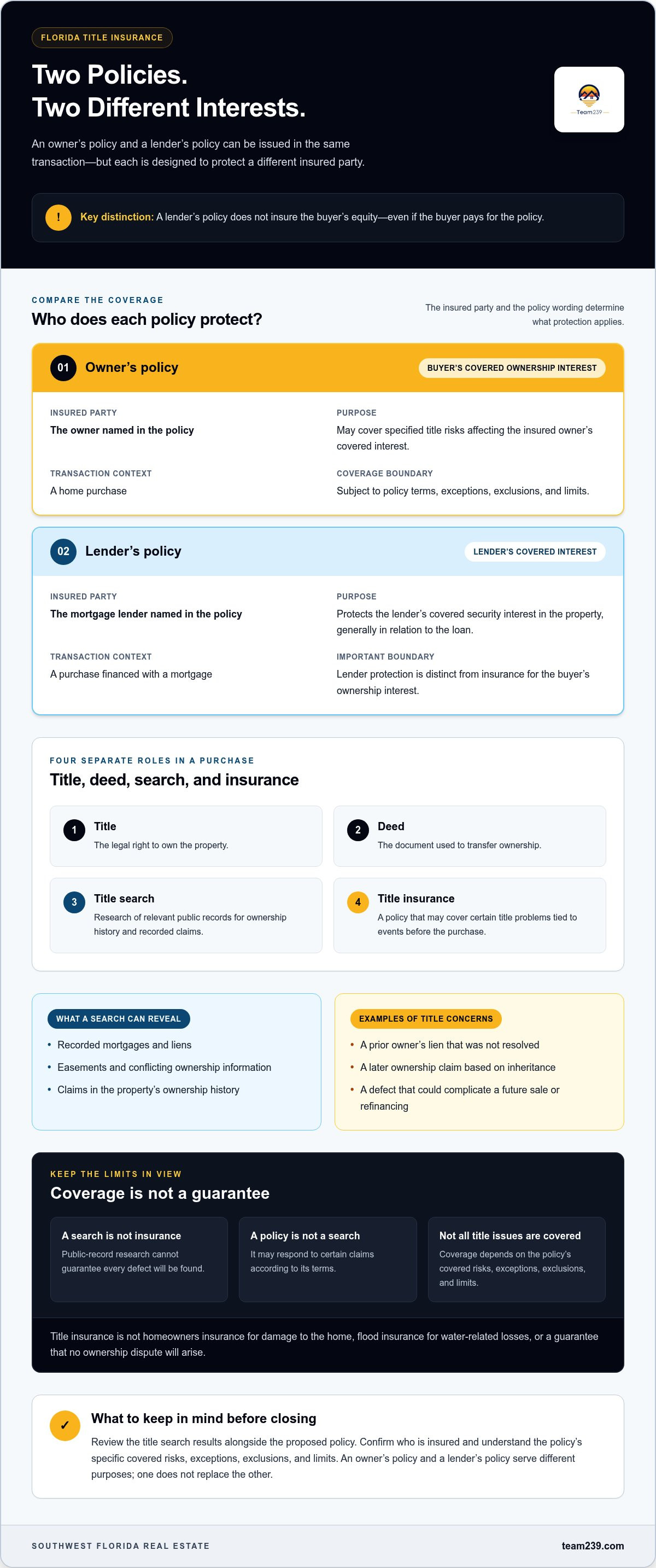
Title insurance may protect a buyer or lender from certain covered title problems connected to events that happened before the property was purchased. It focuses on covered pre-purchase risks that could affect the ownership rights or financial interest insured by the policy. Coverage depends on the policy, including its exceptions and exclusions. It isn’t homeowners insurance for damage to the home, flood insurance for water-related losses, or a guarantee that no ownership dispute will arise. For a general overview of the concept and its history, see Title Insurance.
Consider buying a home in Naples. The title is the legal ownership interest being transferred. The deed is the document used to convey that interest to you. Before closing, a title search examines relevant public records for ownership history and recorded claims. Title insurance is different: it’s a policy that may provide coverage if a covered title issue from before your purchase comes to light later. Understanding title insurance in Florida means knowing that each of these plays a separate role.
How a title search differs from title insurance
A title search is research, not insurance. It can reveal recorded mortgages, liens, easements, or conflicting ownership information, giving the transaction team an opportunity to address issues before closing. But public-record research can’t guarantee that every defect will be found. A policy doesn’t perform the search; it may respond to certain claims according to its terms. Reviewing the search results alongside the proposed policy helps clarify what has been identified and what coverage is being offered.
Why title protection matters to Florida homebuyers
Imagine a prior owner’s lien wasn’t resolved, or someone later asserts an ownership interest based on an inheritance. Either issue could raise questions about who has rights to the property. Depending on the circumstances, a title problem may complicate a future sale or refinancing, although not every defect causes a financial loss or prevents a transaction.
That’s why title review belongs in the purchase process, alongside contract deadlines and closing preparations. Buyers exploring a local purchase can also consult a Naples Florida homes buyer’s guide for broader home-buying context. In Southwest Florida, an agent can help keep title-related questions on the radar as the transaction moves from contract to closing. The policy and its terms determine the scope of insurance coverage.
Owner’s vs. Lender’s Title Insurance: Who Does Each Policy Protect?
These policies can be issued in the same transaction, but they insure different interests. An owner’s policy protects the insured buyer’s covered ownership interest; a lender’s policy protects the lender’s covered interest in the property. A lender’s policy doesn’t insure the buyer’s equity, even if the buyer pays for it.
The table is a starting point, not a substitute for reading the policy. The insured party, coverage terms, exceptions, exclusions, and limits determine what protection applies. When understanding title insurance in Florida, keep the key distinction in view: the loan and the buyer’s ownership are separate interests, so coverage for one doesn’t automatically extend to the other.
What an owner’s title insurance policy is designed to cover
An owner’s policy may cover certain title risks tied to events before the purchase, such as a covered ownership claim or another defect addressed by the policy. It doesn’t promise a defect-free property or provide general coverage for events that happen after closing. Before relying on it, read the actual policy and review its covered risks, exceptions, exclusions, and limits. The specific wording matters.
Why a lender’s policy is not the buyer’s policy
A lender’s policy is designed to protect the lender, not reimburse the buyer for a loss to their ownership interest. A lender may require this policy as part of a mortgage transaction, but that requirement doesn’t mean the buyer’s ownership is insured. The lender’s protection and the buyer’s protection are distinct.
So, do you need both? The policies serve different purposes, and one doesn’t replace the other. An owner’s policy is intended to insure the named owner’s covered interest; a lender’s policy addresses the lender’s covered interest. The decision to obtain owner coverage is personal and depends on your circumstances and the policy terms, not simply on whether the lender has coverage.
As you work through contract and closing milestones, Southwest Florida buyer representation can help keep title-insurance questions in view alongside the rest of your purchase decisions.
Florida Title Insurance Risks, Exclusions, and Defects to Understand
A title issue is a potential problem in the property’s ownership history or recorded rights, not automatically an insured loss. Understanding title insurance in Florida means separating three questions: What issue exists? Does it affect the transfer or ownership? Does the policy cover a resulting claim? The answer depends on the facts and the policy’s language, exceptions, exclusions, and limits.
Examples that may appear during a title review include:
Recorded claims: An unpaid lien, mortgage, or judgment may need to be resolved or otherwise addressed as part of the transfer.
Ownership or inheritance questions: Probate records, an unclear ownership history, or a deed that appears inconsistent with earlier documents can raise questions about who has authority to convey the property.
Public-record or property-right issues: A recording error or an easement may affect how ownership or property use is understood. An easement is a recorded right affecting property, but its existence alone doesn’t mean it’s a defect or a covered claim.
Common title defects that may surface before closing
A mortgage or lien that remains of record can require attention before ownership transfers. A title review may also reveal a gap in the ownership chain, a probate question, or deed details that don’t align across records. These findings call for clarification, but they don’t all have the same impact or outcome. An easement, for example, may be a valid property right that remains in place rather than a problem insurance will remove.
What title insurance generally does not replace
Title insurance addresses certain covered title risks tied to earlier events. It isn’t a substitute for homeowners, flood, or windstorm insurance, and it doesn’t insure the home’s physical condition. Buyers also shouldn’t assume it covers every future ownership dispute or every matter disclosed in the title documents.
Pay close attention to exceptions. A matter identified in the title commitment or otherwise disclosed may be treated differently from an unknown issue, depending on the policy wording. Coverage can’t be determined from the defect’s name alone. Compare the title commitment, closing documents, and final policy. Note which matters are listed as exceptions and what coverage is proposed. If an item is unclear, keep the question on your transaction checklist so its status is understood before closing.
Florida Title Insurance Premiums, Reissue Rates, and Who Pays
Florida title-insurance premiums follow state-promulgated rates rather than rates each insurer sets independently. The calculation uses rate tiers based on the amount insured, so the premium can vary with the transaction. A reissue rate may apply in some eligible cases, but an earlier policy doesn’t automatically qualify a new purchase for a lower rate.
Keep the premium separate from your other closing costs. A closing statement may also include charges such as recording fees and taxes. Review the line items individually so you can distinguish the title-insurance premium from the total cost of closing.
How Florida reissue rates may affect a transaction
A prior title policy can be relevant to reissue-rate eligibility. Under current Florida rate guidance, a policy issued within the previous three years may qualify, subject to applicable requirements. The prior policy and transaction records can help establish the property’s coverage history, so locate any available policy documents early. Eligibility and the applicable calculation depend on current rules and the transaction details. Treat a possible reissue rate as something to evaluate, not a promised discount.
Who pays for title insurance in Southwest Florida?
There’s no single payment arrangement to assume for every Florida transaction. The executed purchase contract controls the parties’ agreement, while local practice can inform negotiations. In Southwest Florida, don’t assume the same arrangement applies uniformly across Collier and Lee counties, or that custom overrides the contract.
Check the contract provisions that identify who pays for the owner’s policy and related title charges. Then compare that agreement with the closing statement before signing. If the documents appear inconsistent, flag the discrepancy during your transaction review so the allocation is clear before closing.
For broader purchase and closing context, consult a Naples homebuyer guide alongside your transaction documents. Understanding title insurance in Florida also means tracking how the premium, possible reissue eligibility, and payment terms fit into the full closing picture.
Work with a Southwest Florida buyer’s agent to keep contract and closing questions visible as your purchase moves forward.
How to Review Title Insurance Before a Florida Closing
A focused review can help you catch discrepancies while there’s still time to raise questions. Use this sequence to connect the contract, title commitment, and final closing documents. Understanding title insurance in Florida means checking not only which policy is planned, but also who it insures and what the proposed coverage says.
A practical title-insurance review checklist
Start with the executed contract. Review who is responsible for title-related costs, what policy types are contemplated, and the deadlines for reviewing title documents. Keep those dates visible as the transaction progresses.
Read the title commitment. This document outlines the proposed insurance. Its requirements section lists items that need to be satisfied before a policy can be issued, such as addressing specified title matters. The exceptions section identifies matters the proposed policy won’t cover as written. The commitment also describes the proposed policy or policies and their terms.
Compare details and flag questions. Check the proposed owner’s or lender’s policy, named insured parties, property description, and coverage amount against your contract and other transaction documents. Review each listed exception and requirement. Note any unresolved matter or inconsistent detail, then track its status with your transaction team.
Gather prior policy records if available. An earlier title policy and related transaction documents may be relevant to a Florida reissue-rate review. Keep those records with your closing paperwork; their existence alone doesn’t establish eligibility.
Review the final documents before signing. Compare the final closing figures and policy details with the commitment and contract. Confirm that required items have been addressed and that the documents reflect the agreed transaction. Raise discrepancies before closing rather than assuming they’ll resolve themselves.
How your real estate agent can support the process
Your agent can help keep contract deadlines, title-related questions, and closing milestones on the transaction checklist. Team239’s transaction management and local knowledge support buyers across Southwest Florida as a purchase moves forward. An agent is a transaction partner, not the title insurer or closing agent, so the policy wording and closing documents remain central to understanding the proposed coverage.
The purchase context can shape which details deserve attention. For example, buyers considering a newly built home may have different contract and closing questions than buyers purchasing a resale property. A new-construction guide can provide broader context for that process, while the title commitment and contract address the specifics of your transaction.
Keep your documents organized and your questions visible. For support coordinating buyer-side milestones in a Southwest Florida purchase, Team239 can help you stay on track through closing.
Move Toward Closing with Clearer Title Decisions
Understanding title insurance in Florida comes down to keeping three details distinct: an owner’s policy and a lender’s policy protect different interests, coverage depends on the policy’s terms and exceptions, and the contract helps determine who pays. Florida’s regulated premium rates and possible reissue eligibility can also affect the title-insurance calculation, so review the relevant documents rather than relying on assumptions.
As you approach closing, compare the title commitment with your contract and final documents. Check the named insureds, property description, proposed coverage, requirements, and exceptions. Keep questions and deadlines visible so you can address discrepancies with your transaction team before signing.
Team239 provides residential transaction guidance across Naples, Bonita Springs, Estero, Marco Island, and Fort Myers, including buyer representation with contract negotiation and transaction management. Explore Southwest Florida homes with Team239 and take your next step with a clearer plan. Stay organized and make your questions part of the process as you move toward closing.
Frequently Asked Questions
What is title insurance in Florida?
Title insurance is a policy that may protect an insured owner or lender against certain covered title problems tied to events before the policy date. It’s different from a title search, which reviews property records, and from homeowners or flood insurance, which address other risks. When understanding title insurance in Florida, focus on the actual policy: its terms, coverage limits, exceptions, and exclusions determine whether a specific claim may be covered.
Do I need both owner’s and lender’s title insurance in Florida?
The two policies protect different interests. A lender’s policy is designed to protect the lender’s covered interest, while an owner’s policy may protect the named buyer’s covered ownership interest. A lender’s policy doesn’t automatically insure the buyer’s equity. Whether to obtain owner’s coverage is a buyer decision to consider alongside the contract, closing documents, and policy terms. Review who each policy insures and what risks it addresses before closing.
Who usually pays for title insurance in Florida?
Payment depends on the purchase contract and local closing practices, so don’t assume one party always pays statewide. In Southwest Florida, terms may vary between transactions in Naples, Bonita Springs, Estero, Marco Island, and Fort Myers. Review the executed contract to see how title-insurance costs are allocated, then compare it with the closing statement. If the documents appear inconsistent, flag the discrepancy with your transaction team before signing.
How are title insurance premiums calculated in Florida?
Florida title-insurance premiums use state-regulated rates, and the calculation can depend on the coverage amount and transaction circumstances. A prior owner’s policy may also be relevant to whether a reissue rate applies. Review the premium using current Florida rules and the transaction documents. Don’t assume every property qualifies for a reduced rate, and keep the title-insurance premium distinct from other charges shown on the closing statement.
Can a prior owner’s title policy reduce the premium in Florida?
A prior owner’s title policy may be relevant to reissue-rate eligibility, but a lower premium isn’t automatic. The earlier policy and supporting transaction information may be needed to assess whether current Florida rules allow a reissue rate to apply. Gather any available prior-policy records for review during the closing process. Treat a possible rate reduction as something to evaluate against the property’s history and applicable rules, not as a guaranteed discount.
What happens if a title defect is found before closing?
A title review may uncover an issue such as an unresolved lien, a deed inconsistency, or a question about ownership history. Depending on the issue and the contract, the parties may need to clarify the record or address the matter before closing can proceed. A defect doesn’t automatically create an insurance claim. Review the title commitment and transaction documents to understand what’s required, what remains unresolved, and whether the proposed policy addresses the issue.
Does Florida title insurance cover flood damage or future property problems?
No. Title insurance concerns certain covered ownership or title risks connected to events before the policy date. It doesn’t replace homeowners, flood, or windstorm insurance for physical damage, and it isn’t a general warranty against future property problems. Keep title coverage and property insurance separate in your purchase review. Read the title policy for its specific coverage and exceptions, and review property-insurance documents for the risks those policies are intended to address.
Comments