
Naples, FL Real Estate: Average Days on Market in 2026

How can Naples homes take a median of 50 days to sell in one report and an average of 124 days in another? The answer matters if you’re weighing a listing price or deciding whether to make an offer. The average days on market Naples FL figure depends on the reporting period, property type, and calculation method, so a single headline number can give you the wrong read.
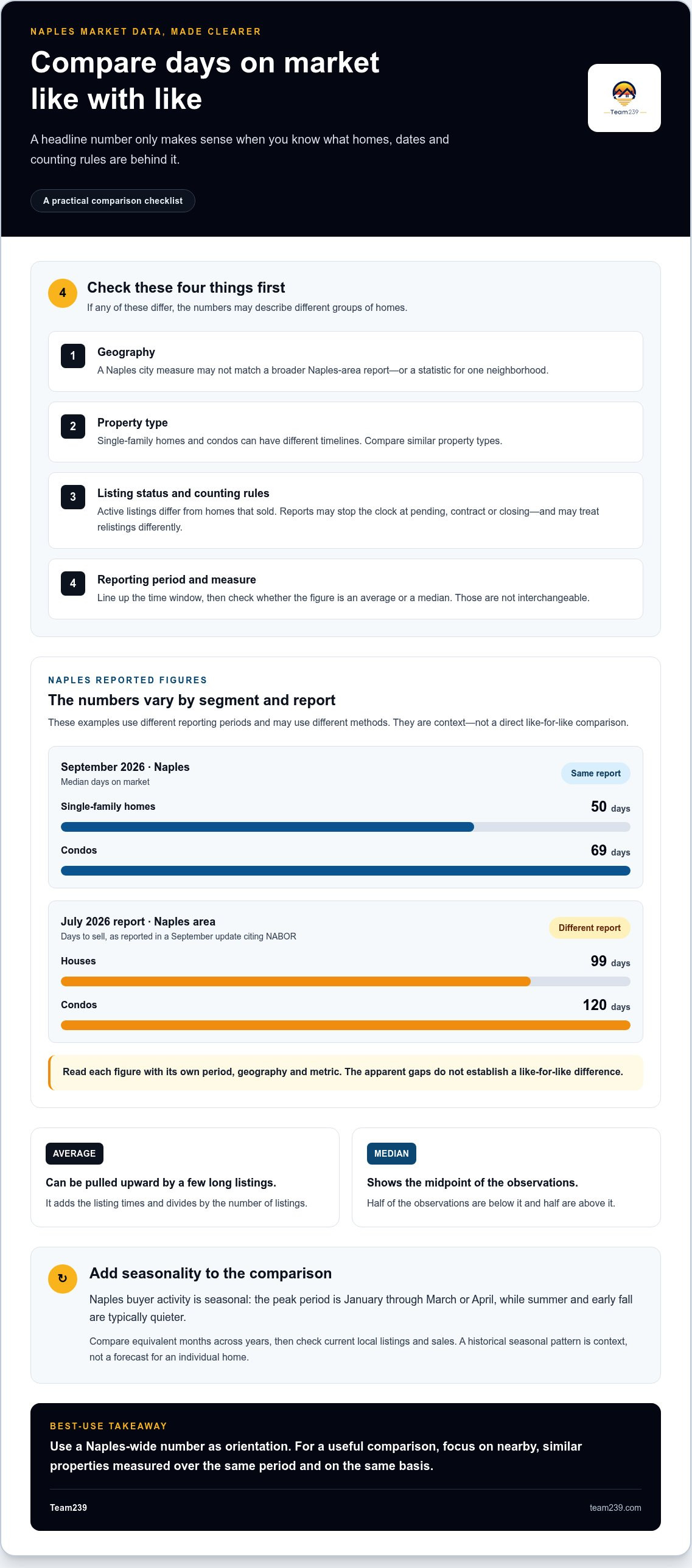
It’s reasonable to want a clear answer about whether the market is moving quickly or slowly. In September 2026, the median time on market was 50 days for Naples single-family homes and 69 days for condos, according to Josh Bohling of LPT Realty. Redfin reported an average of 124 days for homes over the three months ending in August. These figures cover different periods and use different measures, so they aren’t direct comparisons.
This guide explains what days-on-market data tracks, how property type, neighborhood, and seasonality shape the numbers, and how to compare like with like. You’ll also learn how to use market trends as one input in a buying or selling strategy. Team239 helps Naples buyers and sellers interpret local market data in the context of their property and goals.
Table of Contents
What Does Average Days on Market Mean in Naples, FL?
The September 2026 local report from Josh Bohling of LPT Realty puts the median days on market at 50 days for Naples single-family homes. The report describes the geography as Naples. Use this as a general benchmark, not a precise measure for every neighborhood or property.
The phrase average days on market Naples FL is often used broadly, but reports may show an average or a median, and those measures aren’t interchangeable. Days on market tracks how long a property is listed before a specified endpoint under a dataset’s rules. The general concept is outlined in Days on market, but local reports can use different counting conventions.
How Is Days on Market Measured?
A dataset may start counting when a listing becomes active and stop when it goes pending, under contract, or closes. The endpoint matters. Active-listing reports describe properties currently for sale, while statistics based on closed sales look back at listings that completed a transaction during a reporting window. These measures describe different groups of homes.
Relisted homes can also affect the count. Some datasets restart the clock after a relisting; others retain cumulative market time. Check the counting rules before comparing reports, since they may not treat relistings the same way.
Why Can Naples Market Reports Show Different Numbers?
Before comparing figures, line up four details: geography, property type, listing status, and reporting period. A citywide snapshot of active listings won’t necessarily match a monthly measure of homes that sold. A single-family statistic also won’t describe condos or a particular Naples neighborhood.
Check whether the figure is an average or a median. An average adds every listing’s days and divides by the number of listings, so a few homes with unusually long listing periods can pull it upward. The median is the midpoint, with half the observations below it and half above. If most homes sell within a similar timeframe but a few take much longer, the average may rise even though the typical listing hasn’t changed much.
Use any Naples-wide number as an orientation point. For a seller’s pricing and timing decisions, a more useful comparison is a group of similar properties measured on the same basis.
How Naples Seasonality and Property Segments Shape Selling Time
A Naples-wide benchmark can hide very different timelines. September 2026 figures from Josh Bohling of LPT Realty distinguish single-family homes from condos, while a July report from the Naples Area Board of REALTORS® (NABOR) provides another property-type comparison. Read the numbers alongside their dates and methods, not as interchangeable measures.
Why Comparable Homes Matter More Than a Citywide Average
Compare properties with similar types, locations, condition, presentation, and listing periods. Condos and single-family homes can move on different timelines, as the reported figures illustrate, but these sources cover different months and may use different methods. The gap isn’t a like-for-like test. A useful seller comparison focuses on nearby, similar homes and uses the same reporting window and metric.
How to Read Seasonal Changes in the Naples Market
Naples buyer activity is seasonal. The peak period is January through March or April, when seasonal residents can expand the buyer pool, while summer and early fall are typically quieter. That context doesn’t establish how long a particular home will take to sell. Compare equivalent months across years, then check whether changes also appear in current local listings and sales. A historical pattern alone isn’t a forecast.
National context can help frame, but not replace, local comparisons. The Federal Reserve Bank of St. Louis FRED series tracks the national median days on market, using a different geography and methodology from Naples reports. Don’t compare the figures as if they describe the same market. For a seller, average days on market Naples FL is most useful when paired with current, property-specific comparisons. Team239’s local market analysis can help put those comparisons in context.
Does a Longer Days-on-Market Figure Mean a Naples Home Is Overpriced?
No. A longer listing period is a signal to investigate, not a diagnosis. It may prompt a closer look at price, but days on market alone can’t establish a home’s value or reveal its condition. The same timeline can reflect different circumstances, including a mismatch between asking price and comparable homes, needed repairs, limited listing photos or other presentation issues, restricted showing access, or demand specific to that property.
Start with a fair comparison. Look at similar homes in the same area and property category, then check whether they were active or sold during the same period. A broad average days on market Naples FL figure offers context, but it can’t tell you why one particular home is taking longer.
What a Longer Listing Period Can, and Cannot, Tell You
Compared with similar active listings, a home that has been available longer may be facing more competition or attracting less buyer activity. Compared with similar closed sales, its timeline can help show how long completed transactions took to reach an outcome. Neither comparison proves the home is overpriced. Days on market doesn’t measure condition, establish fair market value, or explain buyer decisions by itself.
Check the data’s publication date and the listing’s current status. A market report may describe a past reporting window, while a listing that appears active may have changed status since the data was collected. Confirm whether the displayed time refers to the current listing or includes earlier listing periods.
Which Other Signals Should Buyers and Sellers Review?
Build a fuller picture by reviewing several signals together:
Comparable closed sales: See how similar properties actually sold, and when.
Current competing listings: Compare asking prices, condition, features, and presentation with homes buyers can consider now.
Price adjustments: Note whether the asking price has changed and how it compares with relevant alternatives.
Showing activity: Consider whether buyer interest is developing, while remembering that activity alone doesn’t guarantee an offer.
For buyers, listing time can inform questions and offer planning, but it shouldn’t replace a review of comparable homes and the property’s details. For sellers, use current competition and buyer response to assess whether pricing, presentation, or access may need attention. Avoid assigning a cause until the evidence supports it.
For local context, review monthly market information from the Naples Area Board of REALTORS® alongside the home’s listing history and comparable properties. The goal isn’t to react to one number, but to identify which details deserve a closer look.
How Buyers and Sellers Can Use Naples Days-on-Market Data
Before acting on a days-on-market figure, check what it represents. Use this quick sequence:
Confirm the source and whether it reports an average, median, or another measure.
Check the date range so you know when the listings or sales were recorded.
Verify the geography and property segment, such as Naples condos or single-family homes, rather than assuming a broad regional figure applies.
Compare related indicators, including similar active listings, closed sales, price changes, and showing activity.
This context matters because the average days on market Naples FL figure is a benchmark, not a timetable for an individual property.
A Practical Check for Naples Homebuyers
Start with homes that match the property you’re considering in location, type, condition, and features. Review recent comparable sales as well as current competition. A longer listing history can help you frame questions about pricing, condition, or seller flexibility, but it doesn’t establish the home’s value or mean a buyer should wait.
Consider listing time alongside access for showings and the offer terms that fit your goals. For broader purchase context, explore the Naples homes buyer's guide.
A Practical Check for Naples Home Sellers
For sellers, compare the property with current competing homes and recent closed sales before drawing conclusions from its time on market. If buyer response is limited, review the full listing strategy: how the asking price aligns with comparable properties, whether the home’s condition and presentation are clear to buyers, and whether marketing makes its relevant features easy to understand. These factors work together, so don’t assume one adjustment will solve every issue.
Track changes in competing inventory and buyer activity as the listing progresses. A market figure can set context, while property-specific evidence helps shape decisions about positioning and timing. Team239’s local market analysis can help connect that evidence to your goals. For a step-by-step overview, read the Naples home-selling guide.
Ready to connect current market data with your property and plans? Explore a property-specific market conversation with Team239.
Turn Naples Market Trends Into a Property-Specific Plan With Team239
Days-on-market data is most useful when you compare similar properties, verify the reporting date, and consider more than one indicator. A Naples-wide figure can help frame the market, but it can’t predict how a specific home will perform or determine the right move for every buyer or seller.
Team239 is a family-led team led by Kristin and Jonathan Van Heukelom, serving Naples and Southwest Florida. Their local market analysis helps buyers and sellers put listing time alongside relevant property details, comparable listings, and sales. For luxury properties, the Naples luxury homes guide offers additional context for understanding that segment.
What a Local Market Conversation Can Clarify
A property-specific discussion can connect current data with the home’s type, location, and your intended timeline. For sellers, comparable active listings and closed sales help frame positioning against current competition. For buyers, a home’s listing history adds context to a broader comparison of similar properties, including their condition and location. The aim is to make the evidence more useful, not to promise a particular sale timeline or outcome.
Next Steps for Your Naples Real Estate Decision
Whether you’re buying, selling, relocating, or researching Naples, start with the decision you need to make and the property details that matter most. Share your goals and the relevant location or property type, and Team239 can help you think through the local market context.
Make Your Next Naples Real Estate Move With Context
The average days on market Naples FL figure is a useful starting point, not a prediction for an individual property. Its meaning depends on the source, reporting period, geography, property type, and calculation method. Compare like with like, then consider listing history alongside comparable sales, current competition, pricing, and buyer activity.
A longer time on market can prompt useful questions, but it doesn’t prove a home is overpriced. Buyers and sellers can make more informed decisions by grounding the metric in property-specific evidence and their own goals.
Team239 is a family-led real estate team led by Kristin and Jonathan Van Heukelom. They represent residential buyers and sellers across Naples and Southwest Florida, helping clients interpret local market information in context.
Whether you’re planning to buy, sell, or understand the market, start with a conversation about the property and decisions ahead. Talk with Team239 about your Naples real estate plans, and take your next step with greater clarity.
Frequently Asked Questions
How many days are homes on the market in Naples, FL?
There isn’t one figure that stays accurate for every property type or month. A September 2026 report from Josh Bohling of LPT Realty puts the median at 50 days for Naples single-family homes and 69 days for condos. Treat these as segment-specific medians, then compare similar properties using the same period and method.
What is the average days on market in Naples, FL in 2026?
There’s no single 2026 average that applies to every Naples home. The latest segment-specific figures cited here are September 2026 medians: 50 days for single-family homes and 69 days for condos, reported by Josh Bohling of LPT Realty on October 3, 2026. Those are medians, not averages. For a useful comparison, note the source, date range, geography, property segment, and measure rather than treating one number as a universal benchmark.
Is average days on market the same as median days on market?
No. An average adds the listing times in a dataset and divides by the number of properties. A median is the middle observation after those times are ordered. For example, a few homes with unusually long listing periods can pull an average higher, while the median may change less. Before comparing Naples reports, check which measure each uses, along with its period, geography, property type, and listing-status rules.
Does a high days-on-market figure mean a Naples home is overpriced?
No. A longer listing period is a reason to investigate, not proof that a home is overpriced. Pricing may be one factor, but condition, presentation, showing access, competing listings, and property-specific demand can also matter. Review comparable closed sales, current competition, price adjustments, and showing activity together. Days on market can add context to a pricing assessment, but it can’t determine a home’s value or explain the reason for its timeline on its own.
Why do Naples homes have different days on market by season?
Buyer activity and available inventory can vary throughout the year, and the effect may differ by property. Naples typically sees its peak season from January through March or April, while summer and early fall are generally quieter. That pattern doesn’t predict how quickly a particular home will sell. Compare equivalent months across years, and keep the report’s geography, property type, and date range consistent before drawing conclusions about seasonal changes.
How should sellers use days-on-market data when pricing a Naples home?
Start with recent comparable sales and current competing listings in the same area and property segment. Then consider the home’s condition, presentation, showing access, and any price changes alongside the relevant days-on-market data. A citywide figure is background, not a pricing formula. Sellers in Naples, Bonita Springs, Estero, Marco Island, or Fort Myers should use comparisons relevant to their specific location and property, rather than assuming one local benchmark applies across Southwest Florida.
Where can I find reliable Naples, FL days-on-market data?
Look for current reports from recognized real estate sources, including the Naples Area Board of REALTORS® for local market statistics and Florida Realtors for broader statewide context. Before using a figure, check the reporting period, geography, property type, measure, and listing-status rules. A Naples-specific statistic may not be directly comparable with data for Collier County or Southwest Florida as a whole. Keep those differences clear instead of combining unlike figures.
Comments